Kyrgyzstan runs on one time zone, no daylight saving, a six-day working week in much of the private sector, and a set of rhythms that have nothing to do with office hours.
Getting the timing wrong costs you days. Here is how the country actually schedules itself.
The basics
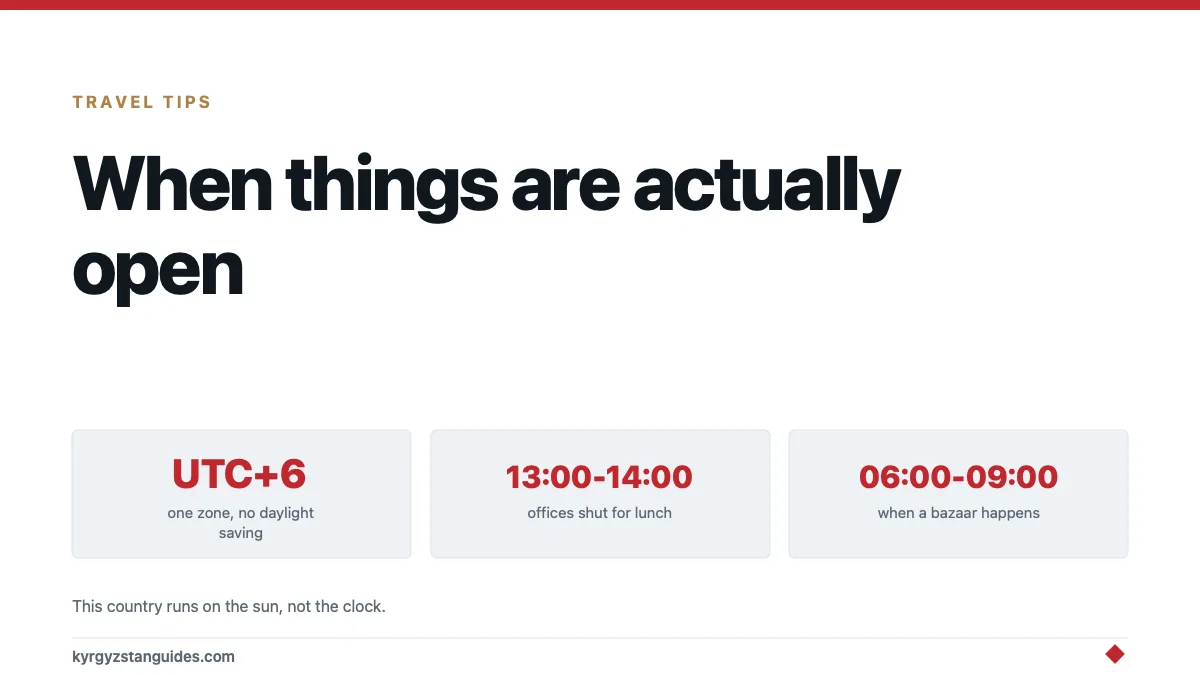
One time zone: UTC+6. The whole country, from Batken to Karakol. There is no seasonal change; the IANA time zone database lists Asia/Bishkek with a fixed offset.
No daylight saving. Kyrgyzstan doesn't change the clocks, so the offset from Europe shifts twice a year while the local time stays put.
The practical consequence is that summer mornings are bright very early and darkness comes earlier in the evening than you would expect for the latitude. In June it is light before five and the light goes sooner than a European summer evening.
Opening hours
| Typical | |
|---|---|
| Government offices | 09:00–18:00, lunch 13:00–14:00, Mon–Fri |
| Banks | 09:00–17:00 weekdays, some Saturday morning |
| Shops | 09:00–20:00, often later, often seven days |
| Small village shops | Irregular; knock if it looks shut |
| Bazaars | Early morning to mid-afternoon |
| Restaurants | 11:00–22:00 or 23:00 |
| Museums | 09:00 or 10:00 to 17:00, frequently closed Monday |
| Pharmacies | Long hours, some 24 hours in cities |
| Village FAP clinic | Daytime only, one practitioner |
The lunch closure is real. Government offices, some banks and some small businesses shut properly for an hour in the early afternoon. Turning up at 13:15 for paperwork is a wasted trip.
Museums close on Mondays, and sometimes on another day too. Check before travelling for one. That includes the Przhevalsky memorial museum near Karakol and the museum on Sulaiman-Too, both of which people make dedicated trips for. Kyrgyzstan's official tourism statistics will not tell you opening hours; a phone call will.
The rhythms that matter more
Formal hours are less important here than four other cycles.
The bazaar morning. Produce markets and livestock markets do their real business between about six and nine. By midday a mal bazar is an empty field.
The lunch peak. Ashkanas fill around one and empty by three. Outside that window a canteen may have very little left.
The mountain day. Start early, be off high ground by early afternoon. This is weather rather than convention, and our mountain weather guide explains why it is not negotiable.
The herding day. On a jailoo, breakfast follows the morning milking and dinner follows the herd coming in. The household's clock is the animals'.
Transport timing
Shared taxis and marshrutkas leave when full, not on a timetable. Our getting around and marshrutka guides cover this properly, but the timing consequence is worth repeating: go early.
Morning is when vehicles fill. A long-distance shared taxi at eight has other passengers. The same car at four may not, and you either wait or pay for the empty seats.
Rural transport stops early. In many villages the last vehicle out is in the morning. Arriving somewhere at five with a plan to leave again is frequently not a plan.
Long drives are morning departures. Bishkek to Osh is ten to twelve hours and nobody sensible starts it in the afternoon.
The seasonal calendar
This is the one that ruins itineraries, and it is covered in detail in our best time to visit guide.
Yurt camps: roughly June to September. Outside that they're packed away, not closed.
High passes: broadly June to October, weather permitting, with Song-Kul at the late-opening end.
Winter closures are covered in our winter guide: several sanatoria, most trekking, and some roads.
Chon-Tuz, the salt mine sanatorium, runs 1 April to 1 October exactly.
The beach season on Issyk-Kul's north shore is July and August, which is when it is crowded and when everything else is not.
The daylight problem
A specific consequence of one time zone across a wide country, and it catches planners.
Kyrgyzstan spans roughly seven degrees of longitude, so solar noon in Batken is meaningfully later than in Karakol while the clock says the same thing. Combine that with no daylight saving and you get a summer where the useful day starts very early and ends sooner than the temperature suggests.
Practical effects:
Summer sunrise is around five. Herders are up before it; so is anyone sensible starting a mountain day.
Summer sunset is earlier than a European traveller expects for the same date. Plan to be off a pass with more margin than you think.
Winter days are short. Dark by roughly half past five in December, which is why our winter guide insists on morning departures.
Photographers should check actual times rather than assuming. The good light comes and goes faster than at higher latitudes, and stargazing has the opposite problem in June — astronomical darkness arrives late and lasts briefly.
The general rule: this country runs on the sun rather than the clock, and the clock is not a reliable guide to where the sun is.
Holidays and closures
Kyrgyzstan has a full set of public holidays, listed in our festivals calendar. Three things worth knowing about timing:
Nooruz, 21 March. The big one. Much closes, celebrations are everywhere, and transport is busy.
Islamic holidays move, because they follow the lunar calendar. UNESCO's record of Nowruz is a reminder that the spring equinox festival is fixed while the Islamic ones aren't — the same müçöl and lunar reckoning that runs through a lot of traditional timekeeping here. Orozo Ait and Kurman Ait shift roughly eleven days earlier each year, so check dates for your specific year.
Independence Day, 31 August, with events and closures.
During Ramadan the country continues to function normally and restaurants stay open, as our piece on Islam here explains.
Seven-day weeks and the private sector
Worth setting expectations, because the formal picture and the lived one differ.
The official working week is Monday to Friday for government, banks and larger institutions, with Saturday and Sunday off.
Shops, cafés and markets run seven days. A family business doesn't take a weekend, and in a country where a great many businesses are family-run that means most of what a visitor needs is open on a Sunday.
Saturday is the busiest bazaar day in many towns, and Sunday is when the Karakol animal market runs.
Guesthouses do not close. They are households, and so is the service.
Tour operators and CBT offices generally keep office hours during the week and respond to messages outside them, which is how most arrangements actually get made — as our community tourism guide describes.
So the practical rule inverts the European one: bureaucracy is weekday-only and everything else is always open.
Practical habits
Do anything official in the morning. Offices, banks, permits, paperwork.
Assume rural shops have no fixed hours. Knock.
Do not plan two long drives in a day.
Build in a spare day for weather, a closed pass, or a mudflow.
Confirm museum days locally rather than online.
Remember the village clinic is daytime only. If something medical happens in a village at night, the plan is the road rather than the FAP.
Book nothing tight around a flight at the end of a road trip.
Holidays complicate this further, and the rules changed in 2025: a holiday falling on a weekend is no longer transferred to the following working day. See our guide to Kyrgyz public holidays for the full list and what actually closes.
FAQ
What time zone is Kyrgyzstan in?
UTC+6 across the whole country, with no daylight saving time.
What are normal business hours in Kyrgyzstan?
Government offices generally 09:00 to 18:00 with a lunch closure around 13:00 to 14:00, shops 09:00 to 20:00 or later, and banks 09:00 to 17:00 on weekdays.
When do bazaars operate?
Early. Produce and livestock markets do their main business from around six to nine in the morning and wind down by midday.
When do marshrutkas and shared taxis leave?
When they are full rather than on a timetable, which in practice means mornings. Rural transport often stops running by early afternoon.
Are museums open on Mondays in Kyrgyzstan?
Frequently not. Many close on Monday and sometimes on a second day, so confirm before making a trip for one.
Do things close during Ramadan?
No. The country functions normally and restaurants stay open, though eating conspicuously in front of someone fasting is poor manners.