Kyrgyzstan has more public holidays than most countries its size, they cluster in January and May, and in 2025 a rule changed that quietly made them less generous than they look on paper.
If your trip crosses one, the practical question is not whether it is a holiday. It is whether anything you need will be open, and that answer varies by institution in a way nobody publishes centrally.
The fixed dates
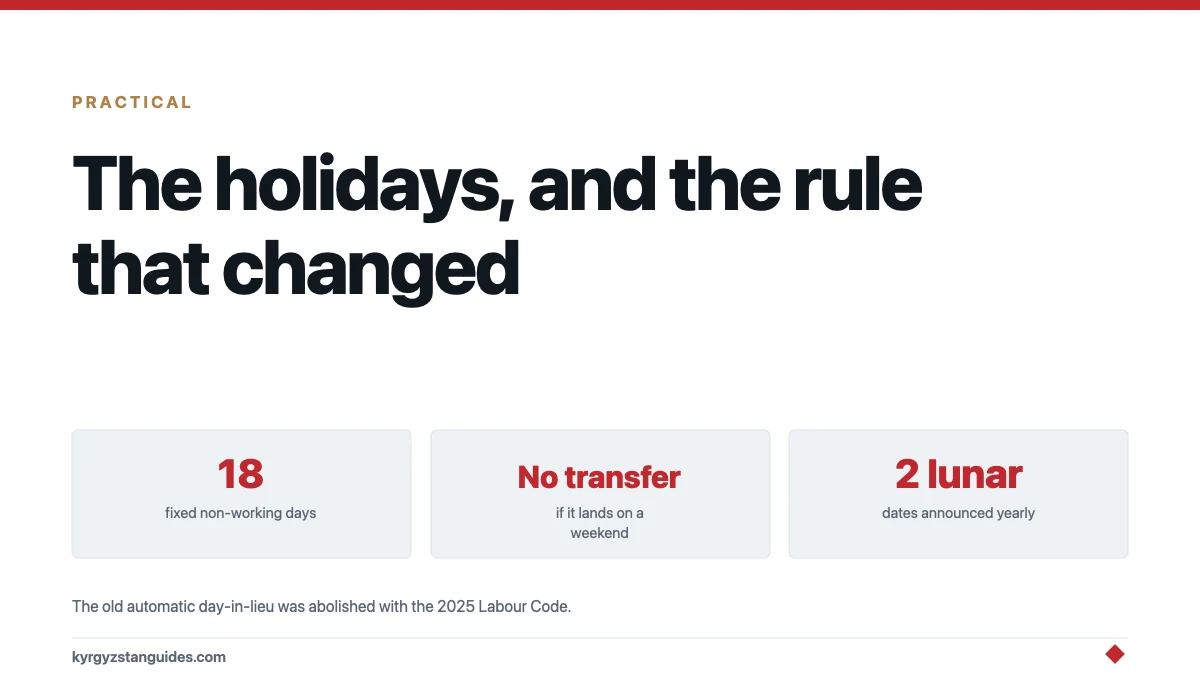
The Labour Code adopted on 23 January 2025 sets the non-working days. The fixed ones:
1 to 6 January — New Year, six consecutive days. 8 March — Women’s Day. 21 March — Nooruz, the spring new year and the biggest cultural holiday of the year. 1, 2, 3, 4, 6, 7 and 8 May, with 5 May Constitution Day and 9 May Victory Day — so the first third of May is largely holiday. And 31 August, Independence Day.
Then there are dates that are officially state holidays but ordinary working days: 23 February, Defender of the Fatherland Day; 7 April, marking the 2010 revolution; and 7 to 8 November, the Days of History and Ancestors’ Memory. People may mark them. Offices do not close.
The two lunar holidays
Orozo Ait, the end of Ramadan, and Kurman Ait, the feast of sacrifice, are both non-working days and both move with the lunar calendar. 7 January, Orthodox Christmas, is also a non-working day.
The dates are announced each year by the Spiritual Administration of Muslims of Kyrgyzstan, and the announcement is what fixes them — there is no published multi-year calendar to plan against.
For 2026: Ramadan began on 19 February, Orozo Ait fell on 20 March and Kurman Ait on 27 May. Note the drift — Kurman Ait fell in June in 2023, 2024 and 2025, and has now moved out of June entirely, about eleven days earlier each year.
A small detail that catches people: the working day before Orozo Ait is shortened by one hour.
Working on a holiday, and what it costs an employer
The Labour Code does not simply designate days off; it restricts what an employer may ask. Article 67 prohibits work on a public holiday except in defined cases and with written consent, and where it is worked it must be compensated — with a day off, with added leave, or at not less than double pay.
That matters to a traveller for an unobvious reason. It is why a guesthouse owner, a driver or a guide may quote you more for a holiday, and why some simply decline. It is not opportunism; it is the law pricing their day.
It also explains the pattern you will notice in the cities: state institutions shut cleanly and completely, while private businesses make individual decisions. A restaurant may open on Nooruz because its staff agreed and are being paid double. The passport office will not, at any price.
The rule that changed: no more day in lieu
This is the part that makes the holiday list less generous than it reads, and it is recent enough that plenty of advice has not caught up.
Under the old arrangement, if a fixed holiday fell on a weekend the rest day was transferred to the following working day. The Labour Code adopted in January 2025 abolished that, and the government decree that used to authorise the transfers lost force at the end of 2024.
The labour ministry restated it plainly in March 2026, when Nooruz fell on a Saturday: no transfer of the rest day is carried out in this case. The holiday simply lands on your weekend and disappears.
So when you count holidays from a calendar, check what day of the week they fall on. A Saturday Nooruz is not a long weekend.
Extra days off still happen, but by separate decree
The abolition of automatic transfers did not end long breaks — it just moved them into individual Cabinet resolutions, which is worth knowing because they are announced late and apply unevenly.
Two worked examples. New Year 2026 was extended by two extra days, 8 and 9 January, for state and municipal budget-funded organisations, which returned on 12 January. And a resolution of 10 July 2026 made 1 September a paid day off around Independence Day — but only for budget-sector workers in Bishkek.
In both cases the private sector was merely recommended to follow. That is the pattern: government offices close, private businesses decide for themselves, and there is no way to know in advance which cafe or tour operator will be shut.
Why the May cluster matters more than it looks
Seven of the nine days between 1 and 9 May are non-working. That is the single longest holiday block in the Kyrgyz year, longer in practice than New Year, and it lands at the start of the travel season.
For a visitor the consequences are concrete. Domestic travel peaks, because Kyrgyz families use it. Accommodation around Issyk-Köl and in the gorges near Bishkek fills with people from the capital. Shared taxis on the main routes leave faster because they fill faster, which is the one way the holiday helps you.
It is also the week when official business simply stops. If any part of your trip depends on a government office, a notary, a permit or a bank branch, do not plan it for the first week of May.
The same applies in compressed form to the New Year block, 1 to 6 January, which in 2026 stretched to the 12th for budget-funded organisations.
What actually closes
Here the honest answer is that it varies more than any guide admits, and I would rather show you the variation than invent a rule.
Government service centres run a uniform nationwide schedule: 09:00 to 18:00, lunch 12:30 to 13:30, closed Saturday and Sunday. That is the one predictable institution.
Banks do not have a uniform holiday rule. Around Independence Day 2026, at least sixteen Kyrgyz banks published individually adjusted schedules. Some closed branches entirely; others kept selected branches open on normal or reduced hours. The National Bank publishes no general rule. Check your specific bank, not a generic statement.
Ordinary branch hours, as examples rather than a rule: one major bank runs roughly 09:00 to 17:00 with a midday lunch, while another keeps its central Bishkek branch open until 20:30 on weekdays. There is no standard.
On bazaars and museums I could find no reliable official source either way. Dordoi and Osh Bazaar are commercial and largely follow demand; museums vary. Do not build a day around either being open on a holiday without checking.
The practical planning rule: treat 1 to 6 January, 21 March, the first week of May and 31 August as days when official business stops, transport gets busy and accommodation in the cities fills with domestic travellers. Everything else is negotiable.
FAQ
What are the public holidays in Kyrgyzstan?
Non-working days are 1-6 January, 7 January, 8 March, 21 March for Nooruz, 1-9 May including Constitution Day and Victory Day, 31 August for Independence Day, plus the two lunar holidays Orozo Ait and Kurman Ait.
Does Kyrgyzstan move a holiday if it falls on a weekend?
No, not since the Labour Code adopted on 23 January 2025. The old automatic transfer of the rest day was abolished and the decree authorising it lost force at the end of 2024. The labour ministry confirmed this in March 2026 when Nooruz fell on a Saturday.
When is Nooruz in Kyrgyzstan?
21 March every year. It is the spring new year and the largest cultural holiday of the year, and it is a fixed non-working day rather than a lunar one.
When are Orozo Ait and Kurman Ait?
Both move with the lunar calendar and are announced each year by the Spiritual Administration of Muslims of Kyrgyzstan. In 2026 Orozo Ait fell on 20 March and Kurman Ait on 27 May. There is no published multi-year calendar.
Are banks open on Kyrgyz public holidays?
It depends on the bank. There is no uniform rule and the National Bank publishes none. Around Independence Day 2026 at least sixteen banks published different schedules, some closing entirely and others keeping selected branches open. Check your own bank.
Which days are state holidays but still working days?
23 February, Defender of the Fatherland Day; 7 April, marking the 2010 events; and 7-8 November, the Days of History and Ancestors' Memory. They are marked but offices stay open.