There are restaurants in Bishkek with menus in English and prices to match. Almost nobody local eats in them.
The food economy here runs on a set of institutions that have no obvious Western equivalent, are not signposted for visitors, and serve far better food for a fraction of the price.
Learning four words changes what you can eat in this country.
The four kinds of place
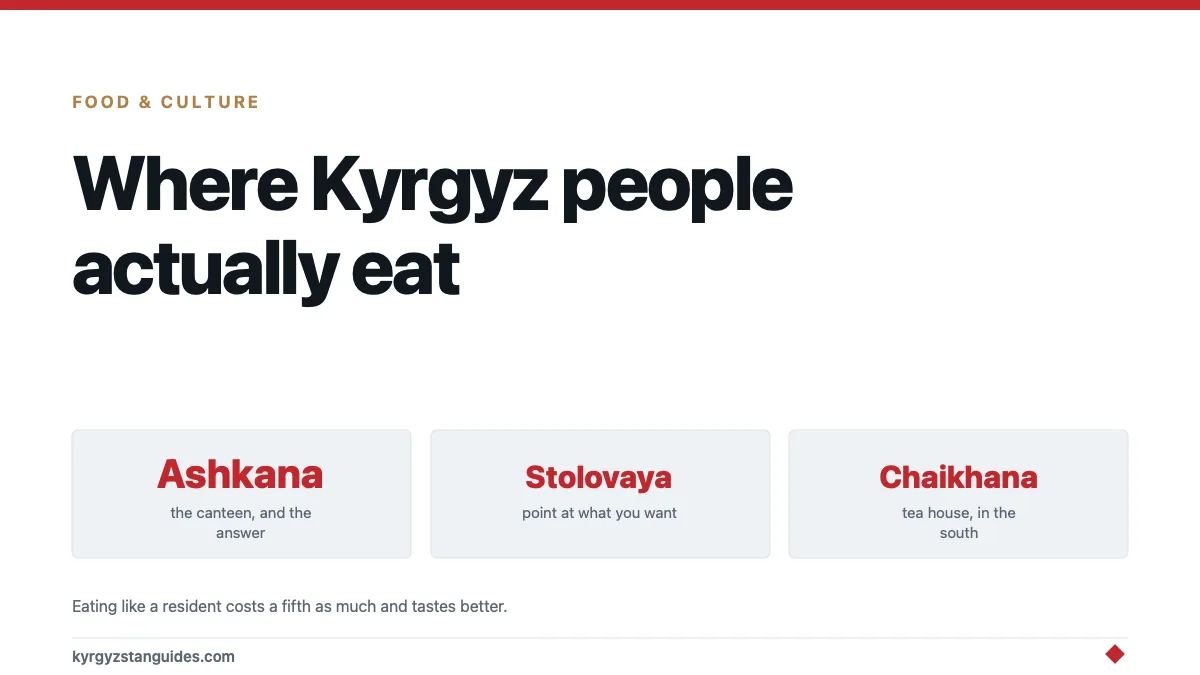
Ashkana (ашкана). The Kyrgyz word for a canteen or eating house. Plain room, short menu on a board, fast service, very cheap. This is where people eat lunch. Usually no English, frequently no written menu at all.
Stolovaya (столовая). The Russian equivalent and the Soviet canteen format: a counter with trays, dishes visible behind glass, you point at what you want and pay at the end. Brilliant if you have no language, because you're choosing by sight.
Chaikhana (чайхана). Tea house. More Uzbek in origin and more common in the south, where the culture is settled rather than pastoral. Raised platforms with carpets and low tables, tea, plov, samsa, and a lot of sitting. Our guide to tea and bread customs covers the etiquette.
Kafe (кафе). Anything from a roadside shack to a mid-range restaurant. Wide range, variable quality, and the default outside cities.
Then there's the one that matters most:
Somebody's house. In villages there is no restaurant. If you are hungry in a village, the answer is a guesthouse or homestay, not a search for a café that does not exist.
What to order where
Ashkana or stolovaya at lunchtime. Lagman, manty, shorpo, plov, salads, bread, tea. Our guides to laghman and manty cover the two you will eat most.
Chaikhana in the south. Plov and samsa, both better here than anywhere north.
Roadside on a mountain pass. Shorpo, bread, tea, and whatever is in the pot. Frequently the best food you'll eat.
A yurt camp or jailoo. Dairy first, our dairy guide explains the kurut and kaymak situation, and then whatever the household is eating.
Bishkek for variety. Georgian, Korean, Turkish, Chinese, Indian and Dungan restaurants all exist. The Korean ones exist because of a deportation in 1937, which is worth knowing while you eat.
IFAD's Kyrgyz beshbarmak recipe is a reasonable primer on what the national dish actually involves before you order it.
How the ordering works
Point. In a stolovaya this is the whole system and nobody minds.
Ask what there is. Emne bar?, what is there? You will get a spoken list. This is more reliable than a menu in many places.
One dish is a meal. Portions are large and bread arrives regardless.
Tea comes by the pot. Green tea in the south, black in the north, and it is ordered by the pot rather than the cup.
Salads are a fixture. Ordinary and good, and the main non-meat option if you are vegetarian.
Pay at the end, in cash. Small notes, as our paying guide explains.
Tipping isn't expected. Rounding up is normal in cities and unnecessary elsewhere.
The north-south food divide
Worth knowing before you order, because the same country serves quite different food at either end.
The north is pastoral food. Meat, dairy, bread, noodles. Beshbarmak, shorpo, kurut, kymyz, the cuisine of people who moved with animals, covered in our food guide. Vegetables are a side rather than a subject.
The south is settled food. Plov, samsa, non bread from a tandyr, more vegetables, more spice, more fruit. This is Fergana valley cooking, shared with Uzbekistan, produced by a culture that farmed rather than herded.
The dividing line is roughly the mountains, and the reason is the herding-versus-irrigation split that runs through everything else here.
Practical consequences: plov is better in Osh, beshbarmak is better in Naryn, and a vegetarian will have a substantially easier time in the south.
Dungan food is the third thing, and it belongs to neither. Chinese-Muslim cooking brought by people who crossed the Tien Shan in 1877 — noodles, cold spiced salads, vinegar, chilli. It's the most distinctive food in the country and the least likely to appear on a tourist menu.
Timing
Lunch is the main meal out. Ashkanas fill around one and empty by three.
Dinner is at home. Which is why a town can seem to have no evening food economy at all.
Bazaar food is a morning thing. The food area of a livestock market or a produce bazaar is at its best very early and gone by midday.
Ramadan shifts everything, though restaurants stay open — see our piece on Islam here.
Practical notes
Hygiene is generally fine at busy places. Turnover is the best indicator: a full ashkana is a safe ashkana. WHO's five keys to safer food is the underlying logic, and the one that matters most here's keeping cooked food hot and raw dairy separate.
Avoid the empty one. Everywhere in the world, and more so where refrigeration is inconsistent.
Raw dairy is the main risk, not cooked food. Our dairy guide covers it.
Water: not from the tap. See is tap water safe.
Vegetarians should learn two phrases and manage expectations outside Bishkek.
Bread is never wasted. Never face down, never in the bin.
What a meal costs
Rough orders of magnitude, because the range is wide and the tourist end is not representative.
An ashkana lunch (a bowl of lagman or shorpo, bread, tea) is the cheapest hot meal in the country and the one locals eat daily.
A stolovaya tray with two or three items costs about the same.
A roadside pass stop is similar again, sometimes less.
A mid-range Bishkek restaurant is several times that, and a restaurant with an English menu in a tourist street is several times that again.
A homestay dinner is normally included in the room rate, which makes it the best value of all.
Prices move, so this guide gives ratios rather than figures; our travel budget guide has the current numbers. The useful point is that the difference between eating like a visitor and eating like a resident is roughly a factor of five, and the food gets better as the price drops.
Why it's worth eating this way
Because the food is better and because of what it costs.
A meal in a working ashkana is a fraction of the price of a tourist restaurant, is cooked for people who eat it every day, and puts money into an ordinary local business rather than one oriented toward visitors.
It's also the easiest form of contact available. Nobody in a stolovaya is performing hospitality at you; they're having lunch, and you are having lunch, and somebody will probably ask where you're from.
That is a better experience than any menu in English, and it costs about two dollars.
FAQ
What is an ashkana?
The Kyrgyz word for a canteen or simple eating house — plain, cheap, fast, with a short menu and no English. It is where most people eat lunch.
What is a stolovaya?
A Soviet-style self-service canteen where dishes are displayed behind glass and you point at what you want. Ideal if you have no Russian or Kyrgyz.
What is a chaikhana?
A tea house, more common in southern Kyrgyzstan, with raised carpeted platforms, low tables, tea, plov and samsa.
Are there restaurants in Kyrgyz villages?
Generally not. People eat at home, so in a village the answer is a guesthouse or homestay rather than a café.
Is street and canteen food safe in Kyrgyzstan?
Busy places with high turnover are generally fine. Avoid empty restaurants, be cautious with unpasteurised dairy, and don't drink tap water.
Do you tip in Kyrgyzstan?
Not expected. Rounding up is normal in city restaurants and unnecessary in canteens and rural places.