Shorpo is the soup you will be served most often in Kyrgyzstan, and it is also the one most likely to be described to you inaccurately before you get there. The usual line is that it is a hearty mutton stew. It is not a stew. A correctly made shorpo is a clear broth with large pieces of meat and vegetable sitting in it, and if what arrives in front of you is thick or cloudy, something has gone wrong in the pot.
That is the single test worth remembering. Clear broth, whole chunks, nothing puréed, nothing floured.
What is in the bowl
Meat on the bone, usually mutton, sometimes beef. Potato in large pieces, carrot in thick rounds or batons, onion. Often a tomato. Herbs on top at the end, usually dill or coriander.
The meat is simmered long and gently. Skimming the foam in the first twenty minutes is what makes the difference between a clear broth and a grey one, and cooks who care about shorpo are noticeably fussy about it. The vegetables go in late, in big pieces, so they hold their shape rather than dissolving into the liquid.
You are meant to eat it with bread, not with rice or noodles. A torn piece of tandyr loaf goes in the broth. Our guide to lepyoshka and tandyr bread covers which loaf you are likely to be handed.
The north-south split is real
This is the part that surprises people who eat shorpo in Bishkek and then again in Osh and assume one of the two was badly made.
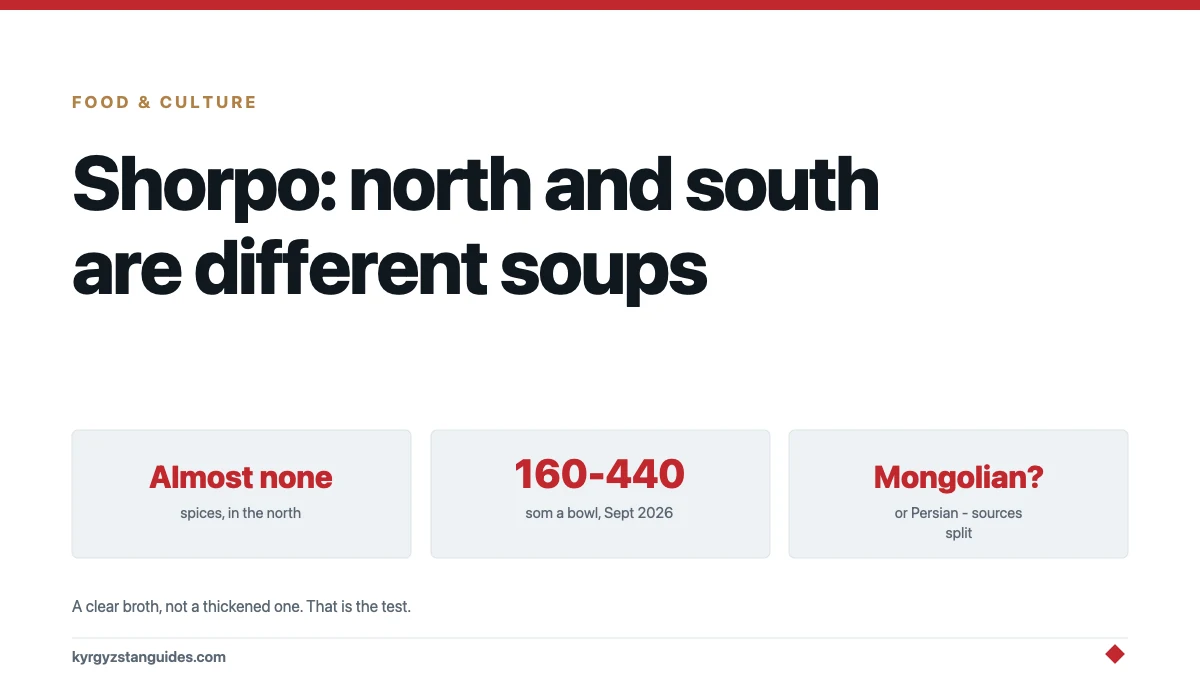
In the north, shorpo is deliberately plain. Salt, and often nothing else. The intention is that you taste the meat and the fat, and any spice in the pot would be interference. A northern shorpo can seem underseasoned to a visitor for exactly the first three spoonfuls, then the fat and the salt do their work.
In the south, around Osh and Jalal-Abad, the same soup carries cumin, black pepper, coriander seed, sometimes chilli, and a good deal more fresh herb. The Fergana Valley's food is spiced across the board, and shorpo follows the pattern.
Neither is a corruption of the other. If you want to compare them properly, eat shorpo on both sides of the mountains rather than deciding on one bowl. The regional differences run through the whole cuisine, which is the frame we use in the Kyrgyz food guide.
Where the name comes from is contested
Two derivations are argued and neither has won.
One traces shorpo to Mongolic, through words for soup or broth that appear across the Turkic-Mongolic contact zone. The other traces it to Persian shorba, built on a root meaning salty, which spread with Persian culinary vocabulary into Turkish çorba, Uzbek shurpa, Russian shurpa, and onward into the Balkans as çorba.
The Persian route is the more commonly cited. The Mongolic route is defended on the grounds of the word's distribution across the steppe. We are not in a position to settle it, and any travel article that states one flatly is choosing a side without telling you there is one.
What is not contested: the dish is shared across Central Asia, and a Kyrgyz shorpo, an Uzbek shurpa and a Kazakh sorpa are close relatives rather than separate inventions.
What it costs in Bishkek, September 2026
Shorpo is priced as a starter in restaurants and as a full meal in canteens, which is why quoted prices vary so widely.
| Where | Typical price per bowl |
|---|---|
| Workplace and bazaar canteens | 160–200 som |
| Ordinary city cafés | 200–300 som |
| Tourist-facing restaurants | 350–440 som |
Those are late-September 2026 figures for Bishkek. Outside the capital, expect the bottom of that range and a larger bowl. The cheapest shorpo in the country is almost always in a bazaar canteen at lunchtime, and it is usually also among the best, because volume means the stockpot never stops. Osh Bazaar in Bishkek is the obvious place to test that.
No heritage listing, and that matters less than you think
Shorpo has no UNESCO intangible heritage inscription and no Slow Food listing. We checked both lists directly. Kyrgyzstan's UNESCO entries cover yurt-making, felt carpets, the Manas epic, akyn poetry, kok boru, ak-kalpak craftsmanship, flatbread culture and, since 2025, the grain drink maksym — the full list is on the UNESCO country page. The Slow Food Ark of Taste holds a handful of Kyrgyz entries, all of them raw ingredients or a drink: jarma, yak-milk sary mai, the Arslanbob walnut, the Batken kandek apricot, the Turkestan barbel.
The reason shorpo is on neither is straightforward. Heritage listings attach to things at risk or to things a state has chosen to nominate. Shorpo is eaten daily by millions of people across four countries. Nothing about it is endangered.
We mention it only because several English-language pages claim heritage status for Kyrgyz dishes that do not have it, and if you are reading this to settle an argument, the answer is no.
When shorpo is the right thing to order
Three situations where it beats everything else on the menu.
Cold weather and altitude. It is hot liquid, salt and fat in a bowl, which at 3,000 metres is exactly what you need after a day outside. See mountain weather in Kyrgyzstan for what that day is likely to have been.
When you do not want another plate of fried food. Kyrgyz restaurant menus lean heavily on fried and grilled dishes, and shorpo is the reliable exception.
When you are unsure about a place. A kitchen that makes clear shorpo with properly cut vegetables is a kitchen paying attention. Ordering it first tells you whether to order anything else there.
The situation where it is not the right call: if you are vegetarian. Shorpo is a meat broth by definition and there is no meaningful vegetarian version, which is a recurring problem discussed in our vegetarian guide.
How to eat it without drawing attention
One more practical note. Shorpo is one of the few Kyrgyz dishes that is genuinely better the second day, because the broth keeps extracting from the bones overnight and the fat sets on top and can be lifted off if you want it lighter. Guesthouses in the mountains often serve yesterday's shorpo at breakfast for exactly that reason, and it is not a cost-cutting move.
The meat comes on the bone and in pieces too large for a spoon. You are expected to take the meat out and eat it separately, often with your hands or with a fork, then return to the broth. Nobody minds. What looks odd is trying to cut everything up inside the bowl.
The broth is sometimes poured into a separate bowl, particularly in a home. If someone hands you a small bowl of broth first and the solids after, that is the intended sequence, not a mistake.
And you will be offered more. Refusing the first offer and accepting the second is the ordinary rhythm of a Kyrgyz table, covered in tea and bread customs, and it applies to soup as much as to anything else.
FAQ
What is shorpo made of?
Meat on the bone, usually mutton or beef, simmered slowly into a clear broth with large pieces of potato, carrot and onion, often a tomato, and fresh herbs added at the end. It is a clear soup rather than a thick stew, and nothing is used to thicken it.
What is the difference between shorpo and shurpa?
They are the same dish under different names across Central Asia: shorpo in Kyrgyz, shurpa in Uzbek and Russian, sorpa in Kazakh, çorba in Turkish. Recipes differ in spicing more than in structure.
Is shorpo spicy?
It depends on the region. Northern Kyrgyz shorpo is deliberately plain, often salt only, so the meat carries the flavour. Southern versions from Osh and Jalal-Abad use cumin, pepper, coriander seed and sometimes chilli, plus more fresh herbs.
How much does shorpo cost in Kyrgyzstan?
In Bishkek in late September 2026, roughly 160–200 som in canteens, 200–300 som in ordinary cafés and 350–440 som in tourist-facing restaurants. Prices outside the capital tend toward the lower end with larger portions.
Does the word shorpo come from Persian?
That is the more commonly cited derivation, from Persian shorba built on a root meaning salty. A competing derivation traces it to Mongolic words for broth. Both are argued in the literature and neither is settled.
Is shorpo recognised by UNESCO?
No. Kyrgyzstan has sixteen entries on the UNESCO intangible heritage lists and shorpo is not among them; the only food and drink entries are flatbread-making culture, inscribed in 2016, and the traditional knowledge of making maksym, inscribed in 2025.