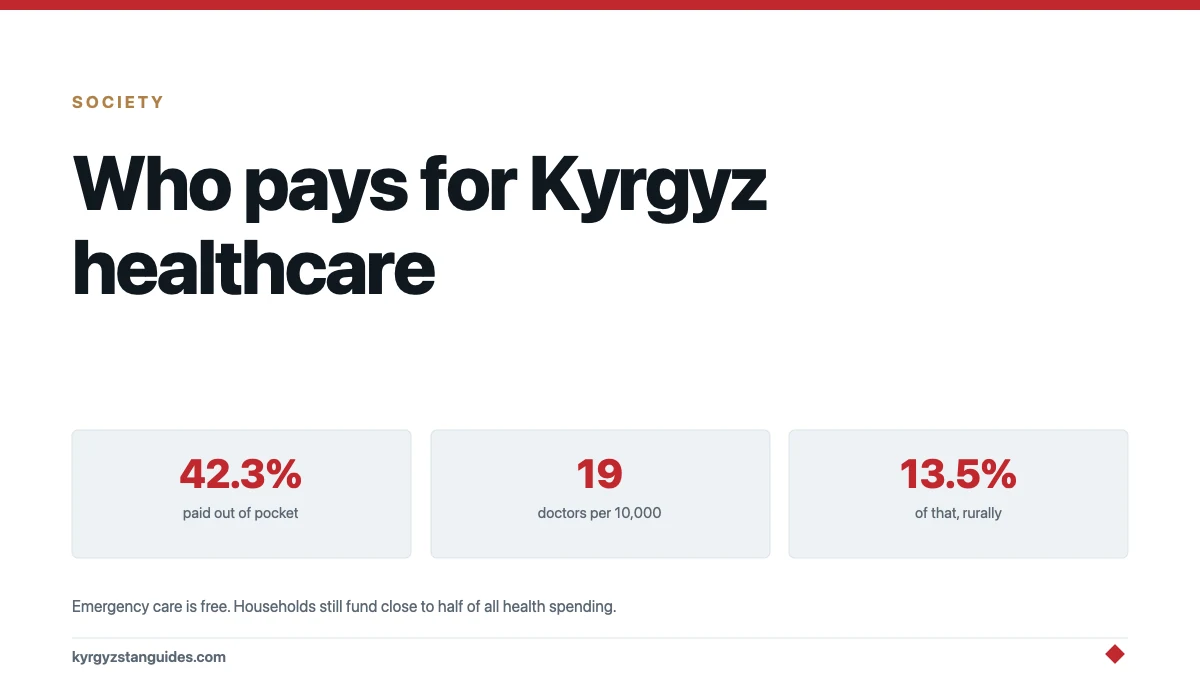
In 2023, 42.3 per cent of everything spent on healthcare in Kyrgyzstan came out of patients' own pockets. That is the single number that explains the system. Care is formally guaranteed, largely free at the point of emergency, and organised around a mandatory insurance fund — and households still pay for something close to half of it directly.
The honest version of that figure is a trend rather than a scandal. Out-of-pocket spending was 57.2 per cent in 2016 and 56.4 per cent in 2017. It fell to 39.1 per cent by 2021. Then it went back up, to 39.9 per cent in 2022 and 42.3 per cent in 2023, the most recent year the World Bank has published. Real progress, then a reversal.
This is not a guide to getting treated as a tourist. We have a separate one on emergency numbers, pharmacies and hospitals for that. This is about the machine itself: who runs it, what it guarantees, and where the money comes from.
The shape of the system
Kyrgyzstan kept the Soviet skeleton and rebuilt the front door.
Primary care runs through Family Medicine Centres, known locally as ЦСМ or by the older ГСВ for a family doctors' group. During restructuring, rural outpatient facilities were folded into these as subdivisions of territorial hospitals. Below them sit more than a thousand paramedic posts, the FAP, which in a small village may be one nurse in one room and is the only medical presence for some distance.
Above primary care the tiers stack upward: district and territorial hospitals, then seven Regional Unified Hospitals with 3,436 beds between them, and then the republican level in Bishkek — the National Hospital with 1,070 beds, six national scientific centres with 2,099 beds, four research institutes with 917 beds, and two narcology centres.
The staffing figures, published in July 2026 for 2025, are over 13,000 physicians and more than 34,000 mid-level medical staff across 191 hospitals and 45 primary care facilities. That works out to 19 doctors per 10,000 people and 47 mid-level staff per 10,000.
The World Bank's comparable series shows the direction: 1.568 physicians per 1,000 people in 2023, down from 1.853 in 2016. Nurses and midwives fell from 4.778 to 4.076 per 1,000 over the same period. The country is not training its way out of this.
The rural gap is not a gap, it is a cliff
In remote and hard-to-reach settlements, the number of doctors runs at roughly 13.5 per cent of the national average density. District polyclinics are short of obstetrician-gynaecologists, paediatric surgeons, ultrasound specialists and general practitioners, and one doctor sometimes covers two villages at once.
Put that next to the tier structure above and the practical consequence is clear. For anything beyond the routine, the system's answer is Bishkek, and for a family in Naryn or Batken that answer includes a day of travel.
What the state guarantees, and what you pay on top
Emergency and urgent care is free to everyone, insured or not, citizen or not. That part is unambiguous.
Beyond that, the Mandatory Health Insurance Fund covers a defined list of people: working citizens with contributions, children under 16 or 18 if still in school, pensioners under 70, students under 21, military personnel, pregnant women, and vulnerable groups including orphans, people with disabilities and low-income families.
Planned hospitalisation carries a co-payment on a tiered scale:
| Co-payment tier | Amount | Who |
|---|---|---|
| Minimum | 330 som | Pensioners under 70 and social benefit recipients, capped at two planned hospitalisations a year at this rate |
| Middle | 840–1,160 som | Insured patients generally |
| Maximum | 8,400–14,310 som | Uninsured patients, or patients arriving without a referral |
That bottom-to-top spread is a factor of about forty. The referral requirement is doing real work in that table: turning up at a hospital without having gone through your family medicine centre can move you to the top tier even if you are insured.
Medicines are free for emergency care and for some chronic conditions — insulin-dependent diabetes, haemophilia, tuberculosis — and subsidised for asthma, hypertension and psychiatric conditions.
The employer and employee contributions that fund the health insurance side are small: since August 2024 the Health Insurance Fund receives 1 per cent of payroll from the employer, within a total social contribution rate of 12.25 per cent. Details are in our post on Kyrgyz pensions, because the same contribution law governs both.
Where the reform history comes from
Health reform in Kyrgyzstan began in 1996 with the national programme called Manas, which ran to 2006 and was followed by Manas Taalimi for 2006–2010, approved by government resolution No. 100 of 16 February 2006. Between them they restructured how care was financed and delivered, and built the ground the insurance fund now stands on. A later programme, Den Sooluk, carried it forward.
The reforms are genuinely well studied, which is unusual for the region. A peer-reviewed analysis of the period after them found that between 2012 and 2018 out-of-pocket payments rose by about US$6 on average, with inpatient care the heaviest burden at US$13.6, then self-treatment at US$10.7 and outpatient care at US$9. The share of people hit by catastrophic health expenditure ran anywhere from 6 to 33 per cent of the population depending on which threshold is used.
That spread is worth sitting with. "Catastrophic" is a definitional choice, not a fact of nature, and a range that wide means any single headline figure is a choice of threshold.
The money, in two lines
Current health spending was 7.36 per cent of GDP in 2014. It fell steadily to 4.25 per cent by 2019, rose to 5.35 per cent in the COVID year of 2021, and then fell again to 5.05 per cent in 2022 and 4.50 per cent in 2023.
The government's share of that spending, meanwhile, went the other way: from 37.95 per cent in 2017 to 51.4 per cent in 2019, and 53.3 per cent in 2023. So the state now funds slightly more than half of health spending, up from well under half — but the total pot shrank relative to the economy over the same decade. Both facts are true and they pull in opposite directions.
One caveat I will not paper over: one Kyrgyz outlet reported state health financing rising from 9.52 billion som in 2024 to 38.98 billion som in 2025, a fourfold jump. A separate report put the 2025 health allocation at 44 billion som with about 1.5 billion unspent. A fourfold single-year increase almost certainly reflects a change in how the budget is classified rather than four times the money, so I am not presenting it as a spending trend.
Where Kyrgyz patients go when it is serious
Abroad. For transplants and complex specialty care the destinations are India, Turkey, China and Pakistan; cancer patients often go to Israel; dental work is a large segment in its own right. Indicative costs cited in Kyrgyz reporting put a liver transplant from $85,000 in Turkey against from $50,000 in India.
The framing in the Kyrgyz sources is worth repeating, because it is not the framing of medical tourism elsewhere. People are not leaving for luxury. They are leaving because they could not get an accurate diagnosis at home.
The part that runs in the other direction
Kyrgyzstan is also a large exporter of medical education, mostly to South Asia.
The International Higher School of Medicine in Bishkek enrols roughly 4,500 students from India, Pakistan and elsewhere, with a degree recognised by Pakistan's PMDC, India's NMC, the WHO and FAIMER. The Asian Medical Institute in Kant has around 1,800 students from more than ten countries. Tuition at one Bishkek medical school runs about $4,500 a year, with total course costs quoted to Indian families around 29–30 lakh rupees.
The widely repeated claim that more than 10,000 Indian students study in Kyrgyzstan comes from MBBS consultancy websites, which are marketing operations, and I could not verify it against any ministry, university admissions office or embassy source. The institution-level numbers above come from secondary reporting rather than primary admissions data too. Treat them as the right order of magnitude, not as counts.
This matters for a visitor in one concrete way: in Bishkek and Kant you will meet a lot of young South Asians, and they are medical students, not tourists.
What kills people here
For January to March 2026 the National Statistical Committee recorded a mortality rate of 4.4 per 1,000 and 8,000 deaths, of which 54 per cent were circulatory system disease, 13 per cent cancers, 7 per cent external causes including road deaths, accidental alcohol poisoning, suicide and homicide, and 6 per cent respiratory disease. Full-year 2024 data gives 16,600 cardiovascular deaths, or 52.5 per cent of the total.
The statistical committee has also flagged that premature deaths among working-age adults aged 30 to 60 run at roughly 20,000 a year.
Against that, the long-run indicators have improved: life expectancy at birth reached 72.4 years in 2024, up from 70.95 in 2016; infant mortality fell to 14.8 per 1,000 live births in 2024 from 18.4 in 2016; and the modelled maternal mortality ratio was 42 per 100,000 live births in 2023, down from a 2021 spike of 70.
One honest hole in the data
Everybody discussing Kyrgyz healthcare mentions informal payments — cash to a doctor, cash for supplies. The official statistics do not let you size it. The WHO and World Bank report out-of-pocket spending as one combined category that includes official co-payments, informally paid money and drugs bought at the pharmacy. No source I could find disaggregates the informal share with a hard percentage. So the honest statement is that 42.3 per cent of health spending is out of pocket, and that an unmeasured part of that is unofficial.
FAQ
Is healthcare free in Kyrgyzstan?
Emergency and urgent care is free to everyone regardless of insurance status or citizenship. Beyond that, insured patients pay co-payments for planned hospitalisation, and 42.3 per cent of all health spending in the country came directly out of patients' pockets in 2023.
What is the Mandatory Health Insurance Fund and who does it cover?
It is the state fund that pays for the guaranteed benefits package. Covered groups include working citizens who pay contributions, children under 16 or 18 if in school, pensioners under 70, students under 21, military personnel, pregnant women, and vulnerable groups such as orphans, people with disabilities and low-income families.
How much does a hospital stay cost in Kyrgyzstan?
Planned hospitalisation co-payments are tiered: 330 som for pensioners under 70 and social benefit recipients, 840–1,160 som in the middle tier, and 8,400–14,310 som for uninsured patients or patients who arrive without a referral from their family medicine centre.
How many doctors does Kyrgyzstan have?
Over 13,000 physicians and more than 34,000 mid-level medical staff, working across 191 hospitals and 45 primary care facilities as of 2025. That is 19 doctors per 10,000 people nationally, but only about 13.5 per cent of that density in remote settlements.
Why are there so many Indian and Pakistani students in Bishkek?
Kyrgyz medical universities teach MBBS programmes in English at a fraction of South Asian private-college fees, with degrees recognised by India's NMC and Pakistan's PMDC. The International Higher School of Medicine alone reports around 4,500 international students. The often-quoted figure of more than 10,000 Indian students nationally comes only from consultancy marketing sites and is not verifiable.
Where do Kyrgyz people go for serious medical treatment?
Abroad, when they can afford it — India, Turkey, China and Pakistan for transplants and complex surgery, Israel for cancer care. Kyrgyz reporting frames this as a response to not being able to get an accurate diagnosis or adequate treatment at home rather than as elective medical tourism.
What do people in Kyrgyzstan die of?
Circulatory system disease accounts for about 52–54 per cent of all deaths, cancers about 13 per cent, external causes including road deaths and alcohol poisoning about 7 per cent, and respiratory disease about 6 per cent. Around 20,000 deaths a year are of working-age adults between 30 and 60.