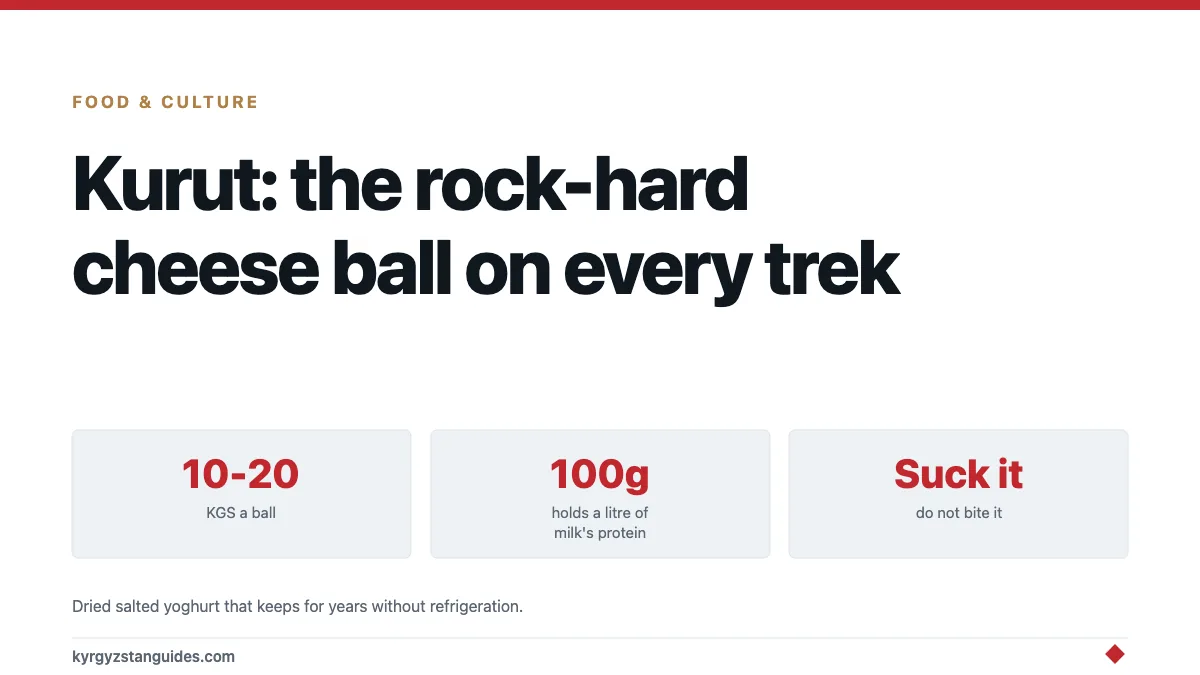
Somebody will hand you a small white ball, hard as a pebble, and watch your face. That's kurut — dried salted yoghurt, sold for 10 to 20 som apiece in any bazaar, and the original trail food of a culture that spent its summers a long way from a shop. It is intensely salty, deeply sour, and about as far from a dessert as a dairy product can get.
Most travellers take one bite and quietly put it in a pocket. That's a reasonable first response and a bad long-term strategy.
What it actually is
Yoghurt, strained, salted, rolled into balls and dried hard in the sun.
That's the whole process, and every step of it's doing a job. Research on how Kazakh qurt is made sets out the regional variations, which come down to which animal, how long the drying, and how much salt. Straining removes water. Salt inhibits spoilage. Sun-drying removes what's left. What you end up with is milk protein and fat with almost no moisture: a food that won't go off, weighs very little, and carries the calories of the milk it came from.
For herders moving between winter villages and summer pasture with no refrigeration, that isn't a snack. It's how a surplus in June becomes food in January.
The milk varies. Cow is standard, sheep and goat are common, and mare's milk kurut exists in places, which is a different and much stronger proposition.
The numbers behind it
This is where kurut stops being a curiosity and starts being impressive.
100 grams of kurut carries roughly the protein of a litre of milk. Analyses put the protein content somewhere in the region of 31–50% by weight, with fat from about 4.5% to over 20% depending on the milk and the method, and salt anywhere from 3% to 13%.
Water content is the crucial figure: low enough that bacteria have nothing to work with, which is why hardened qurt keeps for years without refrigeration.
Think about what that means for a herding household. A litre of milk goes off in a day on a summer jailoo. A hundred grams of kurut made from it will still be food next winter, weighs a fifth as much, and needs no container beyond a cloth bag.
The name itself gives the game away — qurut comes from the word for "dry" across the Turkic languages.
What it tastes like
Salt first, then sour, then a long dairy finish that stays with you.
The texture is the part people aren't ready for. A fresh kurut ball is genuinely hard, closer to chalk than to cheese, and biting straight into it's not how it's eaten. It softens slowly in the mouth, and it is meant to be worked at rather than chewed.
Some are milder and crumblier. Some are aggressively salty and dense. There is no standard, because there's no factory: a bazaar table will have several different producers' kurut side by side and they will not taste the same.
How it's actually eaten
Four ways, and the first one is the mistake.
Bitten into directly. What every tourist does. Too salty, too hard, and you conclude you don't like kurut.
Sucked slowly, like a hard sweet. The correct trail method. It lasts twenty minutes, it replaces salt you've sweated out, and it gives you something to do on a long climb.
Crumbled or grated into soup or broth. Dissolves, salts the dish, adds body. This is how it's used in a kitchen rather than a pocket.
Dissolved in water as a drink. Crush it, stir it into water, and you have a salty yoghurt drink, a rehydration solution that predates the sachet by several centuries.
That last one explains the whole product. On a hot day at altitude you're losing salt and water. Kurut in water returns both.
Where to buy it, and what to look for
Every bazaar. Osh Bazaar in Bishkek has rows of it, and any regional market will too. 10–20 som a ball, which makes it among the cheapest things you can buy in this country.
Look for balls that are evenly dried and not cracked through. Ask to taste — this is normal at a bazaar and the seller will expect it. Try more than one table, because the variation is real.
Roadside sellers on mountain passes often have the best of it, made by families a few kilometres away rather than trucked in. Our Kyrgyz food guide covers the wider bazaar economy.
Why it belongs in your pack
Genuinely, not as a novelty.
It weighs almost nothing. It won't spoil, melt, freeze badly or get crushed. It doesn't need cooking or water. It delivers salt, which is the thing most trekkers under-replace and most trail snacks don't contain. And it costs a fraction of anything marketed as trail food.
On a multi-day trek where you're carrying everything, as our trekking gear guide discusses, that combination is hard to beat. Buy a handful before you leave the last town.
The one caveat: if you genuinely dislike sour dairy, no amount of context will fix that, and you should find out with one ball rather than a bag.
The wider family
Kurut isn't a Kyrgyz invention. Versions run across Central Asia and well beyond — qurut in Tajik and Afghan cooking, kurt in Kazakh, relatives across Mongolia, Iran and into Turkey.
It belongs to the same logic as kymyz and the rest of the nomadic dairy repertoire: milk is seasonal and perishable, animals are wealth, and every technique in the culture exists to move summer's surplus into winter. Our guide to Kyrgyz nomadic culture covers why that logic shaped everything here.
You could reasonably describe kurut as the oldest ration bar in the world, and you would not be exaggerating much.
FAQ
What is kurut?
Dried salted yoghurt, strained and rolled into hard balls and sun-dried. It's a traditional Central Asian preserved dairy food, made so that summer milk keeps through winter without refrigeration.
What does kurut taste like?
Very salty first, then sharply sour, with a long dairy finish. The texture is hard, closer to chalk than cheese, and it softens gradually in the mouth rather than being chewed.
How do you eat kurut?
Suck it slowly like a hard sweet rather than biting into it. It can also be crumbled into soup, or crushed and dissolved in water to make a salty yoghurt drink that works as rehydration.
How much does kurut cost in Kyrgyzstan?
Around 10–20 som a ball at any bazaar, making it one of the cheapest foods in the country. Roadside sellers on mountain passes often have better quality than city markets.
Is kurut good for trekking?
Very. It weighs almost nothing, doesn't spoil, needs no preparation, and replaces salt lost through sweat, which most trail snacks don't. Buy a handful before leaving the last town with a bazaar.
Is kurut only Kyrgyz?
No. Versions exist across Central Asia and beyond: qurut in Tajik and Afghan cooking, kurt in Kazakh, with relatives in Mongolia, Iran and Turkey. It's a steppe and mountain food rather than a national one.