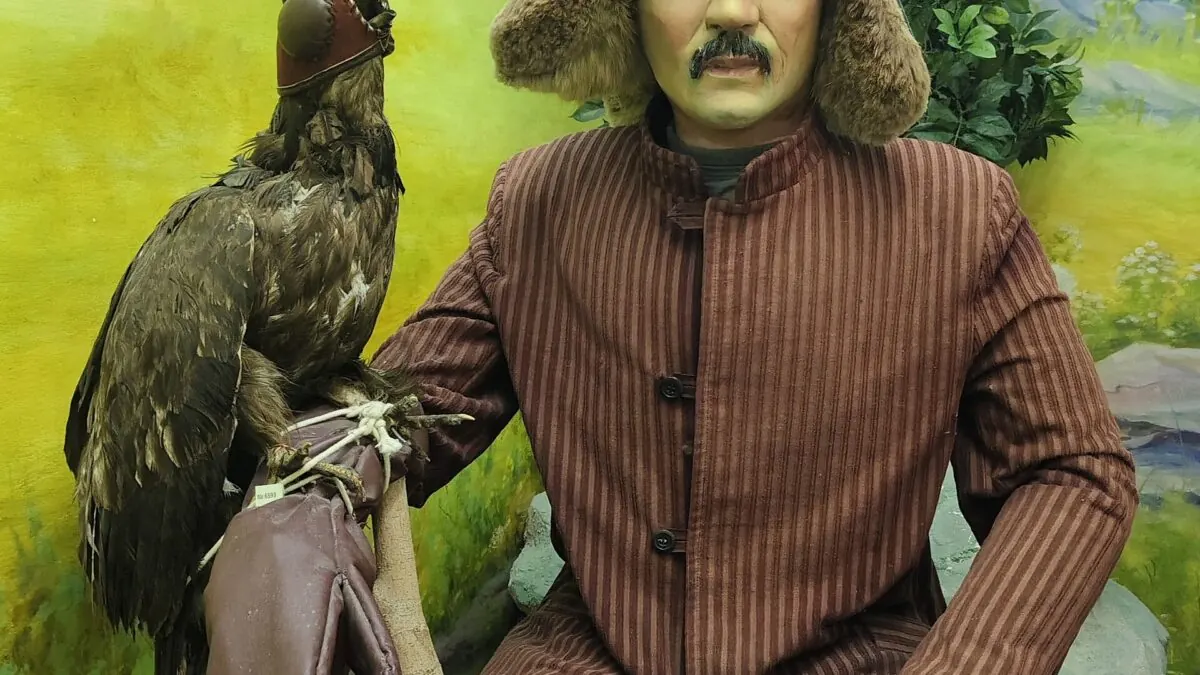
Most travelers picture eagle hunting as a costume show: a man in an embroidered coat holding a big bird for photographs. The reality is both older and more ordinary than that. Hunting with golden eagles is a working winter tradition in which a trained female eagle takes foxes, hares and marmots from horseback, and the polished roadside photo-op you're most likely to be offered is a staged imitation of it.
The Kyrgyz word for the hunter is berkutchi, from berkut, the golden eagle. The wider practice of hunting with eagles, hounds and sometimes falcons together is called salbuurun. Telling a genuine hunt apart from a fur-on-a-rope tourist demonstration is the whole skill if you want to see this properly, so this guide covers how the tradition works, where to find it around Issyk-Kul, the ethics people argue over, and how to read real from performance.
What eagle hunting actually is

A berkutchi hunts with a golden eagle, almost always a female because females are markedly larger and bolder, with a wingspan around two metres and enough power to hold a fox. The work happens in winter, on horseback, across open country and low hills. The hunter spots quarry, slips the hood off the eagle’s head and launches it; the bird does the rest.
The quarry is mostly fox, hare and marmot, though the boldest birds and hunters will take on a young wolf, and historically it was the fox that mattered most. Travelers have described Central Asian eagle hunting for centuries, long before any festival circuit existed. For herding families it sat alongside horsemanship and hound work as an ordinary cold-season skill.
Nor was this ever purely sport. Fox pelts taken this way went into the warm hats and coats a mountain winter demands, so the eagle was a practical partner as much as a status symbol. The tradition is shared with the Kazakhs, and the famous eagle festival many people have seen in photographs is actually the Kazakh event in Mongolia’s Altai rather than anything Kyrgyz. In Kyrgyzstan the practice belongs to the deeper world of nomadic culture, where horse, hound and bird all had a job.
It also rarely stood alone. Salbuurun, the fuller tradition, is a team effort rather than a solo act, bringing together the eagle, the taigan, a lean Kyrgyz sighthound bred for the mountains, and sometimes a falcon, each suited to different prey across the same ground. Seeing salbuurun done properly means watching a whole system of nomadic hunting at work, with the bird as just one member of the team.
How the bond between hunter and eagle works
An eagle is usually taken young, lifted from a nest or trapped as a juvenile, and then trained over months of patient handling. The hunter becomes the bird’s only source of food, which is how trust and dependence are built. A hood called a tomogo keeps the eagle calm and unstimulated until the moment of release, and leg straps let the handler keep control on the arm.
The early work is deliberate and slow. The hunter keeps the young eagle close, feeds it by hand, and gradually accustoms it to people, horses and noise, a process falconers call manning. The bird learns to return to the fist for food and, later, to fly quarry down and wait for the hunter to arrive. None of this holds without daily contact, which is why a serious berkutchi organises his whole winter around the bird.
Carrying the bird is a physical business. A full-grown female can weigh five to seven kilograms, too much to hold on an outstretched arm for long, so the hunter rests the forearm on a baldak, a forked wooden support fixed to the saddle. Ownership, meanwhile, has a built-in expiry date. By tradition a berkutchi keeps an eagle for something like ten to fifteen years and then releases it back to the wild to breed, and hunters point to this release as the reason the practice can be sustainable rather than extractive.
Where to see it: Bokonbaevo and beyond
The clear centre of eagle hunting for visitors is Bokonbaevo, a village on the quieter southern shore of Lake Issyk-Kul. Several hunting families and a local federation run demonstrations here, most easily arranged through the community-based tourism network, and this is where you have the best chance of meeting a working berkutchi rather than a roadside performer.
Arranging a demonstration is straightforward. The community-based tourism office in Bokonbaevo can connect you with a hunting family, usually for a set fee that goes to the household, and a visit typically includes the eagle flown to the arm across a hillside plus time to ask about training, feeding and release. Going through the local network rather than a roadside stop both improves what you see and keeps the money where it belongs.
Beyond Bokonbaevo, summer yurt camps up at Song-Kul sometimes host eagle demonstrations for guests, and the sport turns up along the south shore around Barskoon. The biggest gatherings, though, are the festivals, where eagle hunting is shown as open competition between hunters.
The ethics debate: is it cruel?
This is a fair question, and the honest answer depends on what you are looking at. Golden eagles are legally protected, and the core concerns are the taking of birds from the wild, the welfare of eagles kept tethered, and, at the tourist end of the trade, birds flown again and again to a lure or a dragged fur so a queue of visitors can get a photograph.
There are rules, at least formally: because the species is protected, the number of birds a community may hold is meant to be limited, and the traditional release of older eagles back to the wild is part of what keeps the practice defensible. Hunters and their defenders add that the take from the wild is small, that the birds typically go free after some years to breed, and that the culture around the eagle carries real knowledge and respect. On the traditional side of the line, that case holds up reasonably well.
Where it collapses is tourism volume. A handful of working hunters who fly, feed and eventually free their birds can fairly claim to be keeping something alive, but once an eagle becomes a permanently chained photo prop beside a parking area, stressed and posed for a fee, the heritage argument stops covering it, and that end of the trade has drawn the sharpest criticism for good reason. So the useful question for a visitor is less whether eagle hunting is cruel in the abstract and more which version of it your money supports.
Festivals worth timing your trip around
If you want the real thing without arranging a private hunt, aim for a festival. Salbuurun and eagle festivals are held near Bokonbaevo, commonly in spring and autumn, and bring together hunters, taigan hounds and falcons in genuine competition. The World Nomad Games also stage eagle hunting alongside horse sports when they run, and their Kyrchyn Gorge program is one of the best single places to see it done seriously.
Winter is the authentic hunting season, so a cold-month visit arranged with a Bokonbaevo family gets you closest to the practice as it actually works. And keep the Kyrgyz events separate in your mind from Mongolia’s well-photographed Golden Eagle Festival in the Altai, which is a Kazakh tradition across the border.
Authentic vs staged: how to tell
The gap between a living tradition and a costume prop is wide, and you can usually spot it in a few minutes. Use this as a quick filter before you hand over any money.
- Authentic signs: the eagle flies across open ground to the hunter’s arm, the handler explains hooding, feeding and release, and it happens at a family homestead or a festival, ideally in the colder months.
- Staged signs: a bird chained to a stump or perch at a viewpoint, a fixed fee per photo, no flight and no explanation of how the animal is cared for.
- Ask two questions: will this eagle be released back to the wild, and how many years do you keep a bird. A genuine berkutchi answers both without hesitation.
- Book through community-based tourism in Bokonbaevo or a known hunting family rather than stopping at a roadside setup you have not vetted.
- Treat a midsummer parking-lot photo very differently from a winter demonstration tied to real hunting; the season itself is a clue.
The plain warning is this: if the only thing on offer is a stationary bird and a photo fee, you're paying for a costume, not a tradition, and the kindest thing for the eagle is to walk on and find a family that actually hunts.
FAQ
Is eagle hunting in Kyrgyzstan real or a tourist show?
Both exist, and telling them apart is the whole skill. Hunting with golden eagles is a working winter tradition in which a trained female eagle takes foxes, hares and marmots from horseback. The polished roadside photo opportunity you are most likely to be offered is a staged imitation of it.
What is a berkutchi?
The Kyrgyz word for an eagle hunter, from “berkut”, the golden eagle. The wider practice of hunting with eagles, hounds and sometimes falcons together is called salbuurun.
When is eagle hunting season in Kyrgyzstan?
Winter. It is a cold-season tradition, which is the first test of whether what you are being shown is a hunt or a demonstration — a summer roadside performance is not hunting.
Where can I see eagle hunting in Kyrgyzstan?
Bokonbaevo, on the quieter southern shore of Issyk-Kul, is the clear centre: several hunting families and a local federation run demonstrations there, and the community-based tourism office can connect you with a hunting family. Song-Kul yurt camps sometimes host demonstrations for guests, and the biggest gatherings are the salbuurun festivals near Bokonbaevo.
Are the eagles male or female?
Female. Female golden eagles are larger and are the birds trained for hunting.
Is eagle hunting ethical?
It is argued over, and the guide covers the arguments rather than settling them. The distinction most people care about in practice is between a working relationship with a bird that hunts, and a bird held on a rope beside a road for photographs with fur as a prop.