If you only do one multi-day trek in Kyrgyzstan, make it the Ala-Kul crossing near Karakol — and it isn’t close. The three-day route to a glacial lake and over a 3,900 m pass, finishing at the Altyn-Arashan hot springs, packs more scenery per day than anything else you can reach without a serious expedition.
That said, the best trek for you depends on how many days you have, how high you’re willing to sleep, and whether you’d rather walk or ride. Below are the five multi-day routes we’d actually recommend, ranked, with a comparison table and honest notes on who each one suits. For the practical basics (gear, guides, water) pair this with our Kyrgyzstan trekking guide.
The five best multi-day treks, compared
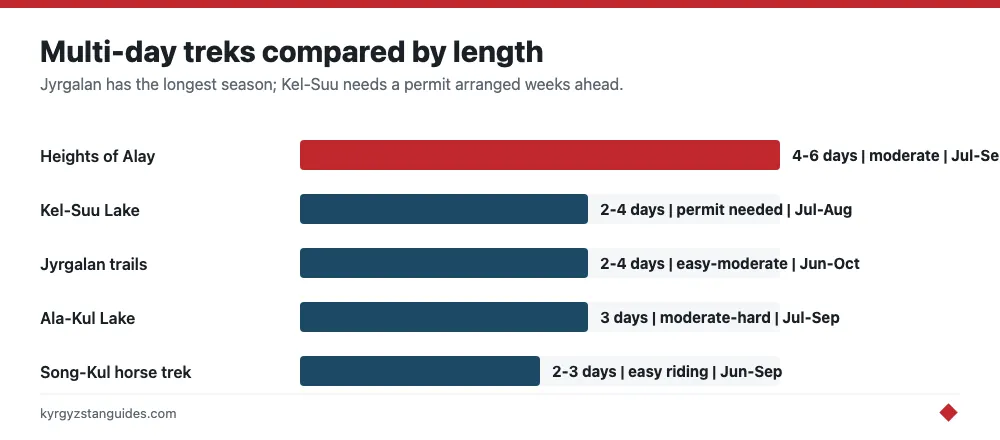
| Trek | Days | Difficulty | Season | Highlight |
|---|---|---|---|---|
| Ala-Kul Lake | 3 | Moderate– hard | Jul– Sep | Turquoise glacial lake, 3,900 m pass, hot springs finish |
| Heights of Alay | 4– 6 | Moderate | Jul– Sep | Meadows and yurt camps under Pik Lenin (7,134 m) |
| Kel-Suu Lake | 2– 4 | Moderate | Jul– Aug | Fjord-like lake by the China border; permit needed |
| Jyrgalan trails | 2– 4 | Easy– moderate | Jun– Oct | Quiet community trails, flexible loops, long season |
| Song-Kul horse trek | 2– 3 | Easy (riding) | Jun– Sep | High alpine lake, jailoo pastures, nomad yurtstays |
1. Ala-Kul Lake, the one to do
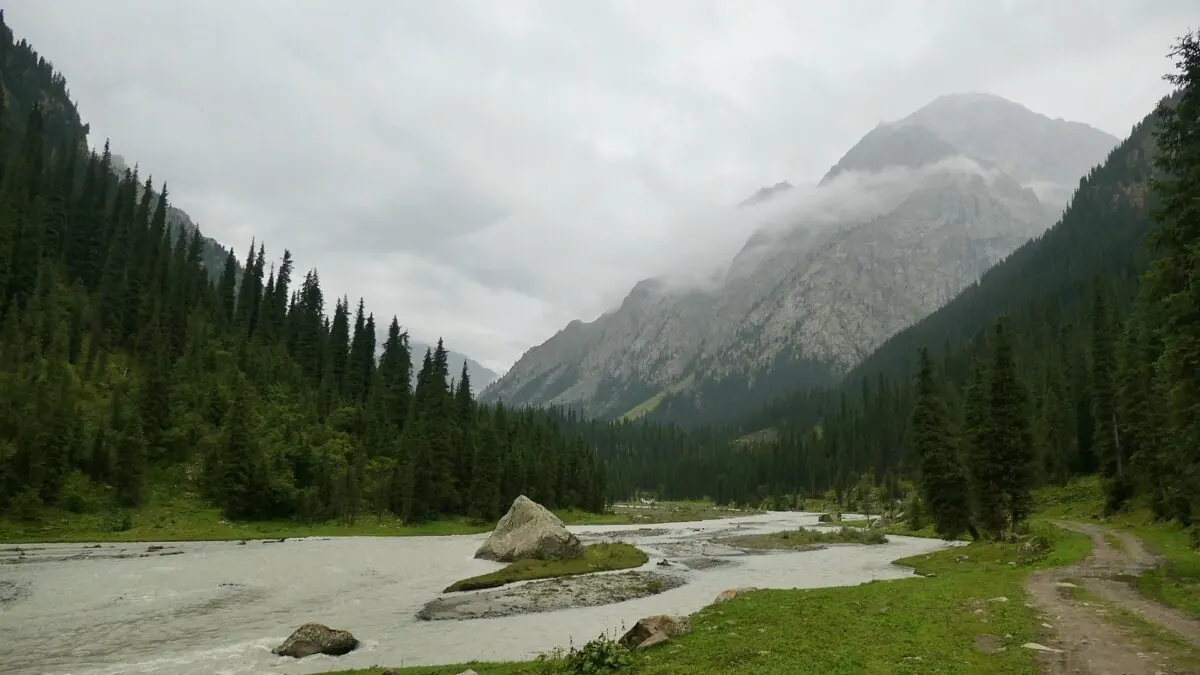
The classic version starts in the Karakol valley, climbs through spruce forest to a camp below the lake, crosses the Ala-Kul pass with the lake glowing turquoise below, then drops to the Altyn-Arashan hot springs for a soak on the last night. It's three hard but hugely rewarding days, and the payoff-to-effort ratio is the best in the country. Go in July or August; the pass can hold snow into early summer. Full route detail is in our Ala-Kul trek guide.
Getting there's easy: it starts a short marshrutka ride from Karakol, a well-set-up trekking town on the east end of Issyk-Kul, reachable by shared minibus from Bishkek in five to six hours. You can walk it in either direction, hire a porter-horse for your pack, and camp or use the seasonal yurt camp below the pass. The one catch is the pass itself, steep, high, and snow-prone into July, so it demands decent fitness and a weather eye.
2. Heights of Alay — nomad country under a 7,000 m peak
In the far south, the Heights of Alay route wanders the meadows and yurt camps of the Alay valley beneath Pik Lenin, one of the most accessible 7,000 m peaks on the planet. It's a gentler gradient than Ala-Kul but longer (four to six days) and higher on average, with camps around Tulpar-Kul. This is the trek for grassland, herders and big-mountain backdrops rather than a single dramatic lake, and it starts from Sary-Mogol near Osh.
Because it sits in a border zone close to Tajikistan, it usually needs a permit arranged a couple of days ahead through the Sary-Mogol CBT office, which also fixes homestays, guides and horses. Access from Osh is a four-to-five-hour drive, so this is the trek to pick if you're already in the south — combining it with the Pamir Highway or a Pik Lenin base-camp visit makes the long journey down worthwhile.
3. Kel-Suu Lake. Remote and permit-gated
Kel-Suu, tucked against the Chinese border in the Naryn region, is a long, fjord-like lake ringed by sheer rock. Reaching it involves a rough drive to At-Bashy and a border zone, so it needs a permit arranged in advance, and the water is only reliably ice-free in July and August. Most people do it as a two-to-four-day combination of jeep and short treks rather than a continuous long walk. See the Kel-Suu guide for permit logistics.
Logistically it's the most involved of the five. You need a border-zone permit organized in advance, transport from At-Bashy or Naryn over rough track, and the weather window is genuinely narrow — the lake can stay frozen or the level can rise and shrink the shore into August. Most visitors camp near the lake for a night and do day hikes rather than a long continuous route, so think of it as a remote lake expedition with short walks rather than a classic point-to-point trek.
4. Jyrgalan, the flexible community base
Jyrgalan, a former coal village east of Issyk-Kul, has reinvented itself as a low-key trekking hub with waymarked trails, homestays and local guides. The routes here, to Boz-Uchuk lakes, over Tulpar pass, or multi-day loops, are easier and have a longer season than the big alpine crossings, running June to October. It's the pick for a first multi-day trek or for travelers who want to build their own itinerary. Our Jyrgalan guide covers the trailheads.
The season is the longest here, June to October, because the trails run lower than the big alpine crossings. That makes Jyrgalan the smart shoulder-season option in early June or late September when Ala-Kul’s pass is still risky. Homestays and a small guides’ cooperative in the village make it easy to hire a local, rent gear or join a set departure, and you can string trails together into anything from an overnight to a week.
5. Song-Kul on horseback: the ride, not the hike
Song-Kul is a wide alpine lake at 3,016 m surrounded by summer pastures where herders bring their animals up for the season. The signature trip here is two or three days on horseback between yurt camps rather than a foot trek, and it is the best window into living nomad culture in the country. It's easy going if you can ride, and the star-filled nights are the memory people keep. Details are in the Song-Kul guide.
You reach the plateau by road from Kochkor, where CBT and tour offices arrange the horses, guide and yurtstay as a package, a two-day trip is very affordable and requires no riding experience beyond a willingness to sit a slow horse for a few hours. Come in July or August when the jailoo is fully occupied and the pastures are green; by late September the herders and their yurts start coming down for winter.
Honorable mentions
A few routes just missed the top five but deserve a look depending on where you are. Sary-Chelek, a walnut-forest lake region in the west, offers gentle multi-day loops in a lower, greener landscape and a longer season. The Boz-Uchuk lakes trek out of the Terskey Ala-Too, often started from Jyrgalan, is a two-to-three-day chain of alpine tarns with far fewer people than Ala-Kul. And for the seriously experienced, the trek toward the Inylchek glacier and the base of Khan Tengri (7,010 m) is a demanding, permit-heavy expedition into the country’s biggest glaciated terrain — guided groups only, and not a casual undertaking.
What to pack
Kyrgyz mountain weather turns fast, and even July nights at 3,500 m drop below freezing. Pack for four seasons in one day.
- Warm sleeping bag rated to at least -5°C, plus an insulated mat.
- Waterproof jacket and trousers, afternoon storms are routine.
- Sturdy broken-in boots and trekking poles for the steep passes.
- Sun protection: high passes and snowfields burn fast at altitude.
- Water purification and enough cash, since there are no shops on the trail.
- A basic first-aid kit and any altitude medication you rely on.
How to choose
Match the trek to your constraints rather than the ranking. A quick decision framework:
- Best single-trek payoff and you’re fit: Ala-Kul.
- You want grassland, herders and a giant peak, with more days: Heights of Alay.
- First multi-day trek, or you want flexible easy loops: Jyrgalan.
- You’d rather ride than walk and want nomad culture: Song-Kul.
- You’ll trade effort for remoteness and don’t mind paperwork: Kel-Suu.
Guided, self-guided, or a set departure?
Kyrgyzstan is one of the easier countries in the region to trek independently. Ala-Kul, Jyrgalan and Song-Kul are all doable self-guided if you're competent with a map, a GPS track and river crossings, and you can rent gear in Karakol or Bishkek. Where a guide earns their fee is on the high, snow-prone passes, in the border zones with permits, and on remote routes where a wrong turn has real consequences.
The middle option (a set departure from a local operator or CBT office) is often the best value: you get a guide, cook, horses and permits sorted for a fixed per-person price, plus company on the trail. Expect roughly $40– 70 a day per person for a small-group guided trek with meals, less if you self-cater and just hire a guide-horseman. Book a few days ahead in peak season, when the popular routes and set departures fill up.
Permits and guides
Most of these need no permit. The exceptions are the border zones: Kel-Suu near China, and parts of the Alay valley near Tajikistan, where a border-zone permit is arranged through local operators or CBT offices a few days ahead. Guides aren't legally required on the popular routes, but on Ala-Kul’s pass and anywhere with river crossings or snow, a guide or at least a local horseman is money well spent. CBT and community tourism offices in Karakol, Jyrgalan, Naryn and Sary-Mogol are the reliable places to book.
Whichever you choose, treat July and August as the safe core season, carry layers for sudden cold at altitude, and don’t plan a long alpine crossing as your first day off the plane. If you have two weeks, the strongest combination is Ala-Kul in the northeast followed by a horse trek at Song-Kul — one hard alpine hit, one gentle cultural one, and a complete picture of what Kyrgyz trekking offers.
FAQ
What is the best multi-day trek in Kyrgyzstan?
The Ala-Kul crossing near Karakol, and it is not close. Three days to a glacial lake and over a 3,900 metre pass, finishing at the Altyn-Arashan hot springs, packs more scenery per day than anything else reachable without a serious expedition.
How many days do I need for a Kyrgyz trek?
Three is the useful minimum for the classic routes, and the right choice depends on how many days you have, how high you are willing to sleep and whether you would rather walk or ride — horse-supported options change the calculation considerably.
Do I need a guide for multi-day treks in Kyrgyzstan?
Not always for the popular routes, which are increasingly well trodden. The argument for one strengthens sharply on remote routes, because there is no national mountain rescue service and evacuation is a private arrangement.
How high do the Kyrgyz treks go?
The Ala-Kul pass reaches about 3,900 metres, which is the highest point most trekkers here will cross. Sleeping altitude matters more than the pass itself — build the itinerary so you have already spent nights high before you attempt it.
Can I trek in Kyrgyzstan without camping?
On some routes, yes — yurt camps and guesthouses cover parts of the popular circuits, and the Ala-Kul route finishes at guesthouses in Altyn-Arashan. Fully hut-to-hut trekking in the Alpine sense does not exist here.
When is trekking season in Kyrgyzstan?
Broadly mid-June to mid-September, when the high passes are snow-free and the yurt camps are standing. September is often the most stable weather of the whole season.
Want mountains without the foot traffic? The regional tourist board has published seventeen quieter routes — our guide to alternatives to the Ala-Kul trek is the companion piece to this ranking.