Kyrgyzstan's railway network is two disconnected fragments, one in the north and one in the south, neither of which reaches the other. The country has talked about joining them for thirty years. The line now being built does that almost by accident, because its real purpose is to move Chinese freight to Uzbekistan and beyond.
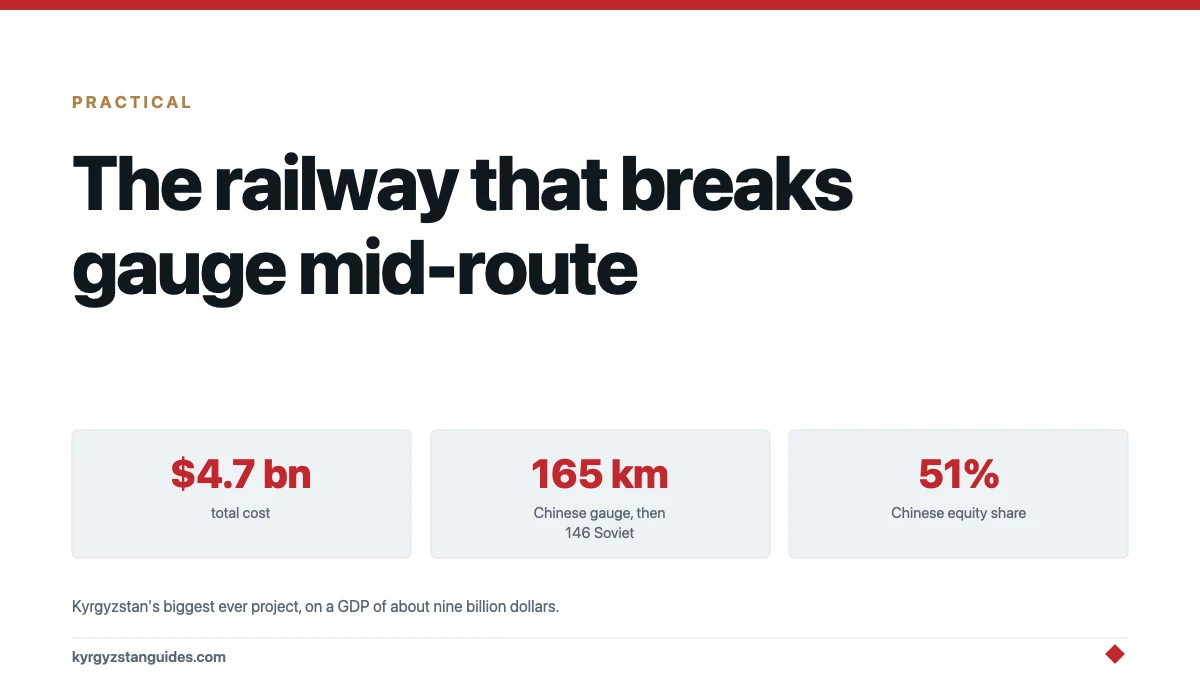
The China–Kyrgyzstan–Uzbekistan railway is the largest infrastructure project in Kyrgyz history, and the numbers are worth seeing laid out before the politics.
The route, and the gauge problem
The line runs from Kashgar in Xinjiang, over the Torugart border station, through Arpa to Makmal, then to Jalal-Abad and on to Andijan in Uzbekistan. Twenty stations are planned.
Total length is reported between 530 and 532.53 km. The Kyrgyz section is where sources diverge most: 260 km, 304.84 km, about 305 km, or 311.76 km depending on who is counting and when. The Kyrgyz Ministry of Transport's own presentation sums its two segments to 311.76 km, which is the figure with the clearest arithmetic behind it.
The interesting engineering decision is the gauge. China runs 1,435 mm standard gauge; the former Soviet world runs 1,520 mm. Rather than pick one, the line breaks gauge in the middle: 1,435 mm from Torugart to Makmal, 165.5 km, then 1,520 mm from Makmal to Jalal-Abad, 146.26 km. Makmal becomes a transshipment station handling train break-up and forming, container transfer, wagon weighing and bogie changes between the two gauges.
That is not a compromise anyone loves. It is the price of a route that has to work with two incompatible rail worlds, and it puts a permanent bottleneck in the middle of Kyrgyzstan — which, from a Kyrgyz point of view, is also a permanent reason for the freight to stop in the country.
Torugart: the border this depends on
The whole northern half of the route hangs on one crossing, and it is worth knowing what Torugart currently is before imagining trains running through it.
Torugart is a Class 2 port, which in practice means it is not a crossing you can simply arrive at. It requires pre-arranged transport on both sides and permits, and the ground approaching it sits inside the controlled border zone — the same zone covering Chatyr-Kol and Kel-Suu that our border-zone permit guide sets out. Travellers who turn up hoping to walk or hitch across are turned back.
It is also high, remote and seasonal, which is the engineering problem in one sentence. A railway through it has to cross the Tien Shan at altitude, in a place where the road itself closes, which is why tunnels and bridges account for something like 40% of the route length.
None of that changes for visitors while construction runs. If anything it gets harder: a border zone with a major construction project inside it is not a place that becomes easier to wander into.
Who is paying, and what that buys
The cost is $4.7 billion. The financing agreement was signed in Bishkek on 16 December 2025 with a syndicate led by China Development Bank and China Exim Bank: $2.3 billion as a 35-year loan and $2.3 billion as equity, split China 51%, Kyrgyzstan 24.5%, Uzbekistan 24.5%.
Set that against a Kyrgyz GDP of roughly nine billion dollars and you have the shape of the criticism. A 35-year Chinese loan plus majority Chinese ownership of the operating company drives the debt-dependency argument, and analysts add a second one: that Kyrgyzstan may end up a low-margin transit country rather than a beneficiary. Supporters point to the opposite framing — that this is a corridor bypassing Russian territory, which has its own strategic value.
The official chronology, from the transport ministry: cooperation agreement signed in Beijing on 6 June 2024; the joint company opened in Bishkek on 28 September 2024; investment agreement signed 20 December 2024; construction launch ceremony 27 December 2024 at Jalal-Abad; key facilities launched 29 April 2025.
What is actually built so far
Enough that the tunnel counts keep changing. At launch in December 2024 the figures were 25 tunnels and 42 bridges. By December 2025 they were 29 tunnels and 50 bridges, with tunnels and bridges together making up about 120 km, roughly 40% of the route. By September 2026, with work under way on the Kyrgyz section, the figures were 27 tunnels, 43 bridges, 88 roadbed sections and 20 stations.
The first concrete milestone came on 5 September 2026: breakthrough on the Kosh-Dobo North No. 2 tunnel, 209.6 metres long, maximum burial depth 41 metres, single track. It is the first tunnel driven through on the Kyrgyz section.
You will see claims that three tunnels exceed 12 km and that total tunnelling runs to 104.83 km. Those trace to a source I could not open and to aggregators. The longest tunnel on the line is not established, so nobody should be naming one, including me.
Design speed is 120 km/h. Freight forecasts run up to 15 million tonnes a year. The stated rationale is that it shortens the East Asia to Middle East and southern Europe route by 700 km and cuts transit to about ten days.
What it does to Kyrgyzstan’s own railway
The freight story is the reason the line is being built. The domestic story is the reason Kyrgyzstan wanted it.
The country’s existing network runs to about 424.6 km with 28 stations, and it is not one network. It is two stubs inherited from Soviet planning that treated this territory as the edge of two different systems: a northern fragment around Bishkek and Balykchy, and a southern one around Osh and Jalal-Abad. There is no rail connection between the north and south of Kyrgyzstan. To move goods by train from Bishkek to Osh you leave the country.
The new line does not fix that directly — it runs east to west across the south, not north to south. But it gives the southern fragment a mainline connection to China and to Uzbekistan, and it puts a major transshipment facility at Makmal in the middle of the country. The government’s stated ambition beyond that is Pacific and Persian Gulf port access, which for a doubly landlocked country is a large claim.
Twenty stations are planned along the route, and passenger services as well as freight. What that means in practice for travellers is unknowable this far out, but the existence of a passenger plan is the difference between a freight corridor and something that might one day change how you cross this country. Our guide to the existing railway covers what actually runs today, which is a great deal less.
Design speed is 120 km/h — a working freight and regional line, not a high-speed railway, and the terrain makes that unsurprising.
When it opens, and why the answer is a shrug
Completion claims span 2030, around 2031 — six years from a 2025 start — and a Kyrgyz suggestion that it could be done in four years rather than six. Nobody agrees, and the project is barely two years into construction on the hardest terrain of the route.
For anyone planning a trip this decade, the practical note is that the existing Kyrgyz rail network is unaffected for now, and Torugart remains what it has always been: a border crossing that needs permits and pre-arranged transport on both sides, not a place you turn up at.
FAQ
What is the CKU railway?
The China–Kyrgyzstan–Uzbekistan railway, running from Kashgar over the Torugart pass through Kyrgyzstan to Andijan in Uzbekistan. Total length is reported at 530-532.53 km, with the Kyrgyz section given as anywhere from 260 to 311.76 km.
How much does the CKU railway cost?
$4.7 billion. The December 2025 financing deal splits it as $2.3 billion in a 35-year loan from Chinese policy banks and $2.3 billion in equity, owned China 51%, Kyrgyzstan 24.5%, Uzbekistan 24.5%.
Why does the CKU railway change gauge?
Because China uses 1,435 mm and the former Soviet network 1,520 mm. The line runs Chinese gauge for 165.5 km from Torugart to Makmal, then Soviet gauge for 146.26 km to Jalal-Abad, with Makmal handling the transfer between them.
When did construction on the CKU railway start?
The launch ceremony was on 27 December 2024 at Jalal-Abad, with key facilities launched on 29 April 2025. The first tunnel on the Kyrgyz section, Kosh-Dobo North No. 2, broke through on 5 September 2026.
When will the CKU railway be finished?
Unsettled. Claims range from 2030 to around 2031, with a Kyrgyz suggestion of four years rather than six. Given the terrain and the stage of works, treat any firm date with caution.
Is the CKU railway a debt trap for Kyrgyzstan?
That is the argument critics make: a $4.7 billion project against a GDP of roughly $9 billion, financed with a 35-year Chinese loan and 51% Chinese ownership. Supporters note it connects Kyrgyzstan's two disconnected rail fragments and bypasses Russian territory.