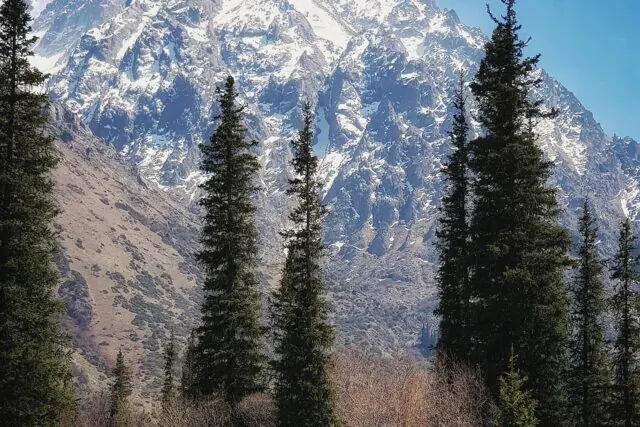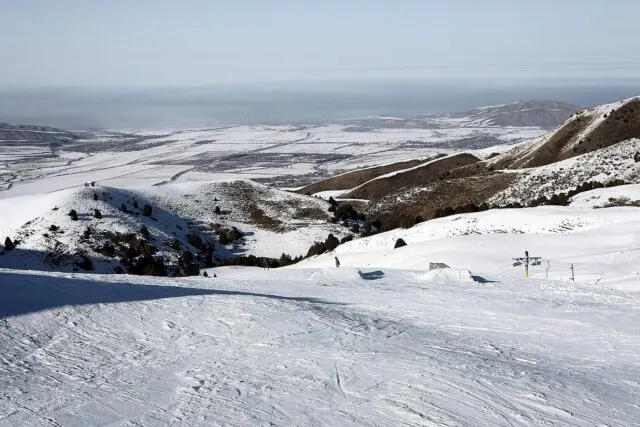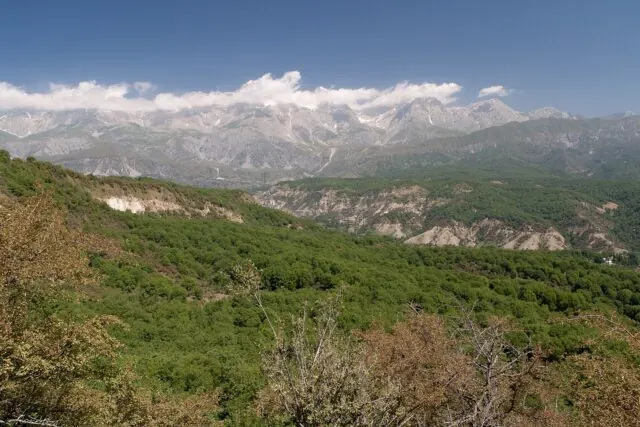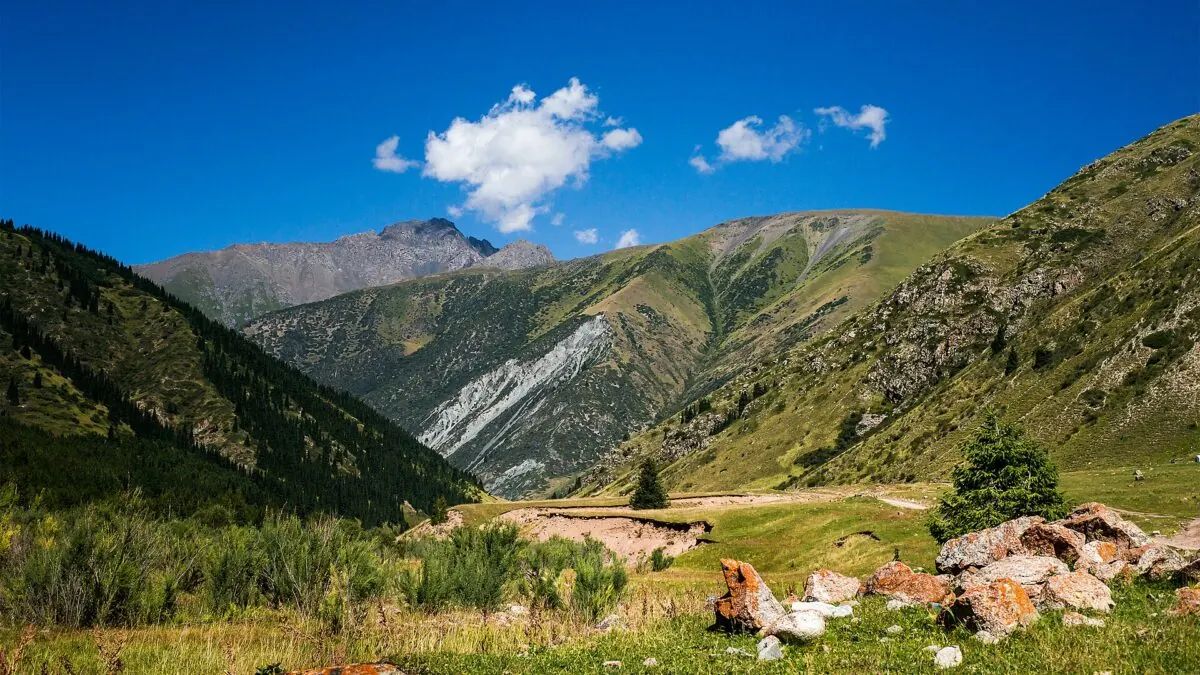
Snowmelt is still running hard down the Chuy and Suusamyr valleys in early June, and the pastures are the greenest they'll be all year. June is the start of Kyrgyzstan’s proper travel season: lowland weather is warm and settled, most trekking passes open through the month, and you get it all with noticeably fewer people than the July–August crush. The one honest catch is altitude: the highest passes above 3,500 m can hold snow through June, and the 3,900 m Ala-Kul pass is typically snow-free only by late July.
Think of June as the shoulder that behaves like high season everywhere except the very top of the mountains. Bishkek and the Issyk-Kul shore are comfortably warm, guesthouses are open but not booked out, and prices sit below their July peak. If you want green landscapes and space to breathe, this is arguably the sweet spot. Our best time to visit Kyrgyzstan guide ranks the whole calendar, but here's why June belongs.
The weather in June
Bishkek and the low country run warm to hot. Daytime highs of 26–32°C by late June, cooling pleasantly at night. The Issyk-Kul basin is milder, in the low-to-mid 20s, and the lake itself is warming toward swimmable (it never gets truly cold, but June is the front edge of beach season). Up in the mountains it's a different climate entirely: expect 10–18°C by day at trekking altitude, near-freezing nights above 3,000 m, and the classic Tian Shan pattern of clear mornings giving way to afternoon showers or thunderstorms. Pack layers and a proper rain shell regardless of how warm the valley felt at breakfast; our packing list breaks down exactly what for each season.
What is open, and what is not quite
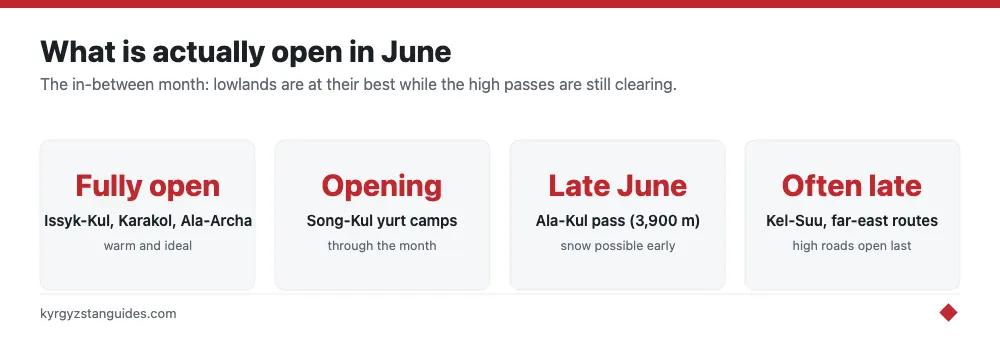
Almost everything low and mid-altitude is a green light. Ala-Archa, day hikes around Bishkek, Issyk-Kul, Karakol and the Jeti-Oguz valley are all in full swing. The famous jailoo (summer pasture) camps are moving up: Song-Kul’s yurts generally open in June as the herders and their animals arrive, though the very first weeks can be hit or miss if late snow lingers on the approach passes.
The nuance is the high stuff. The Ala-Kul trek’s 3,900 m pass can carry snow and ice right through June (more on that below), making it slower and more serious than in high summer; check current conditions before committing and consider a guide if you aren't confident on snow. Remote high-altitude destinations like Kel-Suu (roughly 3,500 m, near the China border) may only become reliably accessible late in the month once the track dries and thaws.
| Destination | June status |
|---|---|
| Issyk-Kul, Karakol, Ala-Archa | Fully open, warm, ideal |
| Song-Kul yurt camps | Opening through June |
| Ala-Kul pass (3,900 m) | Experienced hikers only; ice axe, crampons possibly needed |
| Kel-Suu / far-east high routes | Often only late June |
Crowds and cost
This is June’s quiet advantage. The peak wave of visitors hits in July and August, so in June you get high-season access with shoulder-season breathing room. Popular guesthouses in Karakol and around the lake are open and usually have space without booking weeks ahead, and prices (dorms around $8–12, guesthouses $25–40, yurt stays with meals $15–22) sit at the lower end before the summer bump. A marshrutka from Bishkek to Karakol is still around 500–600 KGS. If your dates are flexible and you want the same landscapes with fewer people in your photos, June beats mid-summer on value. The one thing to watch is that the very first camps and seasonal services are still spinning up early in the month, so some remote guesthouses or yurt operations may not be running until mid-June. A quick message ahead confirms whether a specific place is open yet.
How to plan a June trip
Structure your route by altitude and date. Spend the first days low (Bishkek, Ala-Archa, then the Issyk-Kul shore and Karakol) which are all reliable from day one. Push the higher treks toward the back half of your trip and the back half of the month, giving the snow more time to clear. A standard loop works cleanly in June; our one-week itinerary covers the essentials, and there's a longer 10-day version if you want to fold in a multi-day trek. Book any high-pass trek with a little schedule slack so a snowbound afternoon does not derail the whole plan.
Verdict
June is one of the best months to come, green, warm, open, and calmer than peak season, as long as you respect the altitude and keep the highest passes for the second half. If your priority is settled beach-and-valley weather with room to move, book it. If your single non-negotiable is a clean, snow-free ascent of the very highest passes, lean to July instead, or simply pad your dates and stay flexible.
June by the numbers, and the eight degrees that matter
Averaged across the fifteen Junes from 2010 to 2024, station records give Bishkek a mean daily high of 30.7 °C and a low of 16.7 °C, and Osh 31.0 °C and 16.8 °C. Those two are effectively the same climate. Naryn, at 2,041 m, runs 22.6 °C and 8.4 °C.
That is roughly eight degrees cooler both day and night, and it is the single most useful number for packing. People arrive in a hot Bishkek, look at the forecast, and pack for it, then spend a night at altitude in everything they own. The gap is not weather variation. It is the country.
Rain splits the same way. Bishkek's June normal is about 34 mm. Karakol's is 50.9 mm, half as wet again, which is why the eastern Issyk-Kul trekking hub feels different from the capital. Naryn takes 55.1 mm. Osh is the dry one, somewhere between 13 and 22 mm depending on whether you take the station record or the WMO figure.
One trend worth knowing if you are working from an old guidebook: Bishkek's June mean daily maximum has risen about 1.7 °C between the 1961-1990 and 1991-2020 station records, from 28.4 °C to 30.1 °C. A June described as pleasant in a book from the 1990s is a hotter June now.
The rivers are the hazard, not the passes
June's real danger is water, and it is systematically undersold. Peer-reviewed hydrology of the Naryn basin puts the snowmelt discharge peak in April and May, with glacier melt taking over through June to September. What that means on the ground is that rivers stay high and cold through June, fed by two sources at once.
Kyrgyzhydromet issued 17 storm warnings for mudflow danger and rising water in the mountain and foothill zones during one recent warm season, with a 94% verification rate. In summer 2023 discharge ran at 124-158% of the long-term norm on the Chon-Kyzyl-Suu, Turgen-Ak-Suu, Jeti-Oguz and Ala-Archa — which is to say, on precisely the trekking rivers around Karakol and Bishkek.
The emergencies ministry issued nationwide mudflow and river-rise warnings on 8 June 2026 and again for 27-30 June 2026. And the consequences are not theoretical: in early July 2026 a rapid rise on the Kara-Tokoy river in Chatkal washed out a bridge approach and stranded around 48 people, ten of them foreign tourists, on a jailoo, with rescuers unable to ferry them across.
Drownings are up too: 74 people drowned in Kyrgyzstan's waters in 2026 by late July, against 57 in the same period of 2025. Treat an unbridged June river crossing as a genuine decision point, not a photo opportunity.
What actually opens in June, and what does not
The jailoo season starts now. Herders leave winter camps in April for huts near the villages, shear in May and June, and the move up to the high pastures begins in June. That is why yurt stays become possible, and it is also why they are not guaranteed on 1 June.
Song-Kul sits at 3,016 m and its camps run June to September, with road access closed outside that window. Tash-Rabat's camps run the same months. Both are genuinely open in June; both can be near freezing at night even in July.
Ala-Kul is the one to think hard about. The national tourism portal's position is that mid-July through mid-September offers the most reliable conditions, that the pass is typically snow-free by late July, and that June is possible for experienced hikers with ice-axe skills, with crampons potentially required. That is a materially different trip from the August version, and it is not what "the trekking season starts in June" implies.
Snow on the high roads does not stop at the end of May either: it was falling on the Ala-Bel pass on the Bishkek-Osh highway on 4 July 2026.
Festivals, and the holiday that has left June
Kurman Ait, Eid al-Adha, has drifted out of June. It fell on 28 June in 2023, 16 June in 2024 and 6 June in 2025, but on 27 May in 2026, and the lunar calendar moves it about eleven days earlier each year. Advice written between 2023 and 2025 telling you to expect Eid in June is now simply out of date.
The fixture that has held is in At-Bashy. The "Kyrgyz Shyrdagy" crafts festival, with the "Kyrgyz Daamy" national cuisine competition and the Khan Koshoy wrestling tournament, ran 28-29 June 2025 on the Sary-Tal jailoo in Naryn region. The same late-June slot goes back years: the seventh edition, with a kymyz festival alongside it, ran 28-29 June 2017 in the same district.
On ticks, the good news is counterintuitive. The health ministry records the peaks as April-May and August-September, not mid-summer, and the season trigger as air temperature above 15 °C for more than ten days. In 2024 more than 1,014 people sought help for tick bites, of whom 14 contracted tick-borne encephalitis and 30 North Asian tick typhus. TBE virus has been found in ticks in Ala-Archa, 40 km from Bishkek, at 1,891-2,472 m, so this is not a remote-valley problem. Kyrgyzstan has been certified malaria-free since 7 October 2016, so that is one thing you can stop worrying about.
Frequently Asked Questions
Is Song-Kul open in June?
Usually yes. The Song-Kul yurt camps generally open during June as herders move up to the pasture, though the first week or two can be uncertain if late snow lingers on the approach passes. By mid-to-late June it's a safe bet.
Can you swim in Issyk-Kul in June?
Early beach season, yes. By late June the water is warming toward comfortable and the lakeshore towns are opening for summer. It isn't yet the bath-warm July peak, but plenty of visitors swim.
Is June too early for high-altitude trekking?
Not for most routes, but the highest passes above roughly 3,500 m can still hold snow through June, and Ala-Kul is typically snow-free only by late July. Do lower and mid-altitude treks first, save the big passes for late June, and always check current conditions before you set off.
How hot is Kyrgyzstan in June?
Bishkek and Osh both average about 31 °C by day and 17 °C at night. Naryn, at 2,041 m, runs 22.6 °C and 8.4 °C — roughly eight degrees cooler both day and night. Pack for the altitude, not for the capital.
Is June a good time to trek in Kyrgyzstan?
For most routes yes, but Ala-Kul is the exception. The national tourism portal rates June as possible only for experienced hikers with ice-axe skills, with crampons potentially needed; the pass is usually snow-free by late July.
Are Song-Kul yurt camps open in June?
Yes. Song-Kul sits at 3,016 m and its camps, like Tash-Rabat's, run June to September, with road access closed outside that window. Expect near-freezing nights even so.
How dangerous are river crossings in June?
Genuinely dangerous. Rivers stay high through June as glacier melt takes over from snowmelt, and discharge has run at 124-158% of norm on the Karakol and Bishkek trekking rivers. The emergencies ministry issues repeated mudflow and river-rise warnings through the month.
Does Eid fall in June in Kyrgyzstan?
Not any more. Kurman Ait fell on 28 June 2023, 16 June 2024 and 6 June 2025, but moved to 27 May in 2026 and continues drifting about eleven days earlier each year.
Are ticks a problem in Kyrgyzstan in June?
Less than in spring or late summer. The health ministry puts the peaks in April-May and August-September. Tick-borne encephalitis is present, including in Ala-Archa at 1,891-2,472 m. Kyrgyzstan has been malaria-free since 2016.