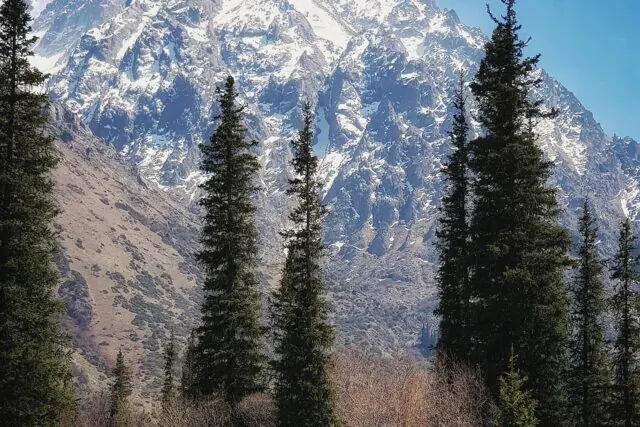
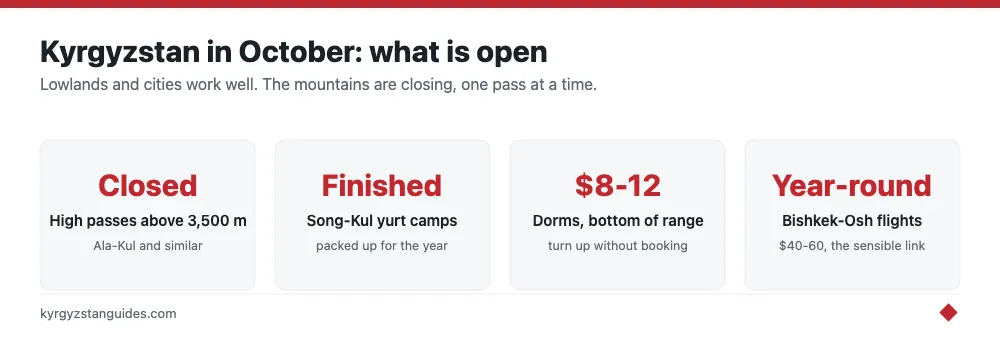
Be clear-eyed before you book October: this is the month the high country shuts. By October the trekking passes are closing, the first snow is settling above 3,000 m, and the Song-Kul yurt camps have finished for the year — so an October trip built around high-altitude trekking will end in disappointment. What October does still offer is genuinely good, though: crisp lowland sightseeing, the last of the autumn colour, quiet towns, low prices, and a front-row seat as the country pivots toward ski season.
Treat October as a low-altitude and cultural month, not a mountain one, and it works. Go in expecting the high routes to be off the table and you won’t be caught out. Our best time to visit Kyrgyzstan guide places October firmly in the shoulder-to-off-season bracket; here is how to make the most of it and what to leave for another trip.
The weather turns
October is a month of steep transition. Early October can still feel like a bright late autumn in the lowlands — Bishkek in the high teens by day, cool and clear — but by late October the first proper cold arrives, nights drop below freezing even at moderate elevations, and snow becomes a real prospect on the passes and in the mountains. The Issyk-Kul basin stays milder than the interior thanks to the lake, but beach season is firmly over. Pack for cold; a warm jacket and layers are essential by mid-month, and our packing list covers the shift.
What still works: lowland sightseeing
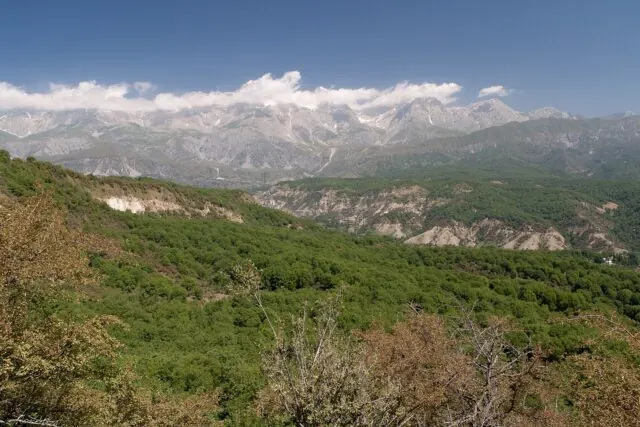
The low-altitude sights are the heart of an October trip, and many are at their best in crisp autumn light with almost nobody around. Bishkek’s museums, bazaars and parks are all-season, and the city is pleasant in the cool. The Burana Tower and the Chuy valley sights are easy day trips. Down south, Osh and the Sulaiman-Too are comfortable now that the summer heat has gone. The last of the autumn colour lingers in the lower valleys and the Arslanbob walnut forests in early October. And the Issyk-Kul shore, while no longer for swimming, is atmospheric and empty. A good base for Karakol and the lower valley walks around it, which remain accessible when the high passes above them don't.
Ski season is coming
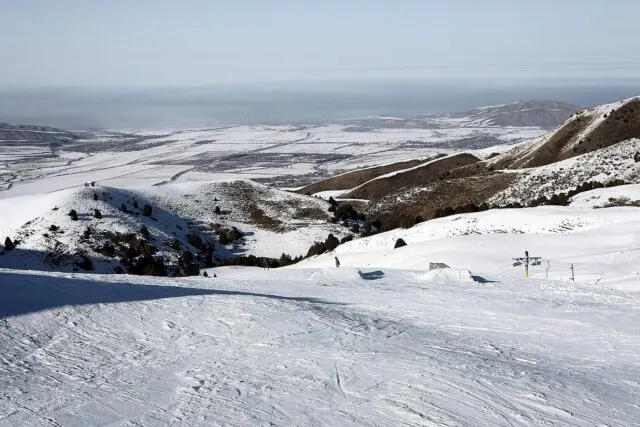
October is when Kyrgyzstan starts turning its attention to snow. The ski bases around Karakol and Bishkek aren't open yet. The season generally gets going from late November, but October is the ideal time to plan and price a winter trip, and late-month snowfalls are the first hint of what's coming. If a ski holiday is your real goal, October is for research and booking, not for skiing; you would want to return in the depths of winter for that.
Getting around in the shoulder
Practicalities shift a little as the season winds down. The core marshrutka and shared-taxi network keeps running all year — Bishkek to Karakol is still around 500–600 KGS — so the main towns stay easy to reach. What changes is the informal summer traffic to the high pastures and remote valleys, which dries up as the herders leave and the tracks ice over; getting to far-flung spots becomes slower and less reliable. Domestic flights between Bishkek and Osh (roughly $40–60) run year-round and are the sensible way to link north and south once the days get short. If you want the full picture of moving between towns off-season, our getting around Kyrgyzstan guide covers it. The upside of October travel is space: half-empty marshrutkas, no queues, and guesthouse owners with time to talk.
Costs and crowds
This is one of the cheapest and quietest times to be in the country. The summer visitors have gone and the winter ski crowd has not arrived, so you have the towns largely to yourself. Accommodation sits at the bottom of the range, dorms around $8–12, guesthouses $25–40, and you can usually turn up without booking. The trade-off for that emptiness is a shorter list of things you can actually do, which is exactly why matching your plans to the season matters so much this month.
What to skip
Be honest with your itinerary. Do not plan October around the high treks: the Ala-Kul pass and similar routes above 3,500 m are closing or closed, and attempting them in early snow is a serious undertaking, not a casual hike. Do not plan a Song-Kul yurt stay; the camps have wound down and the herders have come off the pasture. Remote high-altitude destinations like Kel-Suu are effectively out for the season. And do not count on beach time at Issyk-Kul. If any of those is the centrepiece of your dream trip, October is the wrong month and you should shift to summer or the September shoulder.
The bottom line
October suits a specific traveler: someone after quiet cities, autumn light, cultural sights and rock-bottom prices, who is not counting on the high mountains. Come with that frame and it's a rewarding, uncrowded, inexpensive time to visit. Come expecting to trek high or sleep in a Song-Kul yurt and you'll be turned back by the season. Match your plans to what the month actually allows, low, cultural, and cool, and October delivers a calmer Kyrgyzstan than any summer trip can.
The actual October numbers
Vague talk about "crisp autumn days" is not much use when you are deciding what to pack. Here are the 1991-2020 October normals, by station:
Bishkek (756 m): mean daily high 18.5 °C, mean low 5.9 °C, 38.6 mm of rain. Naryn (2,039 m): 13.6 °C and 1.1 °C, 20.5 mm. Kyzyl-Suu, the nearest station to Karakol with published normals (1,768 m): 14.0 °C and 3.4 °C, 44.1 mm, making it the wettest of the four. Osh has no published 30-year normal, but Octobers from 2021 to 2024 ran highs of 16.1-21.4 °C and lows of 6.4-9.7 °C.
The averages hide the part that catches people out. Kyrgyzhydromet's October outlook has daytime temperatures still reaching +28 °C in Chuy and the south, while individual nights drop to −3 °C in the south, −5 °C in Chuy and Issyk-Kul and −8 °C in Naryn. A 30-degree swing inside one month is the real packing problem, not the mean.
Daylight goes quickly too. Bishkek loses about 1 hour 24 minutes across October, from 11 h 48 min on the 1st to 10 h 24 min on the 31st. Plan sightseeing earlier than instinct suggests.
Which passes close, and where to check before you drive
This is the practical heart of an October trip, and it is worth knowing that some closures are scheduled rather than weather-driven. The Ministry of Transport closes the Kara-Buura and Sary-Kyr passes annually from October through May. In 2024 it did so on 14 October, stating plainly that they shut until spring.
The big Bishkek-Osh passes do not close on a calendar, they close on the weather, and October is when that starts. On 28 October 2025 the ministry imposed heavy-truck restrictions on Too-Ashuu and Ala-Bel from 21:00 after snow, and closed Otmok to all traffic that night. Expect that pattern from late October on: not a shut road, but a road that can shut with a few hours' notice.
The northern approach to Song-Kul over Kalmak-Ashuu is closed all winter for avalanche risk; in 2025 reopening work on the upper section did not begin until 18 April. So the lake is not a question of whether the yurts are up. The road itself is gone.
Before any October drive, check the Ministry of Transport's live pass-status page rather than asking at your guesthouse. It lists passes as open, restricted or temporarily closed, and it is the only source that is current.
Too late for the lakes, too early for the skis
Song-Kul sits at 3,016 m and its yurt camps run June to September. Tash-Rabat's camps run the same window. The state news agency's position is that Song-Kul road access is June to September and the lake is effectively unreachable in winter. October is outside that, and no amount of optimism changes it.
Skiing does not rescue the month either. Karakol's 2025-26 season opened officially on 30 November 2025, with lifts running to 31 March 2026. The resort's own window is late November to early April. An October visitor gets the anticipation and none of the snow.
One fixed date worth knowing: Osh City Day on 5 October, which the city marks properly. Beyond that, Kyrgyzstan's big ethno-festivals, Oymo, Kymyz Fest, Salburun and the rest, fall between May and August. October is a quiet month by design.
FAQ
How cold is Kyrgyzstan in October?
Bishkek averages 18.5 °C by day and 5.9 °C at night; Naryn 13.6 °C and 1.1 °C. But individual nights reach −8 °C in Naryn and −5 °C around Issyk-Kul, while southern afternoons can still touch 28 °C. Pack for both ends.
Can you visit Song-Kul in October?
No, realistically. The yurt camps run June to September, the lake sits at 3,016 m, and the northern Kalmak-Ashuu approach is closed all winter — in 2025 reopening work did not start until 18 April.
Do the mountain passes close in October?
Some do on a schedule: Kara-Buura and Sary-Kyr shut annually from October through May. Too-Ashuu and Ala-Bel close on weather instead, and late October is when that begins. Check the Ministry of Transport's live pass-status page before driving.
Can you ski in Kyrgyzstan in October?
No. Karakol's 2025-26 season opened on 30 November and ran to 31 March. The resort's own window is late November to early April.
Is October a good time to visit Kyrgyzstan?
For lowland sightseeing, autumn colour, low prices and quiet towns, yes. For high-altitude trekking, yurt stays or skiing, no. Treat it as a cultural and low-altitude month and it works well.
How many hours of daylight does Kyrgyzstan get in October?
Bishkek goes from 11 hours 48 minutes on 1 October to 10 hours 24 minutes on the 31st, losing about an hour and a half across the month. Start days earlier than you would in summer.