Search for advice on night travel in Kyrgyzstan and you will be told, confidently and repeatedly, that the UK Foreign Office says do not drive at night.
It does not say that. We read the page. What the FCDO actually says is that many roads are poorly lit and not maintained, with roadworks or damage often not clearly signposted; that pedestrians frequently have low awareness of road safety; that roads outside Bishkek are often blocked by snow in winter; and that you should take extra care over long distances and avoid giving lifts to hitchhikers, because drivers have been robbed by people they picked up. On personal safety rather than driving, it suggests considering private cars or pre-arranged taxis at night and avoiding flagging taxis down.
That is a different set of warnings, and the difference matters if you are deciding whether to take a night bus.
Where an official "avoid night travel" does exist
Kyrgyzstan's own traffic police have asked for it, twice that we could document, and in specific circumstances rather than as blanket advice.
In July 2023, announcing a week of tunnel works on the Too-Ashuu pass, the traffic police directorate asked drivers to plan long trips in advance and, where possible, to refrain from them at night.
In June 2026, after a run of fatal crashes into rivers and canals, Chuy oblast police issued an emergency warning naming driving in the dark without regard to road conditions among the main causes, alongside speeding and inattention, and told drivers to slow down and increase following distance at night and in bad weather.
So the concern is real and locally stated. It is about conditions and driver behaviour, not about a general prohibition.
What the statistics do and do not show
The national picture is bad and getting worse.
| Measure | Figure |
|---|---|
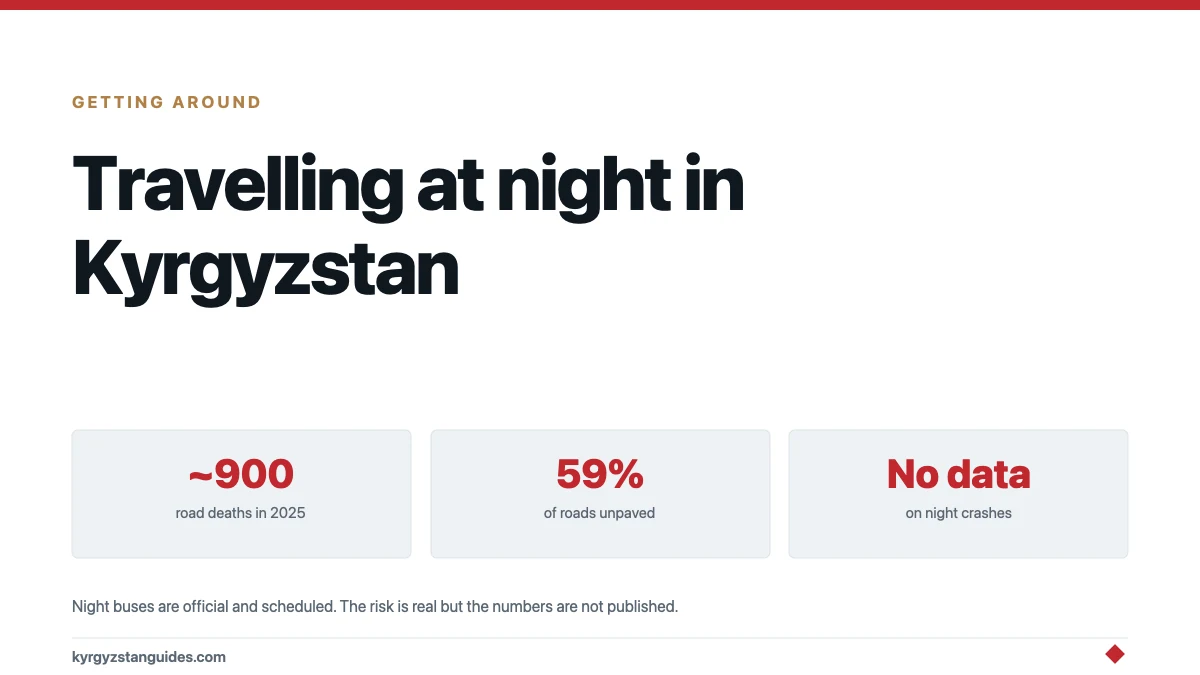
| Road deaths, 2025 | About 900 |
| Road deaths, 1 Jan – 9 June 2026 | 280 |
| Crashes, first half of 2025 | 3,729, up 21.9 per cent year on year |
| Deaths, first half of 2025 | 346, up 23.6 per cent |
| Deaths caused by drunk drivers, 2025 | About 130 |
| Pedestrian share of deaths | 40 per cent |
Bishkek accounts for roughly half of all crashes and Chuy oblast for another eighteen per cent. The UN's special envoy for road safety put the cost to Kyrgyzstan at around $372 million a year, close to four per cent of GDP, with about 22 per cent of victims under eighteen.
Now the part nobody else will tell you. There is no published Kyrgyz breakdown of crashes or deaths by time of day. The National Statistical Committee's open data gives crash counts by year with no time field. The traffic police's own statistics page returns a server error. We could not find a single official Kyrgyz figure for what share of crashes happen in darkness.
You will see a claim that over 40 per cent of crashes in Kyrgyzstan happen at night. It traces to Russian sources, not Kyrgyz ones. Do not rely on it, and be wary of any article that quotes it as local data.
The one documented night crash we can point to
On 16 September 2026 at 01:41, at kilometre 167 of the Bishkek–Osh road in Jayyl district, a Hyundai Sonata crossed into oncoming traffic, hit a truck and then a Kia. Six people were killed and three injured. A passenger said the driver may have fallen asleep at the wheel.
One crash is not a statistic. It is included because it illustrates the specific mechanism that makes long night drives in Kyrgyzstan risky, and it is not speeding or lighting. It is a single driver, awake for too long, on a road with no central barrier.
Night buses are official and scheduled
Despite all of the above, overnight intercity travel is normal here and it runs on government timetables, not informally.
The Ministry of Transport's schedule lists Bishkek to Karakol along the north shore at 21:00, 22:00 and 23:00 for 400 som, and along the south shore at 19:30, 20:50 and 22:30. Karakol to Bishkek departures run to 23:00. Bishkek to Tashkent is listed at 23:30 and Bishkek to Shymkent at 21:30.
Operator listings confirm the Karakol night services at 21:00, 22:00 and 23:00 for 500 som, and a GoBus coach leaving at 23:00 and reaching Bishkek between 05:00 and 06:00 for 750 som.
The honest assessment: a scheduled coach with a professional driver on a main road is a different proposition from a shared taxi whose driver has already done the route twice that day. The vehicle class matters more than the hour.
Livestock, which is the underrated hazard
Animals on the road at night are a documented, quantified problem in a way that night driving generally is not.
In Issyk-Kul oblast, in the first four weeks of September 2022 alone, there were 18 crashes involving livestock, with seven people killed, nine injured and substantial damage to 21 vehicles. Oblast police described grazing in the region as uncontrolled and a genuine threat to road users.
The traffic rules address it directly. Animals should be driven along or across roads in daylight as a rule. Grazing in the road reserve is prohibited except on local roads. It is explicitly forbidden to drive animals across roads or railways outside designated places, or in the dark, or in conditions of poor visibility.
The penalty is 1,000 som under Article 190 of the Code of Offences. If an expert examination finds the animal caused the crash, the owner pays for the vehicle damage and any medical treatment, and if someone dies the owner can face a charge of causing death by negligence.
The rule exists. Enforcement in practice is what the Issyk-Kul figures describe.
Lighting, and one revealing detail
No national dataset on street lighting outside cities appears to exist. The nearest official datapoint tells you enough on its own.
In June 2026, the state airport operator bought 756 lighting poles at its own expense to light the road between Bishkek and Manas airport, with Bishkek municipal services doing the installation, explicitly to improve night-time visibility. That is the country's busiest airport approach, and it was unlit until 2026.
Outside the Chuy valley, assume no lighting at all. About 59 per cent of the maintained road network is gravel or earth rather than asphalt.
What we would do
Take a scheduled night coach on a main route. They exist for a reason, they save you a hotel night, and the Karakol and Osh corridors are served by them.
Do not drive yourself at night on a mountain road you have not driven in daylight. The hazards are unlit, unsignposted and occasionally alive. Our guide to mountain driving rules covers what the traffic code actually requires of you.
Do not take a shared taxi overnight on a long route if you can avoid it. The economics push drivers to do more legs than is sensible, and the September 2026 crash is what that looks like.
And if you are arriving in Bishkek at 05:00 off a night bus, pre-arrange the onward ride rather than flagging something down at the station. That one is straight from the FCDO. See taxi apps in Kyrgyzstan.
FAQ
Does the UK Foreign Office say not to drive at night in Kyrgyzstan?
No. It warns that many roads are poorly lit and not maintained, that damage and roadworks are often unsignposted, and that pedestrians have low road-safety awareness. Separately, on personal safety, it suggests using private or pre-arranged cars at night rather than flagging taxis down. Pages attributing a blanket "avoid night driving" to the FCDO are misquoting it.
Are night buses safe in Kyrgyzstan?
They run on official Ministry of Transport timetables, with departures from Bishkek to Karakol at 21:00, 22:00 and 23:00 and international services leaving late in the evening. A scheduled coach with a professional driver is a much better proposition than an overnight shared taxi, where the driver may already have done the route that day.
How many people die on Kyrgyzstan's roads?
About 900 in 2025, and 280 in the first five months of 2026. Crashes and deaths both rose more than 20 per cent year on year in the first half of 2025. Pedestrians make up around 40 per cent of those killed.
What share of crashes in Kyrgyzstan happen at night?
Unknown. No Kyrgyz government body publishes a time-of-day breakdown; the statistics committee's data has no such field and the traffic police's statistics page is offline. A widely repeated figure of over 40 per cent traces to Russian sources rather than Kyrgyz ones.
Is livestock on the road a real danger at night?
Yes, and it is documented. Issyk-Kul oblast police recorded 18 livestock-related crashes in four weeks of September 2022, with seven killed and nine injured. The traffic rules forbid moving animals across roads in the dark, and owners face a 1,000 som fine plus liability for damage, but enforcement is limited.
Are Kyrgyzstan's intercity roads lit?
Mostly not. There is no national lighting dataset, but the road between Bishkek and Manas airport, the busiest airport approach in the country, only began to be lit in June 2026 when 756 poles were installed. Outside the Chuy valley, assume darkness.