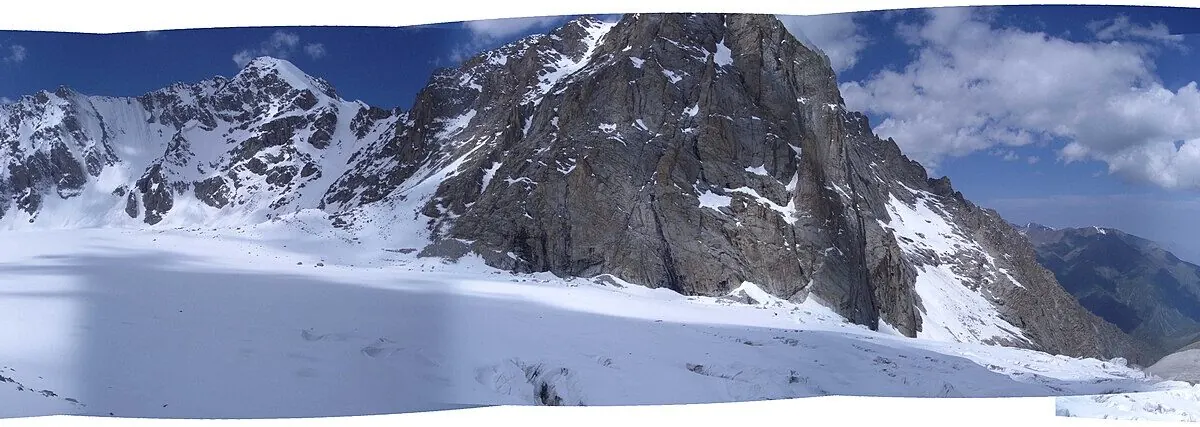
The last hour up to Ratsek is a slog of switchbacks over grey moraine, and then the ground levels, a squat metal-roofed hut appears, and the whole head of the valley opens up in front of you: the Ak-Sai glacier tumbling down between rock walls, snow peaks catching the last light. That’s the payoff. Ratsek hut sits at about 3,350 m in the Ak-Sai gorge of Ala-Archa National Park, reached on a steep 7-8 km hike from the Alplager trailhead with roughly 1,300 m of climbing: figure 4-6 hours up, and most people sleep there overnight before returning or pushing higher.
This is the classic overnight from Bishkek: close enough to reach the trailhead in under an hour, high and wild enough to feel like a proper mountain expedition. It’s also the standard staging camp for climbers heading for the peaks above, which colors the whole experience, you’ll share the hut with rope teams and their gear. Below is how the climb actually goes, what the hut is like, and what you need to carry, graded honestly for a fit hiker rather than an alpinist.
Where Ratsek Fits in Ala-Archa
Ala-Archa is the mountain playground on Bishkek’s doorstep, a glacier-cut national park in the Kyrgyz Ala-Too where the capital’s weekenders go to walk. Most day-trippers stop at the waterfall or wander the lower valley. Ratsek is the next level up: the hut, named for a Soviet-era mountaineer, was built as a base for climbers tackling the peaks ringing the Ak-Sai glacier — Uchitel, Korona, Free Korea and the rest. For a trekker, it’s the highest fixed shelter you can walk to in the park, and the walk itself is the draw. For the wider context of the park’s trails, fees and gate logistics, see our Ala Archa National Park guide; this piece zooms in on the Ratsek route specifically.
Getting to the Trailhead
The trek starts at Alplager, the old alpine camp at the end of the park road, roughly 40 km and under an hour’s drive south of Bishkek. There’s no public transport into the park itself. You have three realistic options: hire a taxi or private car for the day from Bishkek, join an organized group, or take a marshrutka to Kashka-Suu village and arrange a lift or long walk up the final road stretch — the least convenient. Most independent hikers simply charter a car; agree on a pick-up time for the following day, because phone signal dies in the gorge and you can’t just call a ride from 3,350 m. There’s a park entrance fee collected at the gate, payable in cash — carry small som notes.
The Climb: How It Actually Goes
From Alplager the trail crosses toward the Ak-Sai valley and starts climbing almost immediately. The first landmark is the Ak-Sai waterfall, a common turnaround for day walkers and a sensible breather spot for you. Above it the path steepens into a long series of switchbacks up the moraine — this is the grinding middle third, exposed to sun, with loose rock underfoot. Higher still you pick your way across boulder fields and old glacial debris before the hut finally reveals itself on its little shelf.
Be honest with yourself about the numbers. You’re gaining around 1,300 vertical meters over roughly 7-8 km, finishing above 3,300 m. That combination, sustained steepness plus real altitude, is what makes Ratsek harder than its modest distance suggests. Reasonably fit hikers take 4-6 hours up; the descent is faster on the legs but punishing on the knees over all that loose rock. Trekking poles genuinely help here. There’s a clear path, so navigation isn’t the problem — stamina and thin air are.
The Hut and Sleeping Options
Ratsek is a basic mountain hut, not a guesthouse. Expect a simple heated common space and bunk or shared sleeping room, run seasonally, with a warden in summer collecting a per-night fee. It’s functional (a roof, warmth, a place to boil water) rather than comfortable, and in peak season it fills with climbing teams, so a bed isn't guaranteed on a busy weekend. Many people carry a tent and pitch it on the flats nearby, which also frees you from depending on space inside. There’s no shop and no reliable catering, so plan to be self-sufficient with food and a stove. Toilet facilities are rudimentary. Treat it as an alpine base camp, because that’s exactly what it is.
Glacier Views and Going Higher
The reason to sleep up here isn’t just to break the climb. It’s the amphitheater of ice and rock you wake up to. The Ak-Sai glacier fills the valley head, and the peaks above catch alpenglow at dawn before the day’s cloud builds. From the hut, acclimatized and confident walkers can push higher toward the Uchitel peak saddle or the glacier’s lower reaches for even bigger views, though anything on the ice or the technical summits is mountaineering territory needing rope, crampons and skills, not a hiker’s afternoon stroll. Know where your limit is. Wandering onto a glacier unroped because it looks walkable is how people get hurt in this valley.
Altitude and Acclimatization
At 3,350 m, Ratsek is high enough that altitude matters, especially if you’ve flown into Bishkek (760 m) only a day or two earlier and haven’t been up high yet. Gaining well over a kilometer of elevation in a single push to sleep above 3,300 m is a lot for an unacclimatized body, and mild altitude symptoms (headache, poor sleep, breathlessness, loss of appetite) are common at the hut.
A few sensible habits reduce the risk. Do an easier lower-altitude day or two around Bishkek first if you can. Climb at a steady, unhurried pace and drink plenty of water on the way up. If a headache turns into worsening nausea, dizziness or breathlessness at rest, the correct response is to descend. Losing altitude fixes altitude sickness, and Ratsek’s saving grace is that going down is always an option. Don’t push higher the next morning if you slept badly and feel rough; the glacier will still be there another year.
Best Time to Go
The comfortable trekking window is roughly late June through September, with July and August the most reliable and also the busiest, overlapping the climbing season. Earlier in June, snow and ice linger on the upper moraine and the trail can be treacherous; by October cold and fresh snow shut the easy walking down. Even at the height of summer, nights at the hut drop below freezing and the weather can flip from sun to sleet within an hour, so this is never a warm-weather amble. Winter ascents happen, but that’s the domain of experienced alpinists on skis or crampons, not the trek described here.
Costs at a Glance
| Item | Rough cost (2026) |
|---|---|
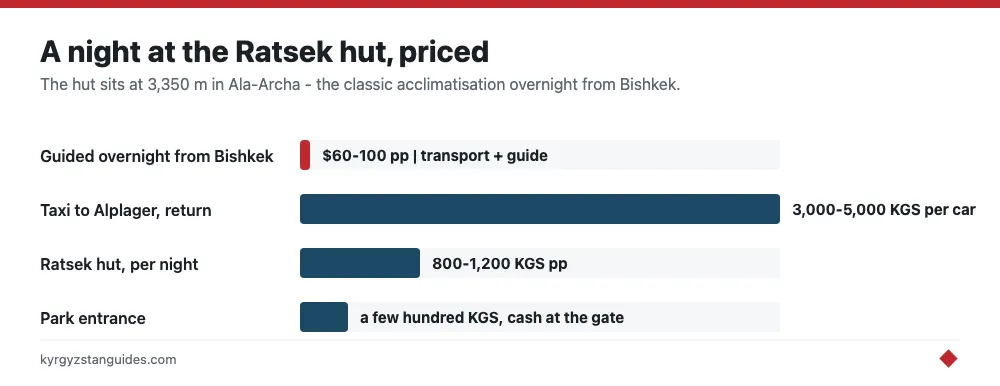
| Park entrance fee (per person) | a few hundred KGS, cash at the gate |
| Ratsek hut, per night | ~800–1,200 KGS pp |
| Tent pitch near the hut | usually a small fee or free |
| Taxi / private car Bishkek–Alplager, round trip | ~3,000–5,000 KGS per car |
| Guided overnight from Bishkek (transport + guide) | from ~$60–100 pp |
Prices shift year to year and none of this is bookable online in a slick way — carry cash, hedge your budget upward, and treat these as ballpark figures rather than quotes.
Gear Checklist
- Sturdy, broken-in hiking boots — the moraine punishes soft soles on the way down
- Warm layers plus a proper insulated jacket; nights at the hut go below freezing even in July
- Windproof and waterproof shell. Weather up here turns fast and hard
- Warm sleeping bag rated for below-freezing, whether you use the hut or a tent
- Tent and mat if you’d rather not rely on hut space in peak season
- Stove, fuel and food, there’s no catering or shop at Ratsek
- At least 2–3 liters of water capacity, or a way to melt/treat glacier water
- Sun hat, strong sunscreen and sunglasses — high-altitude glare off snow is brutal
- Headlamp, basic first-aid kit and any personal altitude/pain medication
- Trekking poles. Close to essential for the steep, loose descent
- Cash in small som notes for fees; there’s nowhere to pay by card
For a full head-to-toe kit list that works across day hikes and multi-day treks, our Kyrgyzstan packing list covers the gaps.
Should You Do It Solo or Guided?
The trail to Ratsek is well-trodden and doesn’t require technical skill, so fit, experienced hikers with the right gear and some altitude sense do it independently all the time: sort out a car to Alplager, pay the park fee, and go. A guide isn’t mandatory. Where a guide or organized trip is worth the money is in removing friction: transport both ways, a warm meal, someone who knows the weather and the hut situation, and a safety margin if altitude hits you harder than expected. If you’re new to high-altitude walking or traveling alone and want backup, book it; the added cost is modest against the reassurance. Ratsek slots neatly into a Bishkek base alongside the city’s other quick mountain escapes: see our roundup of things to do in Bishkek to build the rest of your days, and read our broader Kyrgyzstan trekking guide for how this overnight compares to the country’s longer classics.
Frequently Asked Questions
How high is Ratsek hut and how hard is the trek?
Ratsek sits at about 3,350 m. The hike from Alplager is roughly 7-8 km one way with around 1,300 m of ascent, taking most fit hikers 4-6 hours up. It’s steep and high rather than technical, so stamina and altitude are the challenge, not route-finding.
Can you sleep at the Ratsek hut?
Yes. It’s a basic seasonal mountain hut with bunk space and a heated common room, run by a warden in summer who collects a per-night fee. It fills with climbing teams in peak season, so many trekkers also carry a tent to camp on the flats nearby and avoid depending on hut space.
Do I need a guide for the Ratsek trek?
No, the trail is clear and non-technical, so fit, well-equipped hikers regularly do it independently. A guide or organized trip mainly adds convenience: transport, meals and a safety margin at altitude, which is worth it if you’re new to high-altitude walking or traveling alone.
When is the best time to hike to Ratsek?
Late June through September, with July and August the most reliable for clear trails and warmer days. Earlier, snow and ice linger on the upper moraine; by October cold and fresh snow shut down the easy walking. Even in midsummer, nights at the hut drop below freezing.
How hard is the hike to Ratsek hut?
Harder than the numbers suggest: about 1,300 m of climbing over 7–8 km, finishing above 3,300 m, with a grinding middle third of sun-exposed switchbacks on loose moraine. Reasonably fit hikers take 4–6 hours up. Navigation is easy on the clear path — stamina and thin air are the real tests, and trekking poles genuinely help on the descent.
Can you sleep at Ratsek hut without booking?
In theory yes — a summer warden collects a per-night fee — but a bed is not guaranteed on a busy weekend, because climbing teams staging for Uchitel, Korona, and Free Korea fill the bunks first. Many hikers carry a tent and pitch on the flats beside the hut, which also removes the gamble entirely.