Most travelers who land with three weeks in Kyrgyzstan make the same mistake: they treat it as a longer version of the ten-day trip and try to reach every valley by road. Then they lose two full days to the Bishkek–Osh highway, one in each direction, and arrive in the south too tired to enjoy it.
Here is the fix. Three weeks is enough to do the northern loop properly, add the central highlands, and still see the deep south — but only if you drive the north and fly to the south. The single decision that makes or breaks this trip is refusing to backtrack across the country by marshrutka. Loop the north and centre overland, return to Bishkek, then take the one-hour flight to Osh and explore the Fergana fringe from there.
Below is a 21-day framework built around that logic, with the transport, a realistic budget, and three ways to bend it depending on your season and appetite for rough roads.
How to think about three weeks
Break the trip into three blocks of roughly a week each, so you always know which ‘phase’ you're in and can trade days between them without unravelling the whole plan:
- Block 1 — North & Issyk-Kul (Days 1–7): Bishkek, the Ala-Archa mountains, the lake’s north shore, and Karakol in the east.
- Block 2 — Trekking & the central highlands (Days 8–14): the Karakol gorges, a multi-day trek if you want one, and the summer pastures of Song-Kul.
- Block 3 — The remote centre and the south (Days 15–21): Tash-Rabat and Kel-Suu overland from Naryn, then a flight to Osh for Arslanbob and Sary-Chelek.
The order matters. You acclimatise gently in Block 1, earn the high trails in Block 2, and save the long transfers for when your body and your logistics are dialled in. A two-week plan simply drops Block 3’s remote leg; three weeks is what buys you the south.
What to lock in before you fly
Kyrgyzstan is a country you can largely improvise, with three exceptions that will derail this route if you leave them to chance:
- The e-Visa: most nationalities, including Indian passport holders, apply online in advance through the official portal — do it a couple of weeks out, not at the airport.
- The Kel-Suu border-zone permit: the lake sits in a restricted frontier zone near China and needs a permit arranged several days ahead through a local agency or your Naryn guesthouse. Walk-ups are turned back.
- The Bishkek–Osh flight: the cheap seats on the one-hour hop sell out in peak summer. Book it the moment your dates are firm, well before you need it on Day 18.
Everything else — marshrutkas, yurt beds, shared taxis — you can sort a day or two ahead once you're on the ground.
Week 1: Bishkek, the mountains, and the lake to Karakol
Days 1–3: Bishkek and Ala-Archa
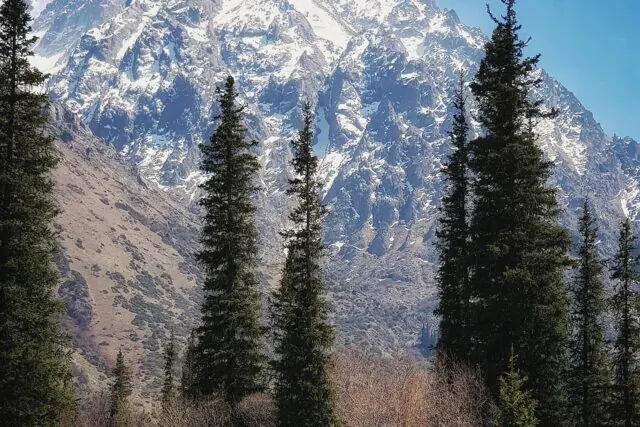
Day 1 is arrival and admin. Most flights land at odd hours; sleep, then change money, buy a local SIM, and withdraw the cash you'll need for guesthouses that don't take cards. Day 2 is the city on foot — Ala-Too Square, the sprawling Osh Bazaar, and a first plate of plov or lagman. Use the afternoon to book onward yurt stays or a Community Based Tourism (CBT) driver if you want one. Day 3 escapes to Ala-Archa National Park, 40 minutes from the capital, for a half- or full-day hike toward the Ak-Sai waterfall and glacier viewpoint. It's the easiest altitude primer in the country.
Days 4–7: Issyk-Kul north shore and Karakol
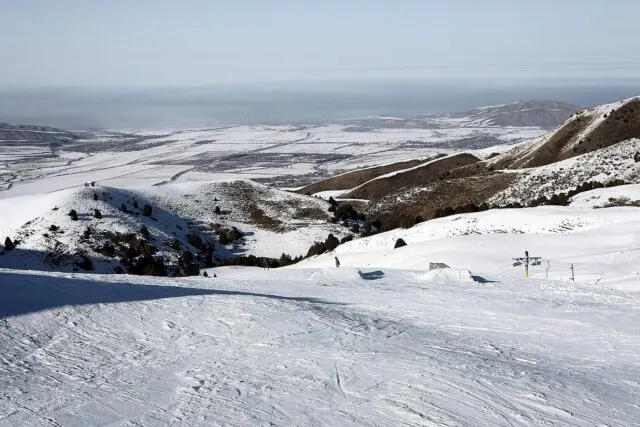
Day 4, head east along Issyk-Kul’s north shore to Cholpon-Ata for the open-air petroglyph field and a swim in the world’s second-largest alpine lake. Day 5, continue to Karakol at the eastern tip. Days 6–7 are for the town itself — the wooden Dungan mosque, the Russian Orthodox cathedral, and, if a Sunday falls here, the raucous livestock market at dawn — plus a day trip into the red sandstone folds of Jeti-Oguz. Karakol is the trekking capital of the east and your base for the next block; read our Karakol guide before you arrive.
Week 2: Trekking and the road to Song-Kul
Days 8–12: The Karakol gorges (and an optional Ala-Kul trek)
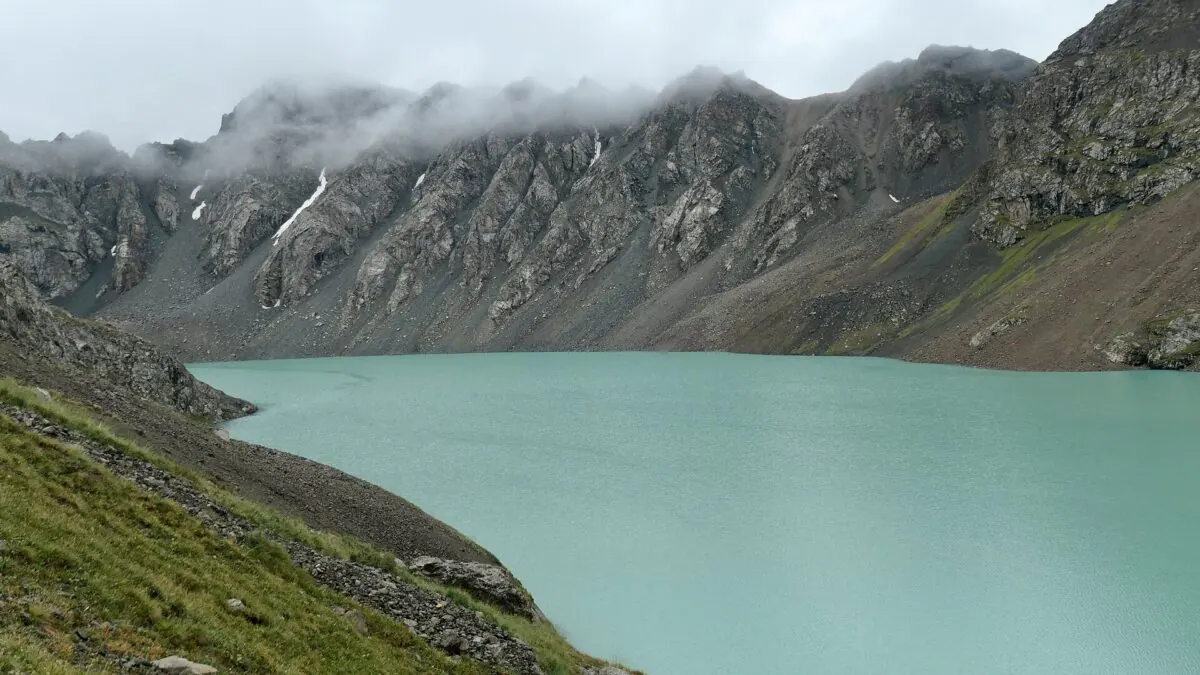
This is where three weeks pays off — you have the days to actually walk. The classic is the two-to-three-day loop from Karakol up to the milky turquoise of Ala-Kul lake, over the 3,860 m pass, and down to the hot springs at Altyn-Arashan. If a hard high pass isn't for you, do it as two separate out-and-back trips instead: a day or overnight at Altyn-Arashan, and a shorter walk toward Ala-Kul’s lower valley.
Budget a rest day in Karakol afterwards — hot showers, laundry, and a proper meal do more for morale than another summit. Guides and horse support are easy to arrange in town if you would rather not carry a full pack.
On altitude: the Ala-Kul pass and Song-Kul both sit around 3,000–3,900 m, and this itinerary is built so you rise to them gradually rather than in one jump. If you skip the earlier walks and helicopter straight to the high sections, expect at least a day of headaches. Drink far more water than feels necessary, and do not plan a hard trek for the day after a big altitude gain.
Days 13–14: Over to Song-Kul
Leave the east and cross the interior to Song-Kul, the high pasture lake ringed by summer yurt camps at 3,000 m. The approach from Kochkor over the Kalmak-Ashuu pass is one of the great drives in the country. Sleep in a family yurt, ride out with the herders in the morning, and do nothing photogenic in particular — the point is the rhythm of jailoo (summer pasture) life. Our Song-Kul guide covers which shore to choose and when the camps open.
Season warning: Song-Kul’s yurt camps and its access passes are only reliably open from mid-June to mid-September. Outside that window, this leg falls apart and you should reroute through lower valleys.
Week 3: The remote centre, then fly south
Days 15–17: Tash-Rabat and Kel-Suu from Naryn
Drop from Song-Kul toward Naryn and At-Bashy, the launch point for the country’s most atmospheric remote corner. Day 15, reach the 15th-century stone caravanserai of Tash-Rabat and sleep in a nearby yurt. Day 16 is the big one: a rough 4×4 run to Kel-Suu, a fjord-like lake hemmed by sheer walls near the Chinese border, reachable only in summer and only with the right border-zone permit arranged in advance. Day 17, return to Naryn and push back to Bishkek for the night. This leg is the reason you kept your overland momentum — it hangs naturally off the central route rather than the southern one.
Days 18–21: Fly to Osh, Arslanbob, and Sary-Chelek
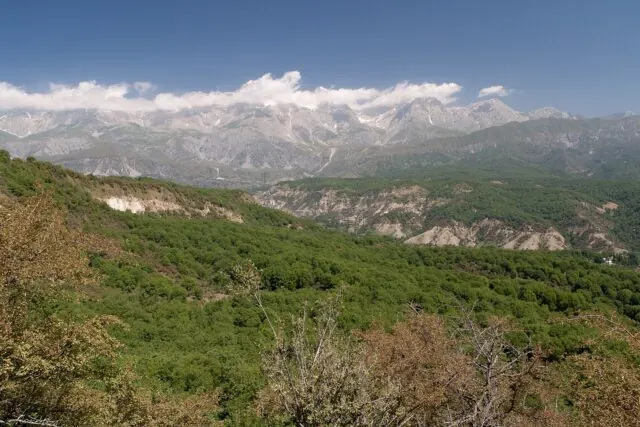
Day 18, take the one-hour flight from Bishkek to Osh instead of the ten-to-twelve-hour road over the Too-Ashuu and Ala-Bel passes. Osh is Central Asia’s oldest continuously inhabited city; climb sacred Sulaiman-Too and lose an hour in the vast bazaar. Day 19, move to Arslanbob, the Uzbek village wrapped in the world’s largest walnut forest, for waterfall walks and a completely different cultural register. Days 20–21, continue to Sary-Chelek, a UNESCO biosphere lake in juniper-clad hills, before flying home from Osh. Deep dives on the south’s gateway city will help you shape these last days.
Fly or drive to the south? The maths
This is the decision the intro promised to defend, so here is the reasoning in full. The Bishkek–Osh road is genuinely scenic, but it's a ten-to-twelve-hour grind over two 3,000 m-plus passes that are prone to closure and truck traffic. Do it once as a shared taxi and you have burned a day; do it in both directions and you have lost two of your twenty-one to a car window.
The flight costs roughly $40–60 and takes an hour. Against the price of a shared taxi seat plus a night’s accommodation you would otherwise need on the road, the real premium is small — and you arrive in Osh rested with an extra day for Arslanbob. The only case for driving is if the mountain road itself is on your big-trip list, or if you are travelling in deep shoulder season when the high central passes to Song-Kul and Kel-Suu are shut anyway and the southern road becomes your main event. For everyone doing the full loop, fly south and drive nothing you do not have to.
How you will actually move
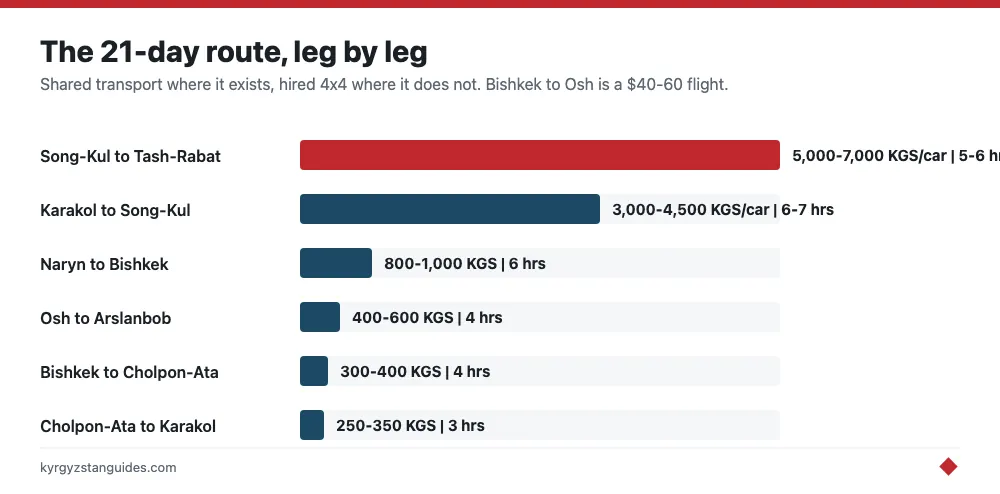
Public transport (shared marshrutka minivans and shared taxis) covers the main routes cheaply; the passes to Song-Kul, Kel-Suu, and some trailheads need a hired 4×4. Rough figures for 2026, with the US dollar around 87–89 KGS:
| Leg | Mode | Time | Approx. cost |
|---|---|---|---|
| Bishkek → Cholpon-Ata | Marshrutka | 4 hrs | 300–400 KGS |
| Cholpon-Ata → Karakol | Marshrutka | 3 hrs | 250–350 KGS |
| Karakol → Song-Kul | Shared taxi + 4×4 | 6–7 hrs | 3,000–4,500 KGS/car |
| Song-Kul → Tash-Rabat | Hired 4×4 | 5–6 hrs | 5,000–7,000 KGS/car |
| Naryn → Bishkek | Shared taxi | 6 hrs | 800–1,000 KGS |
| Bishkek → Osh | Flight | 1 hr | $40–60 |
| Osh → Arslanbob | Marshrutka + taxi | 4 hrs | 400–600 KGS |
Split 4×4 costs across a group of three or four and the per-person price drops sharply. If you would rather not juggle every connection yourself, our transport guide explains where a pre-booked driver is worth it and where it is a waste of money.
What three weeks costs
Kyrgyzstan is inexpensive by any standard, but the 4×4 hires and the internal flight are the line items that move your total. Per person, per day, excluding international flights:
| Style | Per day | 3 weeks | What you get |
|---|---|---|---|
| Shoestring | $25–35 | $525–735 | Dorms and yurts, marshrutkas, shared 4x4s, self-catering |
| Comfortable | $45–65 | $945–1,365 | Guesthouse privates, some hired cars, guided treks, the Osh flight |
| Soft-adventure | $80–120 | $1,680–2,520 | Private driver throughout, better rooms, full trek support |
A comfortable three weeks lands most people near $1,000–1,400 on the ground, excluding the flights to reach the country. The 4×4 hires to Song-Kul, Kel-Suu, and the trailheads are where a solo traveler pays a real penalty, so this is a trip that gets markedly cheaper the moment you find one or two people to share cars with — which the Bishkek and Karakol guesthouse noticeboards make easy.
Is this too much moving around?
Fair question, and the answer is: it can be, if you treat every day as a transfer. This framework deliberately front-loads slower time — the Karakol rest day, two nights at Song-Kul, unhurried mornings in a yurt — precisely so the long Naryn and southern legs don't leave you frazzled. If you are someone who needs to unpack and stay put, cut the Kel-Suu day and give those hours back to Issyk-Kul or Arslanbob. The route is a menu, not a march. What it isn't is a trip you can do by hopping only the famous highlights and expecting the connections to be short; Kyrgyzstan’s distances are real, and three weeks is the length that makes them comfortable rather than punishing.
Three ways to bend this itinerary
- No high passes: skip the Ala-Kul crossing and Kel-Suu’s rough 4×4 day. Replace them with lower valley walks around Jyrgalan and more time on Issyk-Kul’s beaches. You lose the drama, you keep the country.
- Shoulder season (May or late September): Song-Kul and Kel-Suu may be closed by snow. Weight the trip toward the lower south — fly to Osh earlier and give Arslanbob and Sary-Chelek four or five days instead of three.
- Trekking-first: compress the north to five days, spend a full week on back-to-back treks out of Karakol and Jyrgalan, and treat the south as a two-day Osh add-on rather than a full block.
Whatever you cut, protect the fly-south decision. It is the difference between a relaxed grand tour and three weeks of highway.
Frequently Asked Questions
Is three weeks too long for Kyrgyzstan?
No. Three weeks lets you combine the northern lake loop, a proper multi-day trek, the central highlands, and the deep south without rushing. Anyone wanting treks plus the Fergana region needs this much time; two weeks forces you to cut the south.
Should I drive or fly to Osh and the south?
Fly. The Bishkek–Osh flight takes about an hour and costs $40–60, versus a tiring ten-to-twelve-hour road over two mountain passes. Driving both ways wastes two full days you could spend in Arslanbob or Sary-Chelek.
When is the best time for this three-week route?
Mid-July to early September. That window keeps Song-Kul’s yurt camps, the high trekking passes, and the Kel-Suu 4×4 track all open at once. Come in June or late September and expect to reroute around snow on the high sections.
Do I need a guide for the whole trip?
No. The main routes run on cheap shared transport you can arrange yourself. Hire guides only for the multi-day treks and the Kel-Suu border-zone leg, where local knowledge and permits matter.
How much should I budget for three weeks?
On the ground, roughly $525–735 shoestring, $945–1,365 comfortable, and up to $2,520 with a private driver throughout, per person, excluding international flights. The 4×4 hires and the Osh flight are the biggest swing factors.
What must be booked in advance for a three-week Kyrgyzstan trip?
Three things: the e-Visa through the official portal a couple of weeks out, the Kel-Suu border-zone permit arranged several days ahead through a local agency or your Naryn guesthouse (walk-ups are turned back), and the Bishkek–Osh flight, whose cheap seats sell out in peak summer. Everything else — marshrutkas, yurt beds, shared taxis — can be sorted a day or two ahead on the ground.