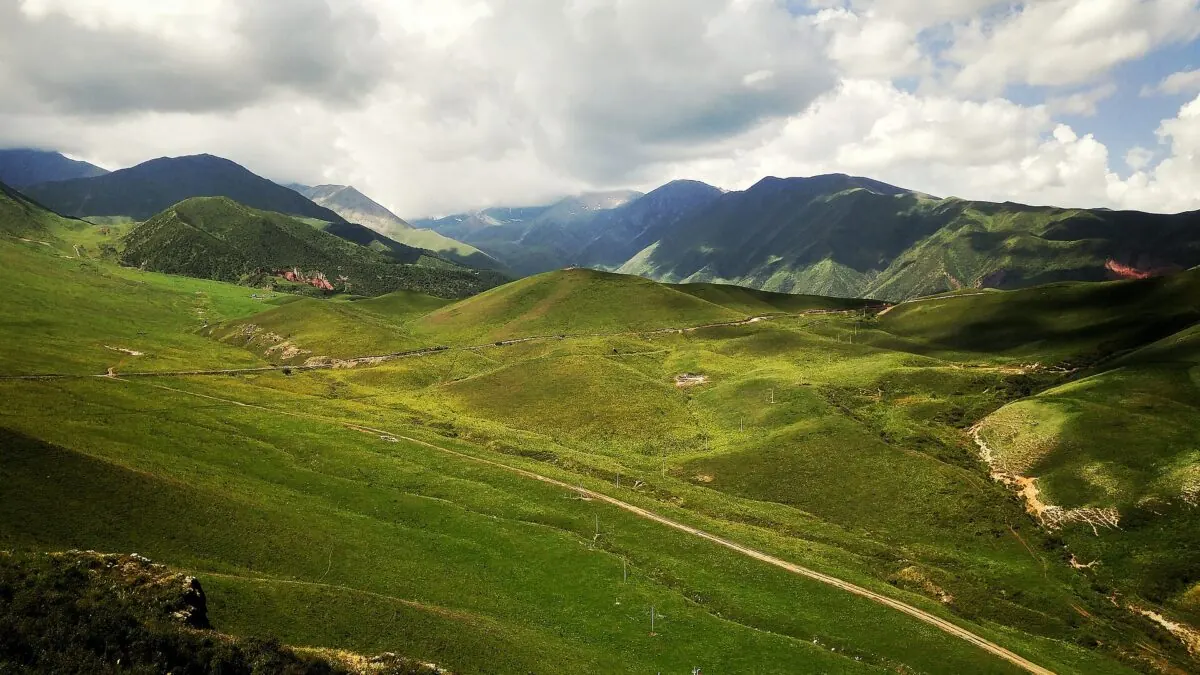
Leave central Bishkek at eight in the morning and by nine you can be standing in a green side-gorge with cows on the slope, a river below, and the noise of the city already gone. That is the appeal of Chunkurchak: it's the closest real mountain valley to the capital, and getting there takes about 40 minutes by car.
The valley runs south of the village of Kashka-Suu into the Kyrgyz Ala-Too, roughly 40 km from Bishkek. In winter it is a small ski and tubing park; in summer it's a walking base with yurt camps, easy meadow walks and horse rides. You can do Chunkurchak as a half-day escape or stretch it into a full day or an overnight. This guide covers both, plus how to get there without a car, what it costs, and where it fits against the better-known Ala-Archa nearby.
Where it is and how to get there
Chunkurchak lies southeast of Bishkek, reached via the Alamedin and Kashka-Suu road. By private car or taxi it's a straightforward 40–50 minute drive; a one-way taxi from the city runs roughly 800–1,200 KGS, and drivers will usually agree a round trip with a few hours’ wait for 2,500–3,500 KGS. There is no frequent public marshrutka running the full way into the gorge, which is the valley’s one real inconvenience, services go as far as Kashka-Suu village, and from there you either walk, arrange a pickup, or hitch. For a day trip most travelers just hire a taxi or join a guesthouse-arranged transfer.
Because the logistics reward planning, it helps to understand the country’s shared-transport system before you go; our getting around Kyrgyzstan guide explains marshrutkas, shared taxis, and how to negotiate a wait-and-return fare.
Chunkurchak in winter
From roughly December to March, the ski park operates on the lower slopes, a handful of runs served by lifts, a rope tow, and a tubing hill that's genuinely the main draw for families from Bishkek. It is not a serious ski destination: the vertical is modest, the runs are short, and experienced skiers will find more terrain at the larger resorts further from the city. What it is, is convenient. Equipment rental is available on-site, lift passes are cheap by international standards, and on a clear weekend the place fills with locals sledding, learning to ski, and eating shashlik between runs.
Weekday visits are quieter and cheaper. If you're in Bishkek in the cold months and want a taste of the mountains without committing to a full ski trip, a morning here is easy to arrange. For the broader picture of the season (what is open, what conditions to expect, and how the country changes when the snow comes) see our guide to Kyrgyzstan in winter.
Chunkurchak in summer
Summer is when the valley earns a place on a travel itinerary rather than a local’s weekend plan. From roughly June to September the slopes turn green, yurt camps set up, and the gorge becomes a hiking base. The easy version is a meadow-and-river walk: follow the valley floor, picnic by the water, ride a horse across the pasture (owners charge a few hundred KGS an hour), and be back down in a couple of hours. It is gentle, scenic, and suits families or anyone easing into altitude before a bigger trek elsewhere.
One correction: Kol-Tor, the turquoise glacial lake at around 2,700 meters that is often listed as a Chunkurchak hike, is not in this valley. It sits in a side branch of the Kegeti gorge, a separate valley further east, and it is a demanding day hike that needs its own transport and a full day. If you want a harder mountain objective after a gentle day here, the Kol-Tor lake hike or the country’s higher alpine lakes, like the famous crossing to Ala-Kul near Karakol, are the natural next step.
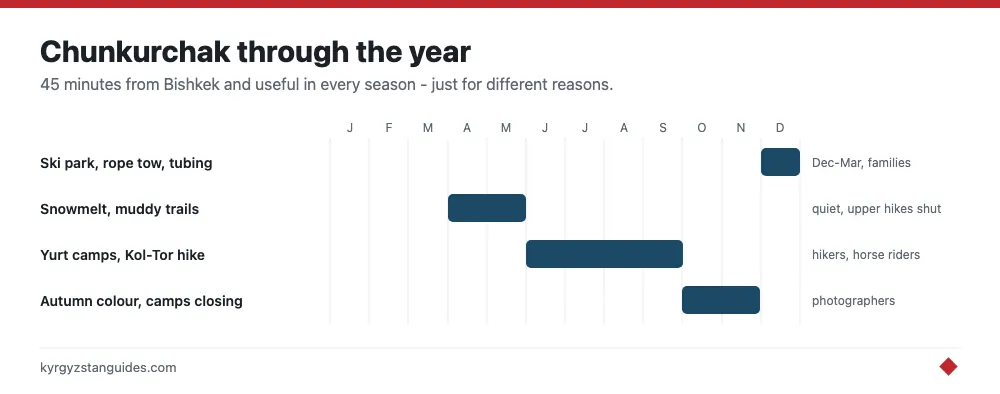
Season at a glance
| Season | What’s on | Good for |
|---|---|---|
| Dec–Mar | Ski park, rope tow, tubing hill | Families, beginner skiers, a quick snow fix from Bishkek |
| Apr–May | Snowmelt, muddy trails, few facilities | Quiet visits; upper hikes not yet reliably open |
| Jun–Sep | Yurt camps, meadow walks, horse rides | Hikers, horse riders, day-trippers, acclimatization |
| Oct–Nov | Autumn color, cold nights, camps closing | Photographers, shoulder-season quiet |
Staying overnight
You don't have to treat Chunkurchak as a day trip. In summer, yurt camps and a few guesthouses in and around the valley let you stay the night — typically $15–25 per person including meals for the yurt option, which is excellent value and lets you start walking early, before the afternoon cloud builds. Sleeping in a yurt on a jailoo close to the capital is also one of the gentlest introductions to the experience; if you have never done it, our yurt stay guide covers what to expect, what's provided, and the etiquette. In winter there are lodges near the ski park at higher rates.
For most travelers, though, the calculus is simple: Bishkek is 40 minutes away with far more choice of beds, food, and price points, so unless you specifically want an early start in the valley or the yurt experience itself, base in the city and come out for the day.
Chunkurchak vs. Ala-Archa
The obvious comparison is Ala-Archa, the national park that is Bishkek’s other close-mountain escape. Ala-Archa is more dramatic, better organized, and better known. A proper national park with a visitor gate, marked trails, and higher, more serious trekking. Chunkurchak is smaller, softer, less trafficked, and has the winter ski park that Ala-Archa lacks. If you can only do one and you want the headline mountain day near the capital, Ala-Archa usually wins; our Ala-Archa national park guide lays out its trails. Choose Chunkurchak when you want snow sports in winter, a quieter meadow day in summer, or a yurt night close to the city.
What to bring, and a realistic day plan
The gear you need depends entirely on which Chunkurchak you're doing. For a winter visit to the ski park, the practical stuff is on-site: rentals cover skis, boards, and tubes, so you mainly need warm, waterproof layers, gloves, sunglasses or goggles against the glare off the snow, and sunscreen: the high-altitude sun is stronger than the cold makes it feel. Cash matters, since lift passes, rentals, and the shashlik stands don't all take cards.
For a summer meadow day, keep it simple: comfortable shoes, a hat, water, a picnic if you want one, and enough cash for a horse ride or a bowl of something at a yurt. If you plan to climb onto the slopes above the valley floor, the list is longer and non-negotiable — sturdy hiking boots with real grip, warm and waterproof layers for higher ground that can be cold and windy while the valley bakes, at least two liters of water each, sun protection, snacks, and a charged phone with an offline map, because the trail isn't always obvious and the weather can close in. An early start is the single most useful decision you can make: leave the valley floor by mid-morning at the latest so you are off the high ground before the afternoon cloud and any storms build.
A realistic full-day plan looks like this. Arrange transport out of Bishkek for around 7:30 to 8am, aiming to be in the valley by 9. If you are doing the easy version, spend the morning walking the meadows and the riverbank, take a horse across the pasture, have lunch at a yurt or from your pack, and be back in the city by mid-afternoon. A genuine half-day. If you want a longer walk, start as early as you can, keep an eye on the sky, and plan your return transport for late afternoon rather than a fixed early slot, because rushing a descent on loose ground is how people get hurt. Kol-Tor is not a Chunkurchak option; it is a separate full day via the Kegeti gorge. Either way, tell your driver or guesthouse your rough timings so someone knows the plan.
One more piece of honest advice: don't treat Chunkurchak as a warm-up you can wing just because it's close to the city. The valley floor is gentle, but the slopes above it are real mountain ground, and the proximity to Bishkek lulls people into under-preparing. If you leave the valley floor, bring what you would bring for any mountain day hike, and the valley becomes exactly the easy, rewarding mountain escape it's meant to be.
Frequently Asked Questions
How far is Chunkurchak from Bishkek?
The valley is roughly 40 km south of Bishkek, via Kashka-Suu village. By car or taxi it is about a 40–50 minute drive, which makes it the closest mountain valley to the capital and an easy half-day or full-day trip.
Can you visit Chunkurchak without a car?
It is harder than to some destinations because there's no frequent marshrutka running deep into the gorge. Public transport reaches Kashka-Suu village, and from there you walk, hitch, or arrange a pickup. Most day-trippers simply hire a taxi round trip or take a transfer arranged through a guesthouse or camp.
Is Kol-Tor lake in the Chunkurchak valley?
No, although it is often listed as a Chunkurchak hike. Kol-Tor sits in a side branch of the Kegeti gorge, a separate valley further east, and it is a demanding day hike to around 2,700 meters that needs its own transport and a full day. Chunkurchak itself is the gentler meadow-and-river outing.
When does the Chunkurchak ski park open?
Roughly December to March, snow depending. It's a small park geared to families, beginners, and tubing rather than expert skiers, but it's by far the most convenient snow near Bishkek and busy on clear weekends.
Should I choose Chunkurchak or Ala-Archa?
For a single, dramatic mountain day from Bishkek, Ala-Archa usually wins on scenery and organization. Choose Chunkurchak for winter skiing and tubing, a quieter summer meadow day, or a yurt night close to the city.
How much does a taxi to Chunkurchak cost from Bishkek?
Roughly 800–1,200 KGS one-way for the 40–50 minute drive, and drivers will usually agree a round trip with a few hours' wait for 2,500–3,500 KGS. There is no frequent marshrutka into the gorge itself — services stop at Kashka-Suu village — so most travelers hire a taxi or take a guesthouse-arranged transfer.