If we had to pick one month, it would be this one. September is the best shoulder month in Kyrgyzstan: the weather turns stable and dry, autumn colour spreads through the valleys, the summer crowds thin out, and most treks are still open before the passes start closing. You get nearly everything July offers, minus the heat and the busy guesthouses, with the bonus of golden larch and walnut forests. The only real cost is the nights, which turn cold at altitude and put a soft deadline on the highest routes.
This is the traveler’s month rather than the postcard month — the case for September is about conditions and timing, not a single headline sight. It edges out June and July for most itineraries, and our best time to visit Kyrgyzstan guide backs that up across the calendar. Here is why it works, and where the deadline falls.
Stable, dry weather
September brings some of the most settled weather of the year. The summer thunderstorm pattern eases, skies are clearer, and the air is crisp rather than hazy. Bishkek and the lowlands drop out of the July furnace into a comfortable low-to-mid 20s by day. The Issyk-Kul basin is warm and pleasant, and early September still offers swimming in a lake that holds its summer heat well into autumn. At trekking altitude, days are cool and bright — ideal walking weather — but the nights are the story: temperatures fall sharply after dark and dip below freezing high up as the month goes on. A proper sleeping bag and warm layers are non-negotiable for any camping trek. The payoff is real, though: the clear, dry air of September gives the sharpest mountain views of the year, and rain days that plague June and early July become rare. For anyone whose enjoyment hinges on not being rained on, that stability is worth a lot.
Autumn colour
This is September’s exclusive draw. From mid-month the valleys turn gold and amber — larch forests, poplars along the rivers, and the vast walnut woods of Arslanbob in the south, which are at their most photogenic as the leaves turn and the harvest begins. It is a genuinely different Kyrgyzstan from the uniform summer green, and it is only on offer for a few weeks. If autumn foliage is your thing, the walnut forests around Arslanbob and the tree-lined valleys near Karakol are the places to aim for.
Fewer people, easier logistics
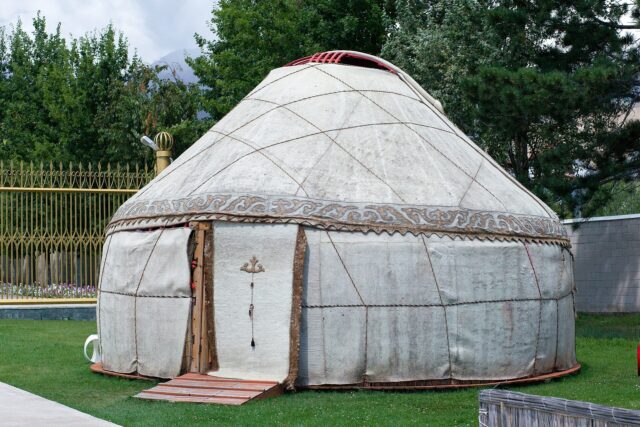
The peak wave recedes after August. Guesthouses that were full in July have space, marshrutkas are less of a scrum, and the popular trails around Karakol feel calmer. Prices ease back toward the lower end of the usual ranges — dorms around $8–12, guesthouses $25–40, yurt stays with meals $15–22 — and you can be more spontaneous about where you sleep. For a trip built on flexibility and space, September is materially more relaxed than mid-summer while still giving you an open country. Restaurants and transport still run on their summer rhythm early in the month, so you get quiet without the reduced services of true off-season. It is the rare window where the country is both fully functional and genuinely calm.
Where the lake fits in
Issyk-Kul deserves its own mention in September. The lake holds its summer warmth deep into autumn, so early-month swimming is still on the table while the resort towns have emptied of the July crowds — arguably a better version of the beach experience than peak season. As the month goes on the focus shifts from swimming to the shore itself: crisp days, dramatic light on the water against the first snow-dusted peaks, and near-empty promenades in Cholpon-Ata. Our Issyk-Kul guide covers the shore towns and the beaches worth the detour. It makes a comfortable low-altitude base to balance the cold nights of any high trek.
Treks still open — with a deadline
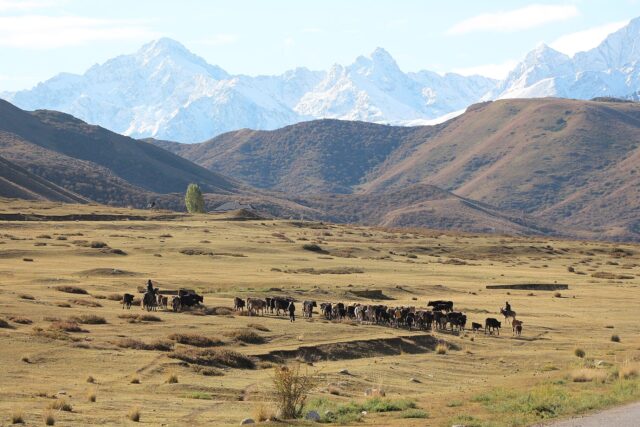
Most of the classic routes are still going in September. The Ala-Kul trek is doable, often at its clearest, and the pastures are still inhabited early in the month. But this is where the deadline bites. Herders begin coming down off the high jailoos as September progresses, so the Song-Kul yurt camps wind down toward the end of the month and are not a safe bet in early October. The highest passes can catch their first snow in late September, which can make a serious route suddenly more demanding overnight. The rule is simple: do your big high-altitude treks in the first half of the month, and always check current conditions before committing to anything above 3,500 m.
Who September suits
September rewards the traveler who values conditions over guarantees — someone happy to carry a warm bag, watch the forecast, and aim the big treks at the early weeks. It is ideal for photographers chasing autumn light, for anyone who found July too busy, and for hikers who want cool, dry days on the trail. It is a slightly worse pick if your single must-do is a late-season Song-Kul yurt stay or a guaranteed snow-free crossing of the very highest passes; for those, July is safer.
Where to go next
If September has convinced you, build the trip early-to-late by altitude: front-load the high treks and Song-Kul while they are still open, then let the lower valleys, the lakeshore and the autumn forests carry the back half as the nights cool. A standard loop fits neatly — start with our 10-day itinerary and slot the autumn colour of the walnut forests toward the end. Watch the forecast, book nothing rigid past mid-month up high, and September will likely be the best-timed trip you take to the region.