If you only have time for one, take Kyrgyzstan first. Kyrgyzstan is the easier, cheaper, more trek-ready country. Visa-free for most, laced with marked trails and yurt stays, and forgiving of first-timers. Tajikistan rewards the more committed traveler with the raw, high, remote Pamir Highway, but demands a visa, a 4×4 budget, and a higher tolerance for rough edges. The two share a border and a mountain heritage, yet they ask very different things of you.
Here is the short version before the detail. Kyrgyzstan’s Tian Shan is where you go to walk: day hikes and multi-day treks with community-run logistics that hold your hand just enough. Tajikistan’s Pamir is where you go to travel: long overland days across a plateau at 4,000 m, with trekking possible but secondary to the sheer act of getting there. Choosing between them is really choosing between hiking and expedition.
The Mountains: Tian Shan vs Pamir
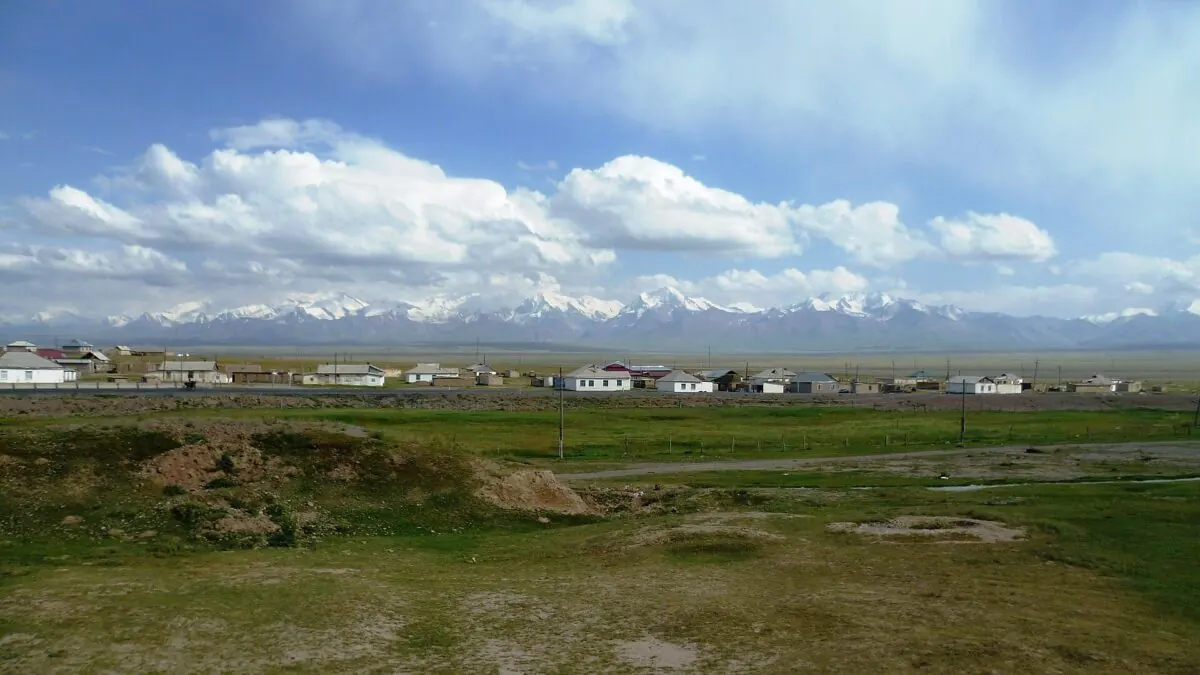
Kyrgyzstan sits almost entirely inside the Tian Shan, a range of green summer valleys, alpine lakes, and glacier-fed rivers that peak around 7,439 m at Jengish Chokusu but present themselves, for most visitors, as walkable 3,000–4,000 m terrain. The classic routes — the Ala-Kul lake trek, the meadows around Song-Kul, the hot-spring valleys near Karakol — are physically demanding but not technical, and you sleep in yurts and family guesthouses rather than tents most nights.
Tajikistan’s Pamir is a different order of place. Locals call it “the roof of the world,” and the description is earned: a high, cold, arid plateau where villages sit above 3,500 m and the horizon is a wall of 6,000 m and 7,000 m peaks, including Ismoil Somoni (7,495 m), the highest in the former Soviet Union. It's emptier, starker, and far higher on average than anything in Kyrgyzstan. The scenery is more dramatic. It is also much harder to reach and to move through.
Trekking: Which Country Is Easier to Walk?
Kyrgyzstan wins this outright for most people, and it isn't close. The country has spent two decades building community-based tourism (CBT) networks that put marked trails, horse hire, yurt camps, and English-speaking coordinators within reach of an independent traveler with no guide and no Russian. You can arrive in Karakol, arrange a three-day trek over breakfast, and be walking by afternoon, an edge it also holds over Nepal for trekking. Our Kyrgyzstan trekking guide lays out the main routes and how the CBT system works.
Tajikistan has spectacular trekking too: the Bartang Valley, the Wakhan Corridor’s side valleys, the trails around Lake Iskanderkul in the Fann Mountains: but the infrastructure is thinner. Routes are less marked, guides and porters are more often necessary, and the logistics of even reaching a trailhead can eat a day of driving. The Fann Mountains, closer to Dushanbe, are the exception and the best entry point for independent Tajik trekking. But as a whole, Tajikistan asks you to work harder for a walk.
| Factor | Kyrgyzstan | Tajikistan |
|---|---|---|
| Signature range | Tian Shan | Pamir + Fann |
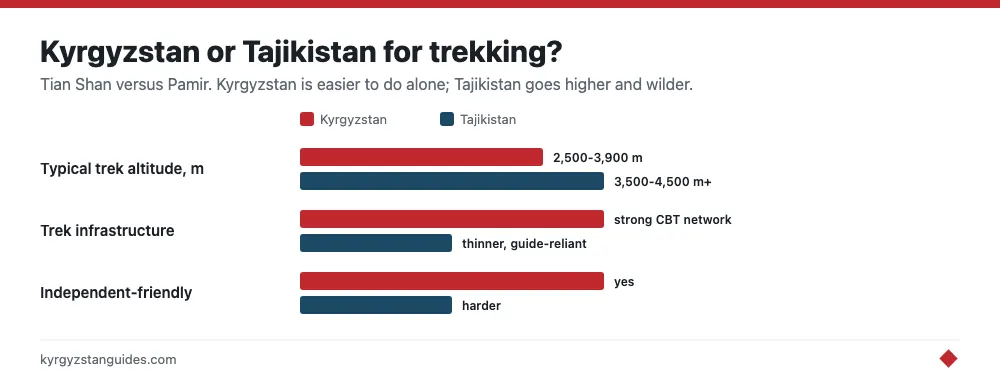
| Trek infrastructure | Strong (CBT network) | Thinner, guide-reliant |
| Typical trek altitude | 2,500–3,900 m | 3,500–4,500 m+ |
| Independent-friendly? | Yes | Harder |
| Signature experience | Yurt-stay treks | Pamir Highway overland |
Access and Getting There
Kyrgyzstan is straightforward. Bishkek’s Manas Airport takes flights from Istanbul, Dubai, Delhi via Almaty, and much of the region, and internal travel runs on cheap marshrutkas and shared taxis that need no booking. You can build a whole two-week trip on the day, turning up at bus stations with cash.
Tajikistan’s capital, Dushanbe, is also reachable by air, but the country’s headline experience (the Pamir Highway (the M41)) is an overland journey best done by hired 4×4 with a driver, typically as a 4-to-7-day run between Osh in southern Kyrgyzstan and Dushanbe or Khorog. That trip alone can cost several hundred dollars per vehicle. Many travelers combine the two countries precisely because the Pamir Highway starts in Kyrgyz territory: fly into Bishkek, work down to Osh, then cross into the Tajik Pamirs from there.
Visas and Paperwork
This is where the gap is widest. Most Western nationalities enter Kyrgyzstan visa-free for 30 days within any 60-day period; nearly everyone else, Indians included, gets a quick e-Visa online. Our Kyrgyzstan visa guide covers the details, but the headline is that entry is painless.
Tajikistan requires an e-Visa for almost all visitors, and crucially, the Pamir region (GBAO) needs a separate GBAO permit added to that visa. Both are applied for online and aren't expensive, but they are extra steps, they occasionally get delayed, and the GBAO permit is checked at roadblocks along the highway. Skip it and you will be turned back. Factor a few days of lead time before you plan to cross.
Cost: Both Cheap, One Cheaper
Both countries are inexpensive by Western standards, but Kyrgyzstan is cheaper to travel day to day, mainly because its transport is public and abundant while Tajikistan’s Pamir travel leans on private vehicles. In Kyrgyzstan a dorm bed runs $8–12, a guesthouse $25–40, and a yurt stay with meals $15–22; a full budget day can land under $30. Our Kyrgyzstan travel budget breaks it down.
Tajikistan’s accommodation and food cost about the same, but the Pamir Highway’s 4×4 hire is the budget-breaker: split a vehicle among four and you might each pay $70–120 for a multi-day route, more for detours into the Wakhan or Bartang. It's worth every cent for what it shows you, but it's a real line item that Kyrgyzstan simply does not have.
| Cost item | Kyrgyzstan | Tajikistan |
|---|---|---|
| Guesthouse night | $25–40 | $20–35 |
| Long-distance transport | Cheap public marshrutkas | Private 4×4 for the Pamir |
| Trek logistics | Low (CBT, optional guide) | Higher (guides more needed) |
| Overall daily budget | ~$25–45 | ~$40–70 on the highway |
Difficulty and Altitude
Tajikistan is physically harder on your body before you take a single step off the road. Living and sleeping at 3,500–4,000 m on the Pamir plateau means many travelers feel the altitude just riding along, and the risk of altitude sickness is real for anyone who ascends too fast. Kyrgyzstan’s valleys are lower, its treks let you sleep at more moderate heights, and altitude is a manageable factor rather than a defining one.
Neither country is dangerous in the way headlines sometimes imply, both are welcoming and safe for ordinary travel, as we cover in is Kyrgyzstan safe. The difficulty is logistical and physiological, not about security. Tajikistan simply demands more self-sufficiency: longer distances between help, thinner mobile coverage, and weather that can strand a vehicle for a day.
Or Just Combine Them
Here is the answer a lot of travelers arrive at anyway: do both, in one trip, with Kyrgyzstan as the base. The geography almost insists on it. Fly into Bishkek, spend a week or two trekking the Tian Shan and easing into Central Asia’s rhythm, then head south to Osh and roll straight onto the Pamir Highway into Tajikistan. Doing them in that order means you acclimatize gently in Kyrgyzstan’s gentler mountains before the Pamir’s altitude, and you handle the harder logistics once you have your legs under you.
Three or four weeks covers a satisfying version of the combined trip. Two weeks forces a choice, and if you must choose, Kyrgyzstan gives the higher hit rate of good days for less money and hassle.
The Verdict
Choose Kyrgyzstan if you want to trek independently, keep costs low, skip visa faff, and not gamble a short trip on rough logistics — it's the better first Central Asian country. Choose Tajikistan if the Pamir Highway is the dream, you have the budget for a 4×4 and the patience for permits, and remoteness is the point rather than the price. And if you can spare a month, refuse to choose: run them together, Kyrgyzstan first, and let the border between them be a highlight rather than a decision.
Frequently Asked Questions
Is Kyrgyzstan or Tajikistan better for trekking?
Kyrgyzstan is easier and better for most trekkers, thanks to its community-based tourism network of marked trails, yurt camps, and horse hire that make independent multi-day treks simple. Tajikistan has superb, wilder trekking in the Fann and Pamir ranges, but with thinner infrastructure and more reliance on guides.
Do I need a visa for Kyrgyzstan and Tajikistan?
Most Western nationalities enter Kyrgyzstan visa-free for 30 days within any 60-day period, while others use a simple e-Visa. Tajikistan requires an e-Visa for nearly all visitors, plus a separate GBAO permit to enter the Pamir region, both applied for online in advance.
Which country is cheaper to travel?
Kyrgyzstan is generally cheaper day to day because its long-distance transport runs on cheap public marshrutkas and shared taxis. Tajikistan’s signature Pamir Highway relies on hiring a private 4×4, which adds a significant cost that Kyrgyzstan travel avoids.
Can you visit both Kyrgyzstan and Tajikistan in one trip?
Yes, and many travelers do. The Pamir Highway connects Osh in southern Kyrgyzstan with the Tajik Pamirs, so a common route is to fly into Bishkek, trek the Tian Shan, then head south to Osh and cross into Tajikistan. Allow three to four weeks for a comfortable combined trip.
Is the altitude worse in Tajikistan?
Yes. Tajikistan’s Pamir plateau has villages and roads above 3,500 m, so travelers feel the altitude even while driving, and the risk of altitude sickness is higher. Kyrgyzstan’s valleys and most treks sit lower, making altitude a manageable factor rather than a constant one.
What is the main difference between the Tian Shan and the Pamir?
The Tian Shan is green and walkable: summer valleys, alpine lakes, and 3,000–4,000 m trekking terrain with yurt and guesthouse beds most nights. The Pamir is a high, cold, arid plateau where villages sit above 3,500 m and the horizon is a wall of 6,000–7,000 m peaks, including 7,495 m Ismoil Somoni. One is hiking country; the other is expedition country.