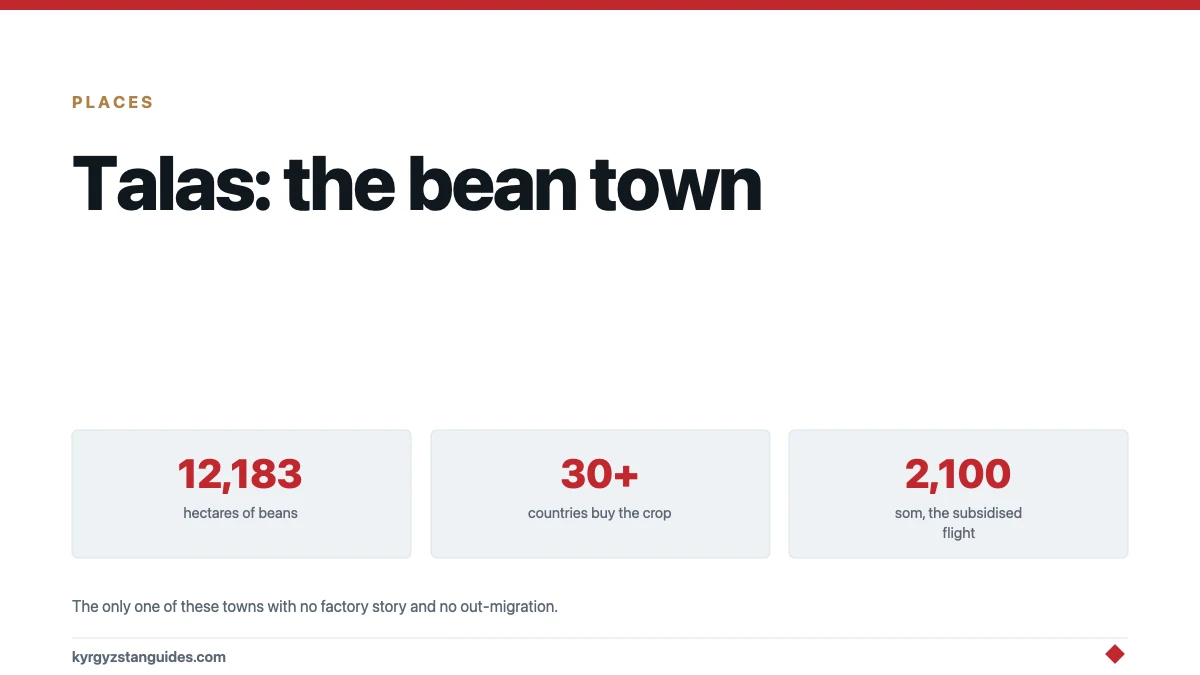
Talas oblast grows beans. Twelve thousand hectares of them, exported to more than thirty countries, under a variety called Nirvana.
That is the whole economy in a sentence, and it is why Talas is the outlier in this series: no dead factory, no tailings pond, no out-migration story. The population went from 39,900 in 2021 to 43,400 at the start of 2025, and the town's own count and the national statistics agree to within forty people — which almost never happens.
The basics
1,244 metres, administrative centre of Talas oblast in the far north-west, against the Kazakh border. 120 kilometres from the nearest railway; there is no line in the Talas valley on the Kyrgyz side.
How it got here
It began as marsh and white reed, called Ak-Chiy. Russian peasant settlers were placed here in 1874, a church to St Dmitry was built in 1887, and the village was renamed Dmitrievka. Further settler waves came in 1892 and 1912, and the place became one of three cavalry-horse breeding centres of Turkestan oblast.
1930: Talas district created, Dmitrievka made its centre. 1939: renamed Talas, population 6,250, of whom only about ten per cent were Kyrgyz. 22 June 1944: Talas oblast created and the village given city status.
The war brought evacuees from the western Soviet Union and then deported Chechen families; a light-industry base made tunics and boots for the front.
Then the usual Soviet build-out: a small hydro plant in 1947, a butter plant, a flour combine, a bakery, a sewing factory and a shoe factory, together employing over 700 people. Population 22,000 by 1974. A meat combine processing about 40 tonnes a day was commissioned in 1990, when the population stood at 34,000.
None of those plants appears among the town's operating enterprises today. What the city reports instead is 386 limited companies and 19 joint-stock companies — a trade and services economy.
The beans
This is the real story and it is current.
Talas district sowed 12,183 hectares of beans in 2025, 319 more than in 2024. Yields run about 1.5 tonnes per hectare. The farm-gate price in August 2025 was 105 to 110 som per kilogram, and mechanical harvesting cost around 5,000 som per two hectares.
The Nirvana variety is exported to more than thirty countries.
In December 2025 the state bought 1,000 tonnes of Talas beans for 100 million som, with export talks under way for India, Iran, Russia, Turkey and Dubai.
And a bean processing, sorting and packing plant is planned for 2026 at roughly one billion som, to trade under the brand Talasia. If it is built, it is the single biggest thing that could change this town — moving it from selling a raw crop to selling a packaged one. As of our sources it is announced, not operating.
The flight
Talas used to be an eight-hour bus town. It is not any more.
Asman Airlines resumed Bishkek–Talas passenger flights in October 2024, after a gap of about thirty years. From 4 January 2026 the route runs twice a week, Mondays and Fridays, at a fixed subsidised fare of 2,100 som, with a ten per cent pensioner discount, booked through the airline's app or website.
Two thousand one hundred som is roughly five times the bus fare and saves the better part of a day, plus two border crossings.
The road, and why it goes through Kazakhstan
The published bus fare is 395 som for 395 kilometres, Bishkek to Talas, with departures at 20:00, 22:00 and 23:00.
Here is the catch. The cheap, year-round route runs through Kazakhstan via Taraz, which means two international border crossings each way. The all-Kyrgyz alternative goes over the Otmok pass and through Suusamyr: 295 kilometres, about a hundred shorter, but it costs 500 som, runs only at 08:30 and 10:30, and is seasonal.
If you do not want the Kazakh crossings, you need the Otmok service and you need the pass to be open. Check before you commit. See Kyrgyzstan's roads and tunnels for the pass situation and Suusamyr valley for what you cross.
Local services from Talas bus station: Kyzyl-Adyr every 25 minutes, 60 som; Bakay-Ata every 25 to 30 minutes, 45 to 50 som; Pokrovka 120 som; Maymak 90 som; Kok-Say 100 som. There is also a daily Chimkent–Kyzyl-Adyr–Talas service at 09:00 for 60 som.
Why Talas is the exception
Worth pausing on, because the contrast with the rest of provincial Kyrgyzstan is instructive.
Every other town in this series was built around an extractive or industrial asset — coal at Kyzyl-Kiya and Sulukta, uranium and oil at Kara-Balta, cement at Kant — and its fortunes have tracked that asset. Talas was built around a valley.
Agriculture does not shut down the way a plant does. A combine can stop; a growing season cannot. When the Soviet processing industry here collapsed, the land underneath it was still the land, and the bean trade grew into the space rather than leaving a hole.
That is also why the proposed Talasia plant matters more than a billion som usually would. Right now the valley sells an unprocessed crop at 105 to 110 som a kilo and someone else does the sorting, packing and branding. A processing plant captures that margin locally. Whether it gets built is the difference between a town that exports beans and a town that exports bean products, and those are different economies.
A note on the border
Talas sits hard against Kazakhstan, and the practical consequences run through everything above.
The main road route to Bishkek crosses it twice. A daily bus runs from Chimkent. And the valley's historic orientation is as much north-west into the Kazakh steppe as south-east over the passes into the rest of Kyrgyzstan, which is why the all-Kyrgyz route is the awkward seasonal one rather than the default.
If you are travelling on a passport that needs anything for Kazakhstan, the routing question stops being about comfort and becomes the whole plan. Confirm your own position on Kazakh entry before booking the cheap overnight bus, and take the flight or the Otmok service if in any doubt.
What is in the town
The town lists a music and drama theatre named for K. Mederbekov, an art museum, the Kyrk Choro cinema, a children's music school named for A. Ogombaev, five libraries, and the city bazaar, which the city itself describes as its trading centre. A new park has opened in the Zhashtyk microdistrict.
One genuinely unusual thing for a Kyrgyz provincial town: 22 nationalities and seven organised diasporas — Slavic, Uzbek, German, Turkish, Tatar, Georgian and Kazakh.
The town also took first place nationally in university entrance test results in 2024, with one higher-education institution, three colleges, a lycée complex, fourteen schools and ten preschools.
The great draw of the valley is of course Manas Ordo, which we cover separately in Manas Ordo at Talas.
FAQ
How do you get to Talas from Bishkek?
Three ways. The bus is 395 som over 395 kilometres, departing at 20:00, 22:00 and 23:00, but it routes through Kazakhstan via Taraz with two border crossings. A seasonal all-Kyrgyz service over the Otmok pass costs 500 som for 295 kilometres. Or fly: Asman Airlines runs the route on Mondays and Fridays at a fixed subsidised 2,100 som since 4 January 2026.
Why does the Talas bus go through Kazakhstan?
Because the direct Kyrgyz route crosses the Otmok pass and the Suusamyr valley, which is higher, shorter and seasonal. The Kazakh route via Taraz is longer at 395 kilometres but runs year-round and costs less, so it is the default service despite requiring two international crossings each way.
What is Talas famous for?
Beans, and Manas. Talas district sowed 12,183 hectares of beans in 2025 and its Nirvana variety is exported to more than thirty countries. The valley is also the site of Manas Ordo, the complex associated with the hero of the Kyrgyz epic.
Is there anything to do in Talas town itself?
A music and drama theatre, an art museum, a cinema and the city bazaar, plus a new park in the Zhashtyk district. It is a working provincial centre rather than a sight, and the main draws of the region are outside it.
Is Talas shrinking like other Kyrgyz provincial towns?
No, and it is the exception in that. The population rose from 39,900 in 2021 to 43,400 at the start of 2025. Unusually, the town's own figure and the national statistics agree closely, and the growth is real rather than an artefact of boundary changes.
What happened to Talas's Soviet factories?
They are gone from the town's own list of operating enterprises: the butter plant, flour combine, sewing factory, shoe factory and the 1990 meat combine that could process 40 tonnes a day. What the city reports now is 386 limited companies and 19 joint-stock companies, which is a trade and services economy rather than an industrial one.