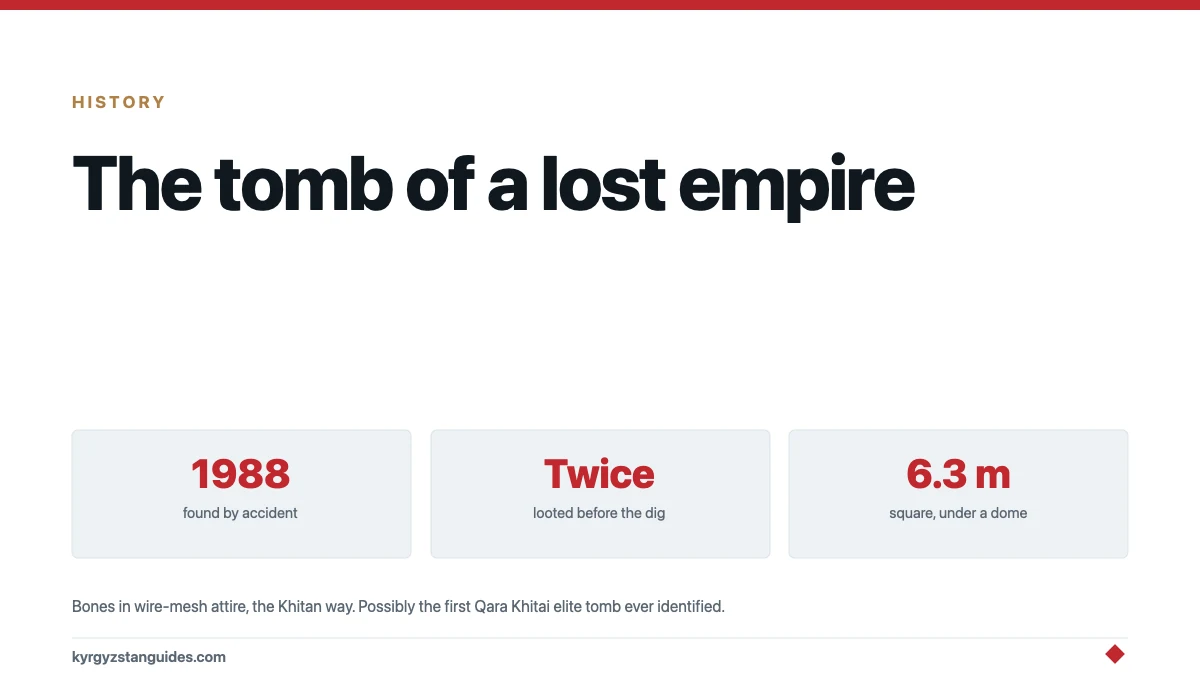
In 1988, near the village of Kum-Döbö in the Kochkor valley, someone stumbled on an underground mausoleum. It was looted in 2010–11 and again in 2015, excavated properly in 2017–18 — and in 2023, a paper in the Journal of the Royal Asiatic Society argued that this modest brick structure in central Kyrgyzstan is the first elite tomb of the Qara Khitai empire ever identified, anywhere.
If that argument holds, a monument of a vanished Buddhist empire that ruled half of Central Asia sits a day's drive from Bishkek, fenced off beside a Kochkor-valley village, and almost nobody has heard of it.
The empire nobody can place
The Qara Khitai are the empire that falls through the cracks of every popular history. They were Khitans — the Buddhist, originally nomadic people whose Liao dynasty had ruled northern China — who fled west when the Jurchen destroyed the Liao in the 1120s. Under Yelü Dashi they rebuilt an empire in exile, and they ran it from Balasagun, the city whose surviving minaret is the Burana tower.
The dates, as the sources give them: Balasagun taken around 1128–1134 (accounts differ within that window); a victory near Samarkand in 1141 that stretched their reach to the Oxus and, incidentally, fed the Prester John legend in Europe; the usurper Kuchlug seizing the throne in 1211; and the Mongols ending the whole thing in 1218.
What made them strange, and makes them interesting, is the arrangement: a Buddhist dynasty ruling a mostly Muslim population, from a Muslim city, largely by leaving it alone. Nearly a century of that, and they left remarkably little behind that anyone could point to — which is exactly why one tomb matters.
What the diggers found
The excavation of 2017–18 was led by Kubatbek Tabaldiev and Kunbolot Akmatov of the Kyrgyz-Turkish Manas University, working with Valery Kolchenko. What they opened, published open-access in 2023, is a two-chamber brick structure: an antechamber of 2.4 by 4 metres, and a burial chamber 6.3 metres square under an octagonal dome.
Inside were three people — a couple, likely husband and wife, and an adolescent — and the detail that drives the whole argument: the bones were covered with the green-stained remains of oxidised wire-mesh attire. Dressing the elite dead in wire mesh of bronze or copper is a distinctively Khitan burial custom, documented in Liao tombs in China. With them were twelve small jade plates, two bronze mirrors, and blue-glazed ceramic.
The first reading of the site, years earlier, had been that it was an unusual Muslim mausoleum. The 2023 argument runs the other way: the tomb has no Muslim features, and its design and contents line up with Liao elite practice. On that basis, scholars argued it is the first Qara Khitai elite tomb ever identified.
Looted twice before anyone understood it
The tomb's modern history is a compressed lesson in how Central Asian archaeology actually goes.
Found by accident in 1988, it then sat for over two decades as local knowledge — long enough for looters to work it over in 2010–11 and again in 2015, before the 2017–18 excavation finally put archaeologists inside. Whatever portable wealth the burial once held left in those two episodes, unrecorded. Nobody will ever know what the couple was buried with beyond what the looters did not want.
There is a bleak irony in what they left. Thieves take gold and leave bones, brick and corroded wire — and it is precisely the bones in their mesh attire, and the architecture around them, that carried the Qara Khitai argument. The evidence that survived is the evidence that had no resale value. The jade plates and bronze mirrors that remained suggest either hurried looters or a burial whose richest goods were elsewhere in the structure; the paper does not speculate, and neither will I.
It is the same pattern this site has met at the Saka kurgans: in Kyrgyzstan, the question is rarely whether a site was looted, only whether anything diagnostic survived the looting.
How strong is the claim, honestly
This is the part most retellings will skip, so it goes here in full.
There is no clean date on the burial itself. The one radiocarbon date, 1264–1300, comes from the adolescent's skull — which the excavators consider a later addition to the tomb, not part of the main burial. A Chaghadaid coin found in the structure gives only a latest-possible date. So the attribution to the Qara Khitai period rests on architecture and grave goods, not on laboratory dating — a strong argument from parallels, and still an argument.
It is also worth flagging that popular summaries have already started garbling it: one 2026 news piece describes the tomb as eleventh-to-twelfth century and holding two men. The paper says a couple and an adolescent. When the retellings disagree with the open-access original, read the original — it is free.
Why a tomb, here
Kochkor sits about a day's ride from Balasagun across the mountains, high pasture country then and now — the same valley floor where today's travellers arrange Song-Kul trips from Kochkor town. For a dynasty of steppe origin that governed from a city but never fully became of it, an elite burial out in the high valleys is exactly where you would look, and nobody had.
It also quietly extends a pattern this site keeps meeting in the Chui and Kochkor valleys: the ground here holds layers — Nestorian gravestones, plague cemeteries, Buddhist temples, and now a Khitan tomb — that the standard nomad-and-Silk-Road telling of Kyrgyzstan's history never quite finds room for.
Seeing it
The site is fenced, and official plans mention walkways and drainage for eventual visitors, under the state heritage programme running 2023–27. What that means in practice, as of now: there is nothing to tour, and the tomb's contents are with the archaeologists, not on display in the valley.
The honest itinerary advice is to treat Kök-Tash as a reason to look differently at country you may already be crossing. The Kochkor valley road to Song-Kul passes within a few kilometres of a possible imperial tomb, and the Burana tower — the capital those buried people may have answered to — is two hours the other way. Stand at Burana and the connection is no longer abstract.
What I could not establish
Whether the walkways-and-drainage plan has a budget or a date — the programme is named, the works are not scheduled anywhere I could find. The identities of the couple, which the paper does not claim to know. And the full authorship of the attribution argument: the publication is open access and its authors are listed there; I have deliberately not attached a shorthand name to "the scholars" without rereading the author list, because secondary coverage has already proven careless with this paper's details.
FAQ
What is the Kök-Tash mausoleum?
An underground two-chamber brick tomb near Kum-Döbö in Kyrgyzstan's Kochkor valley — an antechamber and a 6.3-metre-square burial chamber under an octagonal dome — found in 1988, looted in 2010–11 and 2015, and excavated in 2017–18 by archaeologists from Kyrgyz-Turkish Manas University.
Why do scholars think it is a Qara Khitai tomb?
Because of the burial custom: the bones were covered with the oxidised remains of wire-mesh attire, a distinctively Khitan elite practice known from Liao tombs in China, and the tomb lacks Muslim features despite an earlier reading as a Muslim mausoleum. A 2023 open-access paper argued on those grounds that it is the first Qara Khitai elite tomb ever identified.
Is the dating certain?
No, and the paper does not pretend otherwise. The only radiocarbon date, 1264–1300, comes from an adolescent the excavators consider a later addition, and a coin in the structure gives only a latest-possible date. The attribution rests on architecture and grave goods — a serious argument from parallels rather than a laboratory result.
Who were the Qara Khitai?
Buddhist Khitans who fled the fall of their Liao dynasty in northern China in the 1120s and rebuilt an empire in Central Asia under Yelü Dashi, ruling a mostly Muslim population from Balasagun — the city of today's Burana tower — from roughly the 1130s until Kuchlug's usurpation in 1211 and the Mongol conquest of 1218.
Who was buried in the tomb?
Three people: a couple, likely husband and wife, and an adolescent whom the excavators read as a later addition. Their identities are unknown. The grave goods included twelve small jade plates, two bronze mirrors and blue-glazed ceramic.
Can you visit Kök-Tash?
Not meaningfully yet. The site is fenced, and the state heritage programme for 2023–27 mentions plans for walkways and drainage, but there is no scheduled opening and nothing is on display locally. The Kochkor valley road toward Song-Kul passes close by, and Burana — the empire's capital — makes the natural paired visit.
Where was the Qara Khitai capital?
Balasagun, in the Chui valley — the site marked today by the Burana tower, about two hours' drive from the Kochkor valley. The empire ran from there for most of a century while leaving so little physical trace that a single identified tomb is a genuine event in its archaeology.