Most travelers assume customs in Kyrgyzstan means the usual airport routine — declare nothing, walk through, done. That’s true for the vast majority of trips. But two categories of traveler regularly run into trouble: anyone carrying a meaningful amount of cash, and anyone buying old carpets, musical instruments, or other antique-looking items as souvenirs. Both have specific rules that aren’t obvious until something goes wrong at the border.
The currency rule is the one to know before you even land: amounts equivalent to roughly $10,000 USD or more, in any currency or combination of currencies, must be declared on arrival and departure. Under that threshold, you generally don’t need to declare cash at all. Over it, an undeclared amount found during a spot check can be confiscated, and the traveler can face fines or worse — this is standard practice at most former-Soviet border posts, not something specific to Kyrgyzstan, but it catches travelers who assume cash is simpler than cards.
Currency declaration in more detail
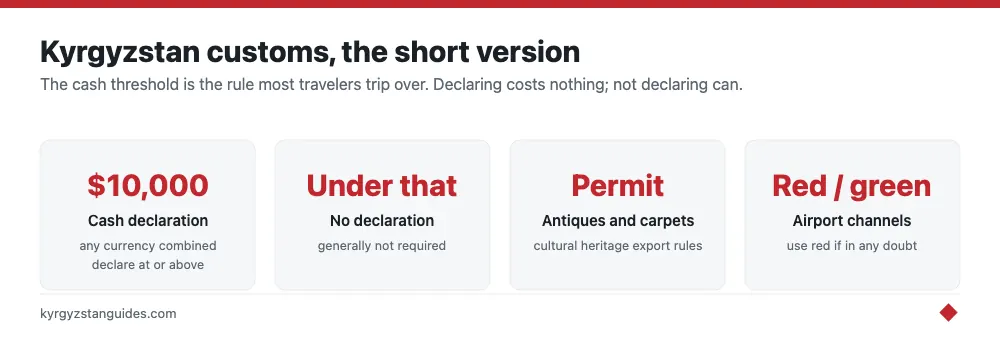
If you’re carrying above the threshold — which is uncommon for a typical traveler but not unheard of among those paying cash for extended trips, vehicle purchases, or business — fill out the customs declaration form available at the airport or land border and keep the stamped copy for your departure. Kyrgyzstan doesn’t restrict how much currency you can bring in or take out; the rule is about declaring it, not limiting it. The practical risk is entirely in skipping the paperwork, not in the amount itself.
For the overwhelming majority of travelers carrying a few hundred or a couple thousand dollars in mixed cash and cards, none of this applies. It’s worth knowing the threshold exists mainly so a large cash withdrawal for a long trip, or cash brought for a big group purchase like handwoven textiles, doesn’t accidentally cross it without you realizing.
Alcohol and tobacco allowances
Duty-free allowances follow a fairly standard regional pattern: travelers arriving in Kyrgyzstan can typically bring in a limited quantity of alcohol (commonly cited around 1-2 liters of spirits or equivalent) and a limited quantity of tobacco (commonly around one carton of cigarettes, roughly 200 units) without paying import duty. These allowances are for personal consumption, not resale, and quantities well above them can attract duty or questions at the border. Since these limits shift periodically with regulation updates, travelers bringing anything beyond a bottle or two for personal use should check current figures via the official Kyrgyz government portal gov.kg or with their airline before departure rather than relying on a fixed number.
Cultural heritage: the rule that actually catches people
This is the customs issue that trips up more travelers in practice than the cash threshold, precisely because it’s less obvious. Kyrgyzstan, like most Central Asian countries, restricts the export of items considered cultural heritage — genuinely old carpets, antique musical instruments (particularly traditional ones like the komuz), pre-modern manuscripts, archaeological artifacts, and similar items. Taking these out of the country without an export permit or authentication from the relevant cultural authority can mean the item is confiscated at the border, regardless of how or where you bought it.
The practical distinction that matters: a newly made carpet or instrument bought from a craft market or workshop, with a receipt, is not a cultural heritage item and travels fine. A old or antique piece — the kind that makes for a much more interesting souvenir story — is exactly the kind of item this rule targets. If a seller markets something specifically as antique, old, or family heirloom, ask directly whether it needs an export document, and get any paperwork offered at time of purchase rather than trying to sort it out at the airport.
Sellers at established craft cooperatives and museum shops catering to tourists are generally aware of this rule and sell new work specifically to avoid it; it’s markets and individual sellers offering old family pieces where the risk concentrates. When in doubt, buying new, well-made contemporary work — which Kyrgyzstan has plenty of — sidesteps the entire issue.
Common traveler mistakes
- Assuming cash never needs declaring — true under the threshold, not above it
- Buying what a seller calls an antique felt rug or instrument without asking about export documentation
- Packing dried fruit, nuts, or other agricultural products in checked luggage without checking the destination country’s own import rules (this is more often a problem on arrival elsewhere than on departure from Kyrgyzstan)
- Assuming duty-free allowances at the Kyrgyzstan airport shop match what you can bring back into your home country — check both ends
- Losing the stamped currency declaration form after arrival, then having nothing to show on departure if carrying a large amount
What airport customs actually looks like
Manas International Airport in Bishkek runs a fairly standard green-channel/red-channel system: nothing to declare, walk through; something to declare, use the red channel and fill out the form. In practice, most tourist departures pass through without any interaction beyond the standard security and passport checks. Spot checks do happen, particularly around cash and around larger checked bags containing textiles or handicrafts, but they’re not the norm for a typical traveler leaving with the usual souvenirs, photos, and worn hiking boots.
Land border crossings, especially toward China, Tajikistan, or Uzbekistan, tend to involve more thorough baggage checks than the airport, partly because these are also routes used for informal trade. Travelers crossing overland with significant souvenir purchases should expect a somewhat closer look than at the airport, though the underlying rules are the same.
None of this should make anyone nervous about a standard trip — the actual risk is concentrated in two narrow situations: large undeclared cash, and antique cultural items without paperwork. Steer clear of both and Kyrgyz customs is a formality, not an obstacle. Anyone planning overland exits should also check current border crossing conditions and confirm visa requirements are still valid for departure, since visa and customs checks happen at the same checkpoint. If shopping for textiles or handicrafts is part of your trip, our souvenirs guide covers what to buy and where, including which sellers specialize in new work versus old pieces. General safety questions around carrying cash and valuables are covered in is Kyrgyzstan safe.
Customs FAQ
Do I need to declare cash under $10,000?
No. Amounts below the roughly $10,000 threshold generally don’t require declaration. Above it, declare on both arrival and departure and keep the stamped form.
Can I take an old carpet or instrument out of Kyrgyzstan?
Only with an export permit or authentication confirming it isn’t classified as cultural heritage. Newly made items with a purchase receipt aren’t affected — the restriction targets antique pieces.
What happens if I don’t declare cash above the threshold?
Undeclared amounts found during a check can be confiscated, and the traveler can face fines. It’s a straightforward paperwork step that avoids the entire risk.
What is the cash declaration limit in Kyrgyzstan?
Roughly the equivalent of $10,000 in any currency or combination of currencies, on both arrival and departure. Below that you generally need not declare cash at all; above it, an undeclared amount found in a spot check can be confiscated.
Who actually has problems at Kyrgyz customs?
Two groups. Anyone carrying a meaningful amount of cash, and anyone buying old carpets, musical instruments or other antique-looking items as souvenirs. For everyone else the airport routine is unremarkable.
Can I buy an antique in Kyrgyzstan and take it home?
Not without paperwork. Items that appear antique — old carpets, instruments and similar — fall under cultural property rules, and the problem typically surfaces at the border rather than at the point of sale. Get documentation from the seller before you buy, not after.