The common worry about Kyrgyzstan — that it's a hard, off-grid country you need real expedition experience to handle — is mostly wrong. For a first-timer, Kyrgyzstan is one of the easiest adventure destinations going: safe, cheap, visa-light, and built for independent travel, with a week to ten days being the sweet spot for a first visit. What it demands isn't toughness but flexibility, because the good stuff runs on informal transport and a short summer season.
If this is your first trip here, the single most useful mindset is to plan loosely and go slow. The country is small on paper but slow to cross in practice, and the travelers who leave happiest are the ones who picked a region and went deep rather than sprinting the whole map. This briefing covers where to go, how long to stay, whether to book a guide, and the mistakes that catch newcomers.
Where a First-Timer Should Go
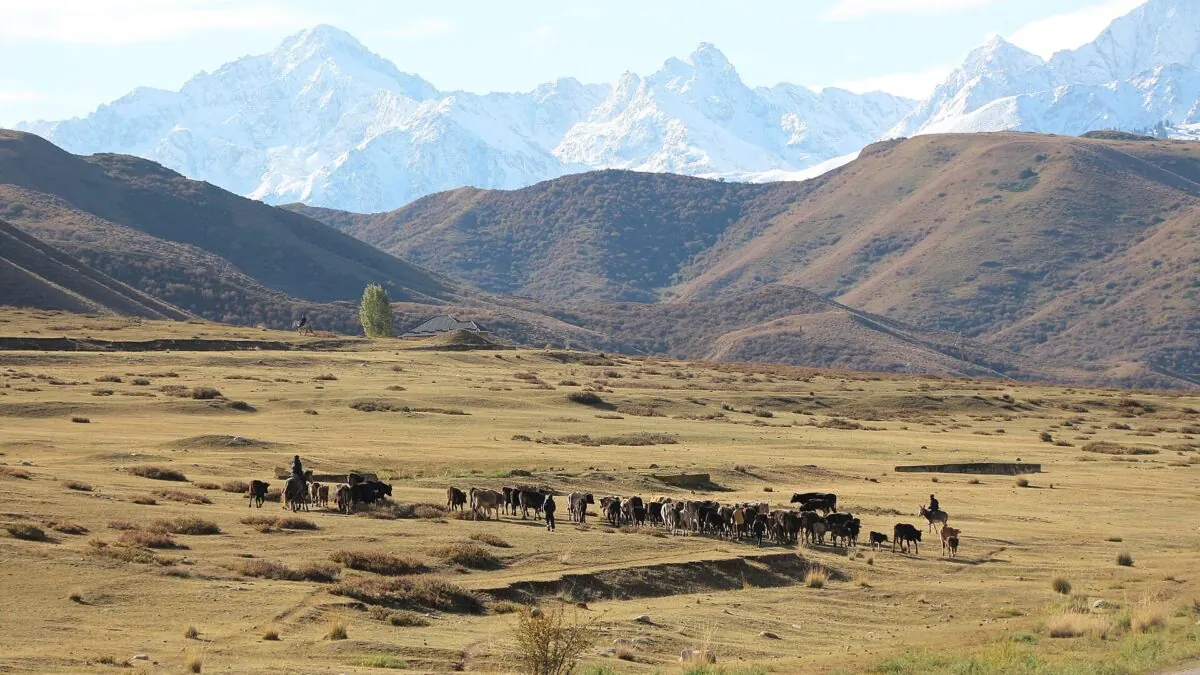
Start in the north. It has the best combination of scenery, infrastructure, and short drives, and it's where nearly every classic Kyrgyzstan image comes from. A first visit built around Bishkek and Lake Issyk-Kul covers most of what you came for.
The shortlist that rarely disappoints: Bishkek for a day to land and adjust, with our things to do in Bishkek guide to fill it; Karakol as a base for the eastern mountains, hot springs, and the famous Sunday animal market, covered in our Karakol travel guide; the Issyk-Kul shoreline for canyons, beaches, and yurt stays; and, if you have the days for it, a night at Song-Kul, the high summer-pasture lake ringed by shepherds’ yurts. That last one is the country’s postcard, and worth the rough road in — see our Song-Kul lake guide.
Save the south — Osh, Arslanbob, the Pamir fringe — for a second trip or a longer first one. It is wonderful, but the distances are bigger and the logistics rougher, and a first-timer gets more joy per day up north.
How Long to Stay
Seven to ten days is the honest minimum to do a first trip justice. Five days works if you stay tight and northern, but you'll feel rushed. Two weeks lets you add a real multi-day trek or push south. Anything under four days and you're really just visiting Bishkek and the nearest mountains — which is fine, but don't expect the full sweep of yurts and alpine lakes.
Whatever your number, subtract travel days honestly. A “seven-day trip” with two full days lost to arrival and departure logistics is really five days on the ground. Build the plan around that reality, not the calendar.
Guided or Independent?
You don't need a guide to travel Kyrgyzstan, and most first-timers should not book a full guided tour. The country’s community-based tourism (CBT) network makes independent travel genuinely easy: guesthouses arrange drivers, treks come with optional local guides you hire by the day, and marshrutkas connect the main towns for a couple of dollars. English is patchy but a phone translator and a smile bridge nearly everything.
Where a guide is worth the money is on specific multi-day treks, the Ala-Kul lake trek over its high pass, say, where route-finding, weather, and horse support help. Hire one for the trek, not the trip. The middle path most people land on is fully independent for towns and transport, with a local guide or driver booked for one or two specific adventures. That keeps costs down and the days flexible while removing the one or two things that actually benefit from expertise.
The Biggest First-Timer Mistakes
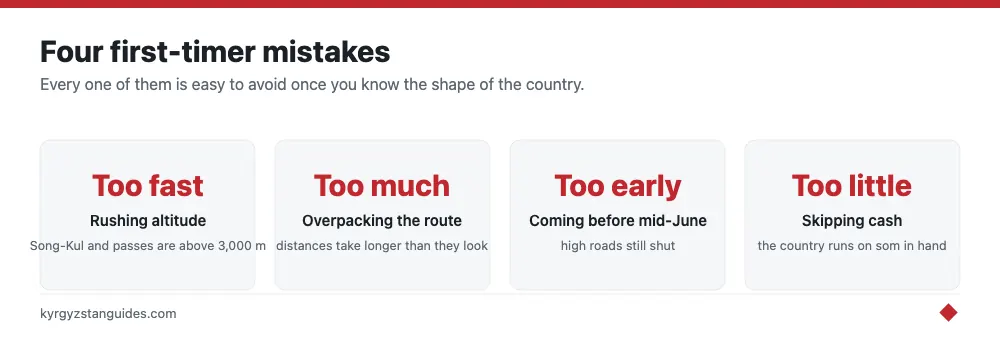
The mistakes here are predictable, which means they are easy to avoid. The classic is overpacking the itinerary. Trying to fit Song-Kul, Osh, and a big trek into a week, then spending the trip in transit. Pick a region and go deep.
The second is getting the season wrong. Kyrgyzstan is a summer country: the high roads and yurt camps run roughly June to September, and a May or October trip can find Song-Kul’s track impassable and the camps shut. Our best time to visit Kyrgyzstan guide has the month-by-month picture. The third is underestimating cash, rural Kyrgyzstan runs on som notes, not cards, so withdraw plenty in the cities before heading out. And the fourth is rushing altitude: Song-Kul and the high passes sit above 3,000 m, and charging up too fast turns a highlight into a headache.
What the Trip Is Actually Like
Set your expectations honestly and you will love it. Kyrgyzstan is not polished. Marshrutkas leave when full, not on a timetable; guesthouse plumbing is basic; and the yurt you sleep in is a working shepherd’s home, not a boutique glamp. What you get in return is scenery that outpaces almost anywhere for the price, hosts who feed you like family, and a rawness that has largely vanished from more traveled mountains.
It is also reassuringly safe. Petty crime is low, solo and female travelers report positive experiences, and the practical risks are the mundane ones, road conditions, altitude, weather, rather than anything sinister. Our is Kyrgyzstan safe guide goes deeper, but the short answer is that ordinary common sense is enough.
Your First-Trip Checklist
- Go in summer. June to September for the full experience; July and August for peak reliability.
- Stay north for a first trip — Bishkek, Issyk-Kul, Karakol, and Song-Kul if time allows.
- Give it a week or more. Ten days is comfortable; five is tight but doable.
- Travel independently, hiring a local guide only for a specific multi-day trek.
- Carry cash, plan loosely, and start every travel day early.
Frequently Asked Questions
Is Kyrgyzstan good for first-time travelers?
Yes. Kyrgyzstan is one of the more approachable adventure destinations — safe, cheap, and visa-light, with a community-based tourism network that makes independent travel easy for newcomers. The main thing it asks is flexibility, since transport is informal and the best season is short.
How many days do you need in Kyrgyzstan?
Seven to ten days is the sweet spot for a first visit, enough to combine Bishkek, Lake Issyk-Kul, Karakol, and ideally a night at Song-Kul without rushing. Five days works if you stay in the north, and two weeks lets you add a multi-day trek or head south.
Do I need a guide to travel Kyrgyzstan?
No, most first-timers travel independently. Guesthouses arrange drivers, marshrutkas link the main towns cheaply, and you only really need a local guide for specific multi-day treks where route-finding and support help. Hire one for the trek, not the whole trip.
Is Kyrgyzstan hard to travel in?
Less than its reputation suggests. It is safe, cheap, visa-light and built for independent travel. What it demands is not toughness but flexibility, because the good parts run on informal transport and a short summer season.
What is the biggest first-timer mistake?
Sprinting the map. The country is small on paper and slow to cross in practice, and the travellers who leave happiest are the ones who picked one region and went deep rather than trying to see all of it.
When should a first-timer visit Kyrgyzstan?
Inside the short summer season, roughly June to September, when the mountain roads are open and the yurt camps are standing. Outside that window the itineraries that make the country worth visiting mostly do not run.