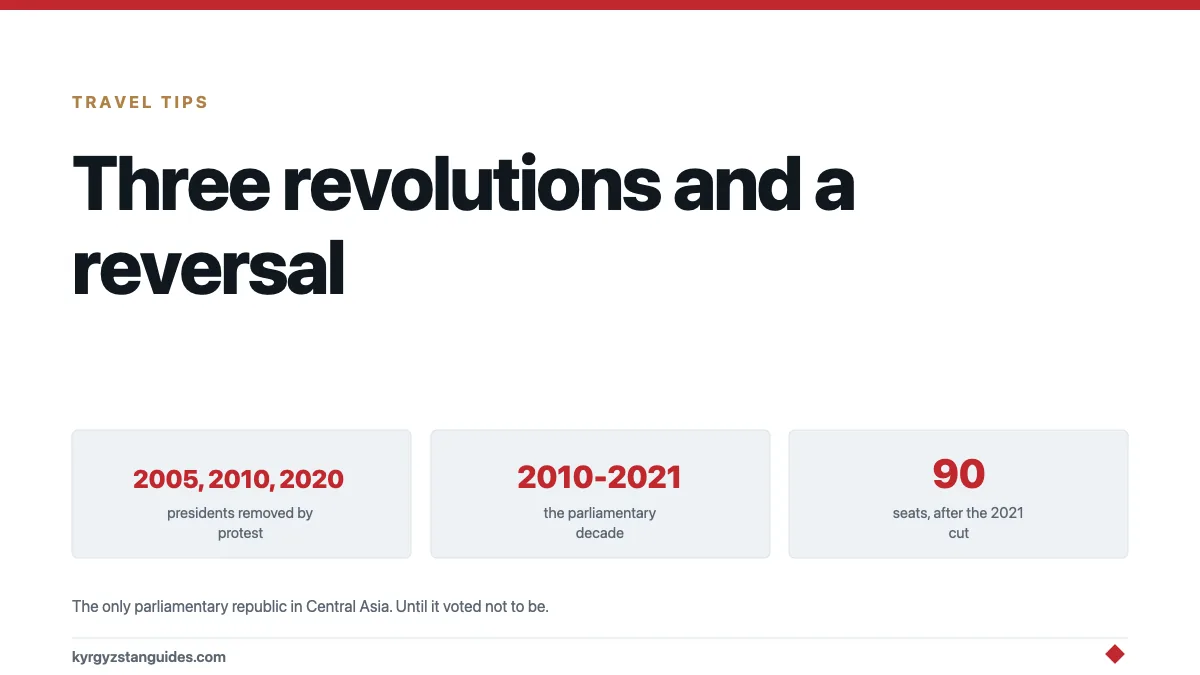
Kyrgyzstan has removed three presidents by street protest — in 2005, 2010 and 2020.
For a decade after the second of those it was Central Asia's only parliamentary republic, a genuine regional outlier. Then in 2021 it voted, by a large margin, to go back to a strong presidential system.
That arc is the shortest available explanation of modern Kyrgyzstan, and it makes sense of a great deal a visitor will hear.
The three removals
2005 — the Tulip Revolution. Disputed parliamentary elections triggered protests that spread from the south and removed President Askar Akayev, who had held office since before independence. Kurmanbek Bakiyev replaced him.
2010. Anger over utility prices, corruption and the concentration of state assets in the president's family produced protests that were met with force in Bishkek. Around 85 to 87 people were killed. Bakiyev left. Two months later came the violence in the south that's the darker half of that year.
2020. Disputed parliamentary elections again. Protesters took the White House, the results were annulled, and Sadyr Japarov — released from prison during the disorder. Became prime minister and then acting president within weeks.
Three times in fifteen years, by the same mechanism.
The parliamentary experiment
The interim government under Roza Otunbaeva after 2010 did something unusual. It concluded that concentrating power in a presidency was the root of the problem, and moved to a parliamentary system.
For a decade Kyrgyzstan had a strong legislature, coalition governments, a prime minister with real authority and a constrained president. No other Central Asian state has attempted this.
It was also messy. Coalitions collapsed, governments turned over frequently, and the model didn't deliver the stability its designers hoped for. Whether that reflected the system or the circumstances is argued about; ConstitutionNet's account of the 2020 events and what followed traces how the case for reversing it was built.
The 2021 reversal
Two votes, a few months apart.
January 2021. Japarov won a snap presidential election with 79% of the vote. On the same day a referendum on the form of government returned 81% in favour of a presidential system.
11 April 2021. A new constitution was approved by referendum. Preliminary figures: 79% in favour, on a turnout of 37%. Above the 30% threshold required for validity.
What it changed:
| Change | Effect |
|---|---|
| Powers moved from parliament to president | Executive strengthened substantially |
| Parliament reduced from 120 to 90 seats | Smaller legislature |
| Presidential terms | Two five-year terms permitted |
| New body: the People's Kurultai | 700 delegates, able to propose legislation and petition for removal of ministers |
The US Congressional Research Service summarised the outcome at the time.
Note the turnout. 37% is a low figure for a constitutional rewrite, and it is the number critics point to.
What this means in practice
Kyrgyzstan is a presidential republic with a unicameral parliament, the Jogorku Kenesh, of 90 members.
The Kurultai is unusual and worth knowing about. It draws on a traditional Kyrgyz assembly concept, a gathering of representatives, reconstituted as a formal body. Whether it functions as genuine consultation or as a parallel channel around parliament is a live question.
Press freedom has declined sharply over the same period, as covered in our media guide: from 82nd in the world in 2020 to 146th in 2026.
Elections continue. Parliamentary and presidential elections are held on schedule, are contested, and are observed internationally; the OSCE's observation mission reports are the standard reference for how they are conducted.
Regional and clan networks matter alongside formal institutions. Our piece on sanjyra and the clan system covers why voting and appointment patterns are read here in terms of region and network as much as party.
Why the revolutions kept happening
Not a mystery, and the pattern is consistent across all three.
Disputed elections as the trigger. 2005 and 2020 both followed parliamentary votes widely believed to have been manipulated. 2010 was driven more by prices and corruption, but the same grievance about a captured state runs through it.
A capital that can be reached. Bishkek is compact, the government quarter is central, and the country's population is concentrated within a few hours' drive of it. Protest is logistically possible here in a way it is not in a larger or more dispersed state.
Regional mobilisation. Crowds arrive from outside the capital, organised through the regional and kinship networks that do a great deal of the real organising in this country.
Security forces that did not hold. In each case the state's coercive capacity failed or fractured rather than being overcome. That is the decisive variable, and it's what separates Kyrgyzstan from neighbours where protests have been crushed.
No settled successor arrangement. Each removal produced an interim government improvising the next constitutional order. Three times.
There is a tempting narrative in which this is admirable: a people that won't tolerate a bad government. There is another in which it is the failure of institutions to resolve disputes any other way. Both are defensible, and Kyrgyz people themselves are split roughly along those lines.
How to talk about it
People will discuss politics openly with you. This remains true and distinguishes Kyrgyzstan from its neighbours.
Do not lecture. A visitor arriving with a view on whether the 2021 constitution was legitimate isn't adding anything.
Ask rather than assert. "What changed after 2020?" gets you a better conversation than any opinion you could offer.
Be careful about publishing. As the media piece sets out, posting political commentary from inside the country carries risk that a conversation doesn't.
Do not photograph government buildings or security. The White House in Bishkek, ministries, police. This is standard and it is enforced.
Remember what people lived through. Anyone over thirty-five has seen three governments fall and has been in a city where that happened. Add 1916, the 1944 deportations and the collapse of the farm economy in the 1990s, and the twentieth century here wasn't calm.
Why a traveller should care
Because it explains the two things visitors most often find contradictory about this country.
Kyrgyzstan is the most politically open society in Central Asia, people argue loudly, protest happens, journalism exists. It's also becoming less open, quickly, by the same measures.
Both of those are true at once, and the arc above is how it got there: three popular removals of governments, one constitutional experiment that did not stabilise anything, and a decisive vote to return to concentrated executive power after the third.
That isn't a story with a villain. It's a small, poor, mountainous country trying to work out what kind of state it can actually run, in public, repeatedly, which is more than most of its neighbours have attempted.
FAQ
What type of government does Kyrgyzstan have?
A presidential republic with a unicameral parliament, the Jogorku Kenesh, of 90 members, under a constitution approved by referendum in April 2021.
How many times has Kyrgyzstan changed government by protest?
Three: in 2005, 2010 and 2020, each following disputed elections or public anger over corruption and prices.
Was Kyrgyzstan a parliamentary republic?
Yes, from 2010 until 2021, the only parliamentary system in Central Asia during that period, adopted after the removal of President Bakiyev.
What did the 2021 constitution change?
It transferred powers from parliament to the president, cut parliament from 120 to 90 seats, allowed two five-year presidential terms, and created the People's Kurultai.
What is the People's Kurultai?
A body of 700 delegates established under the 2021 constitution, with authority to propose legislation and petition for the removal of government ministers.
Is it safe to discuss politics in Kyrgyzstan?
In conversation, yes — people discuss it openly. Be more careful about publishing or posting political commentary while in the country, and avoid photographing government or security buildings.