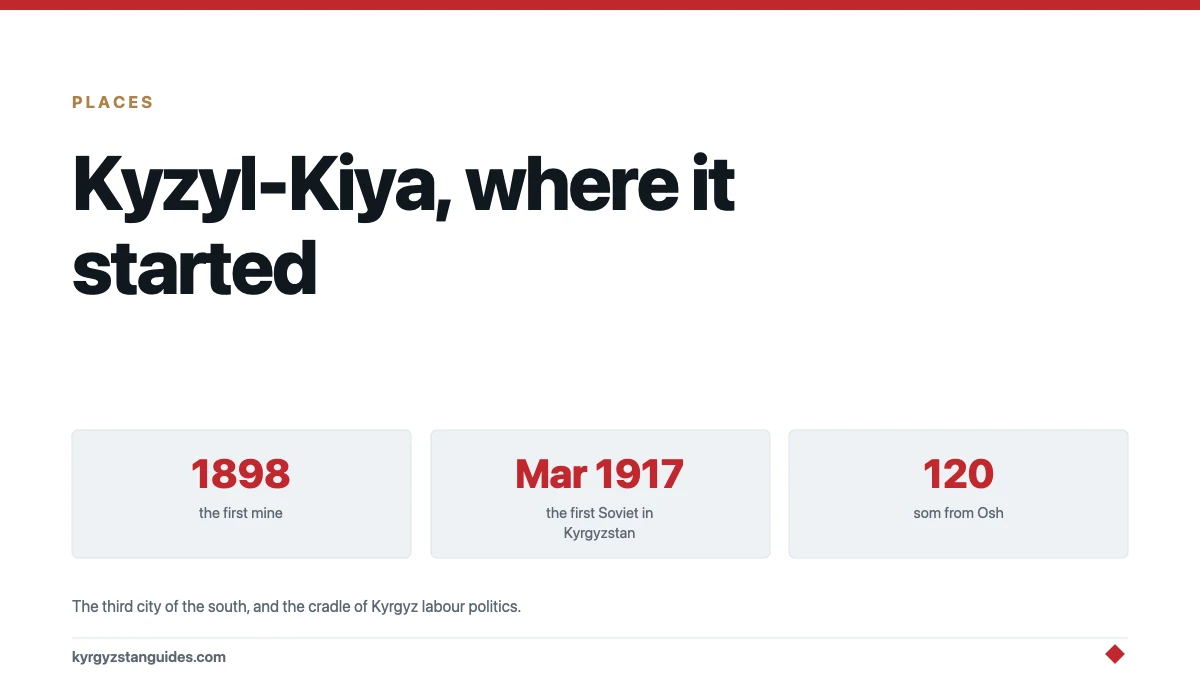
The first Soviet of People's Deputies in Kyrgyzstan was created in Kyzyl-Kiya in March 1917. By November of that year power in the town had passed to it entirely.
That is not a footnote. Kyzyl-Kiya is a coal town founded in 1898, and it was the country's first industrial working class — which is why the revolution arrived here before it arrived anywhere else in what is now Kyrgyzstan.
It is also the third-largest city in southern Kyrgyzstan after Osh and Jalal-Abad, and almost nothing is written about it in English.
The basics
918 metres, in the Kichi-Alai range on the southern rim of the Fergana valley at the foot of the Pamir-Alai. A city of oblast subordination in Batken oblast, covering about 20 square kilometres.
Population 64,100 at the start of 2025 — but for 2023 the national statistics split the same figure into 45,600 urban and 15,600 rural. The town proper is around 45,000 to 46,000; the rest is subordinated villages. More than fifty nationalities are represented.
Coal, from the first day
On the basis of research by the Russian engineer Mikhailov, the first coal mine opened and the town was founded in 1898.
A railway reached it in 1901, and the line linking Kyzyl-Kiya to Skobelev — now Fergana — was commissioned in 1909. The town's own history gives both dates, so treat them as two stages of the same project.
By 1913 around 700 workers were in the mines. Coal from here supplied the whole Fergana valley and southern Kazakhstan.
1938: the Jin-Jigen mine opened and Kyzyl-Kiya received city status.
Coal still provides 55 per cent of the town's gross product.
The first Soviet
The detail is specific enough to be worth setting out.
The first Social-Democrat cells in Kyrgyzstan were organised here. Veterans of the 1905–07 Russian revolution — I. I. Edrenkin and L. G. Solnyshko — came to revive the movement. The first Soviet of People's Deputies in the country was created in March 1917, and a 130-strong Red Army detachment was formed under the same two men.
If you have any interest in how the Soviet period actually arrived in Central Asia, this town is where the answer starts, and it starts in a mine rather than in a city.
The 1977 mudflow
On 1 June 1977 torrential rain sent a sel — a mudflow — through Kyzyl-Kiya. Bridges, housing, roads and communications were destroyed, with damage totalling 42 million roubles.
Relief came from across the Soviet Union. 17,400 square metres of housing was commissioned in the same year. A new residential district went up on vacant land and was nicknamed BAM, after the Baikal–Amur Mainline then under construction. The first microdistrict was finished with builders brought in from other regions.
Both districts are still there, and they are the physical record of the disaster. For the hazard itself, see mudflows in Kyrgyzstan.
What runs now
Coal remains the base. The national coal producer put 2025 output at 1,350,000 tonnes across the country, and the Cabinet has fixed development boundaries for the Kyzyl-Kiya and Markay-Severny plots.
New small industry is arriving, at a modest scale:
A flour mill has been fully re-equipped with Turkish milling equipment, producing up to 60 tonnes of enriched flour a day with 25 workers, supplying the Batken oblast market.
A building-materials plant is under construction on a 0.4-hectare municipal plot with US$150,000 of private investment, launch scheduled for 31 August 2026, expected to make 60 to 70 tonnes a day and create about 15 jobs.
In 2026 the town budgeted over 91 million som for capital road repairs, street lighting and irrigation network modernisation, along with school repairs.
A trade and logistics centre is planned on the territory of the airport — which is to say the airfield is being repurposed rather than reopened to passengers.
The Soviet-era list was much longer: a mining administration, the Alai military equipment plant, a shoe factory, a dairy, a tobacco fermentation plant, electro-mechanical enterprises, a building-materials combine, a cement plant and a cannery. We could not establish which of those still operate, and the cement plant in particular has had a contested ownership history with reports it was at risk of stopping production.
Population is rising: 57,500 in 2021 to 64,100 in 2025. Unlike Sulukta, this is not a shrinking coal town.
What to see
The town's own cultural record is unusually detailed, which is a gift for a place nobody writes about.
A museum opened in 1974 with 2,360 registered exhibits. Two cinemas — the Druzhba, opened 1961, and the Zarya, opened 1968. A central library, which now hosts an internet point.
The best story is the Modo Gulmat garden. In 1932 an elder named Gulmat Almatov turned his two-storey house into a free rest house for miners and his garden into a Pioneer camp. It became the town's culture and leisure centre in 1947 and was given his name in 1997.
Also: the plant club from 1954, a veterans' choir founded on 9 May 1976, and a folk-ethnographic ensemble of "Heroine Mothers" formed in 1977.
We cannot tell you the museum's current opening hours, or whether the two cinemas still function. The city's page records their founding, not their status.
Reading the town
Kyzyl-Kiya rewards a particular kind of attention, and it helps to know what to look for.
The layout is a mining town's layout: pit heads and industrial ground on one side, the old settlement grown around them, then the post-1977 districts built fast on empty land after the flood. BAM and the first microdistrict are visibly of a different decade to everything around them, because they are.
The Soviet civic layer is unusually intact for a provincial Kyrgyz town — a museum, two cinemas, a library, a plant club, a choir, an ensemble, all with founding dates on record. Whether each still functions is another matter, but the buildings are there and the sequence is legible.
And the fifty nationalities are not a statistic here. This was a mining town in the Fergana valley, which means Kyrgyz, Uzbek, Tajik, Russian and Tatar families arriving over a century for the same reason, and that composition is what you will see in the bazaar.
One practical caution
Kyzyl-Kiya sits close to the Uzbek frontier in a part of the country where the border does complicated things.
None of the routes described above crosses it, and no border permit is needed for the town itself or for the Osh road. But the Fergana fringe is stitched with enclaves and salients, and a route that looks direct on a map may not be. Do not improvise cross-country routes here on the assumption that a road on a map is a road you may use.
The same applies westward. The Osh–Batken–Isfana highway has been rebuilt specifically to keep traffic inside Kyrgyzstan, including a 92-to-97-kilometre stage routed around the Uzbek Sokh enclave. Stay on it.
Getting there
This is the easiest of these six towns to reach, by some distance.
Osh to Kyzyl-Kiya is 120 som, departing every forty minutes from 09:00 to 17:40 from Osh bus station. One of the two operators is the town's own transport enterprise.
The same road continues west: Kadamjay 180 som, Aidarken 240 som, Batken 307 som. See Osh for the starting point.
FAQ
Where is Kyzyl-Kiya?
In Batken oblast, at 918 metres in the Kichi-Alai range on the southern rim of the Fergana valley. It is the third-largest city in southern Kyrgyzstan after Osh and Jalal-Abad, with about 45,000 people in the town itself and 64,100 in the wider municipality.
How do I get to Kyzyl-Kiya from Osh?
By bus from Osh bus station for 120 som, departing every forty minutes between 09:00 and 17:40. It is the most frequent and cheapest connection to any of the western Batken oblast towns.
Why is Kyzyl-Kiya historically important?
It was Kyrgyzstan's first industrial coal town, founded in 1898, and therefore home to the country's first industrial workforce. The first Social-Democrat cells in Kyrgyzstan formed here, and the first Soviet of People's Deputies in the country was created in the town in March 1917.
What happened in Kyzyl-Kiya in 1977?
A mudflow tore through the town on 1 June 1977, destroying bridges, housing, roads and communications with damage of 42 million roubles. Relief came from across the USSR, 17,400 square metres of housing was built the same year, and a new district nicknamed BAM was created — it still stands.
Is there still coal mining at Kyzyl-Kiya?
Yes. Coal provides about 55 per cent of the town's gross product, and the Cabinet has fixed development boundaries for the Kyzyl-Kiya and Markay-Severny plots. Unlike Sulukta further west, the town's population is growing rather than falling.
Is there a museum in Kyzyl-Kiya?
The town has a museum opened in 1974 with 2,360 registered exhibits, along with a central library and two Soviet-era cinemas. The city's own records give founding dates rather than current status, so check locally before relying on opening hours.