Oromo looks like a Swiss roll made of dough and meat, steamed until the outside is glossy and slightly translucent, then cut into thick rounds. Every visitor who sees it on a menu next to manty assumes it is the same filling in a different shape.
They are close relatives, but they are not the same dish, and the difference is structural rather than a matter of the filling.
What actually separates it from manty
Not the filling. Both are minced or finely chopped meat with onion, and in most kitchens both go into the dough raw. The difference is structural, and it changes how the dish eats.
Manty is dozens of individually sealed parcels. Each one traps its own juice, which is the entire point of manty and the reason the meat is chopped rather than ground. Our guide to manty goes into that.
Oromo is one continuous sheet of dough, greased, spread with filling, rolled into a coil and steamed as a single piece, then sliced across so each round shows the spiral. Nothing is sealed. The juice runs into the layers instead of pooling, so oromo is drier and more bread-like, and the layers separate rather than bursting.
That is also why oromo very often contains potato and manty does not. A sealed parcel does not need a starch to hold the moisture. A coil does.
Where the sources disagree, and they do
Two details of oromo are stated confidently in different places and do not reconcile, so we are giving you both rather than picking one.
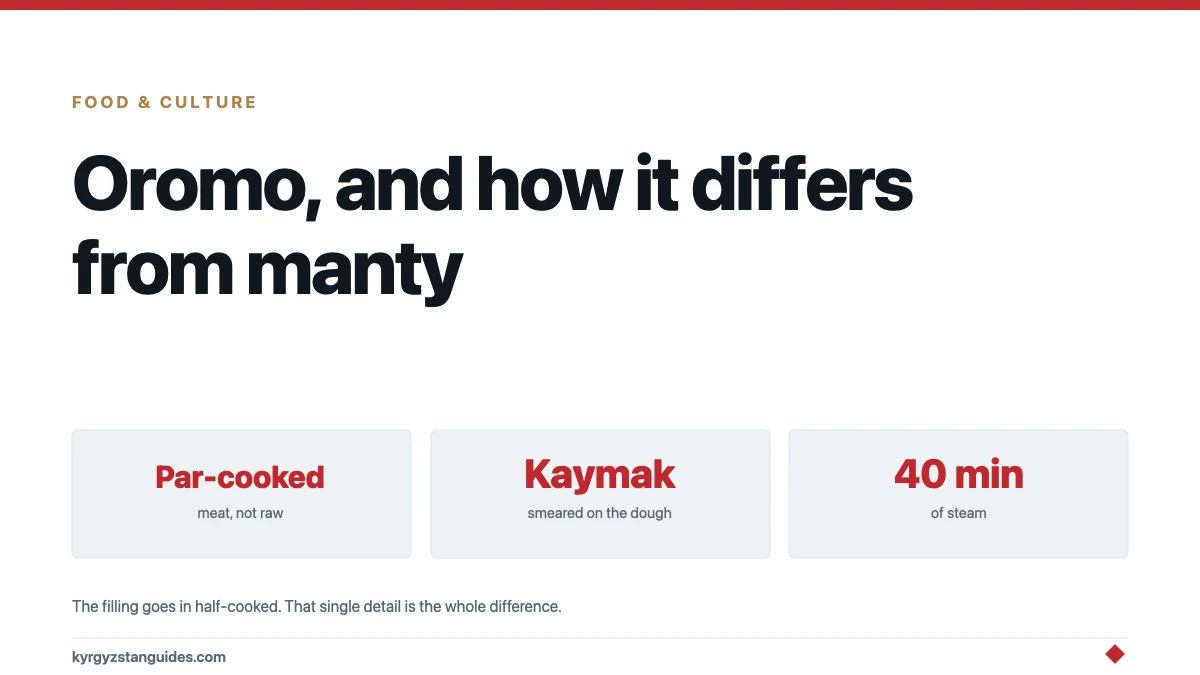
Raw or part-cooked meat. English-language recipes are unanimous that the meat goes in raw and cooks inside the roll. Some Kyrgyz-language descriptions of the dish say the meat is browned first, half-cooked, before it is spread on the dough. Both methods clearly exist in home kitchens. Pre-browning drives off water and makes a roll less likely to flood and split, which is a real advantage; raw is what most published recipes do.
Steaming time. The published figures run from about 15 minutes at one end to 45 to 55 minutes at the other, with 30 minutes the most commonly given. That spread is too wide to be a rounding difference; it reflects how thick the coil is and how much heat the steamer actually delivers. Cook it until the dough is glossy and firm rather than to a clock.
How it is actually built
The dough is rolled out thin, into a long rectangle. Then it is greased. Oil is usual, butter in richer versions, and that fat layer is what separates the coils so the finished roll pulls apart in sheets instead of compacting into a lump. Kaymak belongs to this dish at the table rather than inside it: sliced oromo is commonly served with kaymak or ayran alongside. The dairy side of that is covered in our guide to Kyrgyz dairy.
The filling goes on: finely chopped or minced meat and onion, very often potato, sometimes pumpkin. Pumpkin oromo is common in autumn and is sweeter and softer than the meat version.
The sheet is rolled up from the long edge, coiled into a spiral, and set on an oiled steamer tier. Some cooks invert a dish or plate over it during steaming, which traps a pocket of steam and keeps the top from drying.
Then it steams. Published times vary widely, as above; thirty minutes is the most commonly given figure. It comes out and is sliced across into rounds, so each slice shows the spiral.
Oromo compared with manty and hoshan
| Filling | Shape | Cook | |
|---|---|---|---|
| Manty | Raw, chopped meat and onion | Sealed individual parcels | Steamed 40–45 min |
| Oromo | Raw in most recipes, often with potato | One long coiled roll, sliced after | Steamed, 15–55 min reported |
| Hoshan | Raw, minced | Small parcels | Steamed, then fried on one side |
The practical difference at the table: manty is eaten with your hands and the first bite is about the juice. Oromo is eaten with a fork, the texture is drier and layered, and the potato makes it heavier than it looks. Two slices is a meal.
Where the dish comes from, and why we are not going to tell you
Almost every English-language page about oromo attributes it confidently to one group. Some say Dungan, some say Uyghur, some present it as straightforwardly Kyrgyz.
We looked for a documented origin and did not find one. There is no ethnographic study, no dictionary entry establishing the word's derivation, and no heritage listing that fixes it to a community. Kyrgyzstan has sixteen entries on the UNESCO intangible heritage lists and oromo is not among them; the only food-related ones are flatbread culture, inscribed in 2016, and the grain drink maksym, added in 2025. You can check the whole list on the UNESCO country page.
So the honest position is that oromo is a steamed dish of the Central Asian dumpling family, made and claimed across several communities in the region, and that anyone stating a single origin in a travel article is repeating something they also could not source. The Dungan community of Kyrgyzstan certainly cooks it, which is not the same as having invented it.
We would rather say that than pick a group and sound authoritative.
What it costs
Oromo is a restaurant and canteen dish more than a street food, and it is priced by weight or by portion depending on the venue. In Bishkek, a portion in an ordinary canteen sits in a similar band to manty.
The frozen version is worth watching as an economic indicator. At O!Market, frozen oromo moved from 640 som per kilogram to 740 som per kilogram — a rise of nearly sixteen per cent on one item. Meat and flour prices move fast in Kyrgyzstan, and if you are comparing any food price in this article against what you find on the ground, assume the number has drifted upward rather than down. The wider picture is in our piece on Kyrgyzstan's bazaar economy.
Ordering it without disappointment
Three things worth knowing.
First, oromo is often made in the morning and held. A place that has had it sitting since ten will serve you a slice with a slightly leathery exterior. Asking whether it is fresh is normal and nobody takes offence.
Second, the pumpkin version is genuinely different rather than a lesser substitute, and it is the one that suits people who find mutton fat heavy. It is not vegetarian in most kitchens — there is usually rendered fat in the layers even when there is no meat in the filling — which is the recurring problem described in our vegetarian guide.
Third, portion sizes are unpredictable because it is cut from a roll. One order might be two slices or four. If you are two people, order one and see.
Making it at home is easier than manty
Here is the case for oromo over manty if you are cooking: there is no folding. Manty demands dozens of sealed parcels with a pleat that holds, and beginners lose half of them in the steamer. Oromo needs one rectangle of dough, a smear of fat, a spread of filling, and a roll.
The failure modes are different. The two that matter are a filling that is too wet, which soaks the base and glues the coil shut, and a roll packed too tight, which stops steam reaching the middle. Leave the coil loose. It expands.
The other thing worth knowing about a home-made oromo is that it is a communal quantity by design. A single roll feeds six or eight people, and it cannot sensibly be scaled down, which is part of why it belongs to guest meals and family lunches rather than to a quick dinner for one. Leftover slices reheat badly in a pan and well in a steamer, so if you are given some to take away, put them back over water rather than into oil.
A standard tiered steamer works. So does a colander over a pot with a lid, provided the lid actually seals.
FAQ
What is the difference between oromo and manty?
The structure, not the filling. Manty is dozens of individually sealed parcels, each trapping its own juice. Oromo is one sheet of dough, greased, spread with filling, rolled into a coil, steamed whole and then sliced across. Nothing is sealed, so oromo is drier and layered, and it usually contains potato where manty does not.
Where does oromo come from?
There is no documented origin. It is cooked by Kyrgyz, Dungan and Uyghur households in Kyrgyzstan and claimed by more than one of them, but no dictionary entry, ethnographic study or heritage listing fixes it to a single community. Sources that state one confidently are not citing anything.
How long does oromo take to steam?
Published times range from about 15 minutes to 55, with 30 minutes the most commonly given. The spread reflects how thick the coil is more than any disagreement about the dish. Judge it by the dough turning glossy and firm, and coil it loosely so steam can reach the middle.
Is there a vegetarian oromo?
Pumpkin oromo exists and is common in autumn, but most kitchens still brush the dough with animal fat and many add a little meat to the pumpkin. Ask specifically rather than assuming the pumpkin version is meat-free.
What does oromo cost in Kyrgyzstan?
Restaurant portions are priced similarly to manty. As a reference point for the raw product, frozen oromo at O!Market rose from 640 to 740 som per kilogram, so food prices here are moving quickly and any figure should be treated as a floor rather than a fixed rate.
Is oromo on any UNESCO heritage list?
No. Kyrgyzstan's UNESCO intangible heritage entries include flatbread-making culture, inscribed in 2016, and the traditional knowledge of making the grain drink maksym, inscribed in 2025. No steamed dumpling dish from Kyrgyzstan appears on the lists.