Almost everyone reaches Song-Kul the same way: a jeep from Kochkor over the Kalmak-Ashuu pass, a night or two in a yurt camp, and back. It is a good trip and it is also the mass-market product, commonly sold at $80 to $120 a head for two days.
There is another way in, from the west, through the Suusamyr valley and the village of Kyzyl-Oi, and it takes seven days on foot.
The route
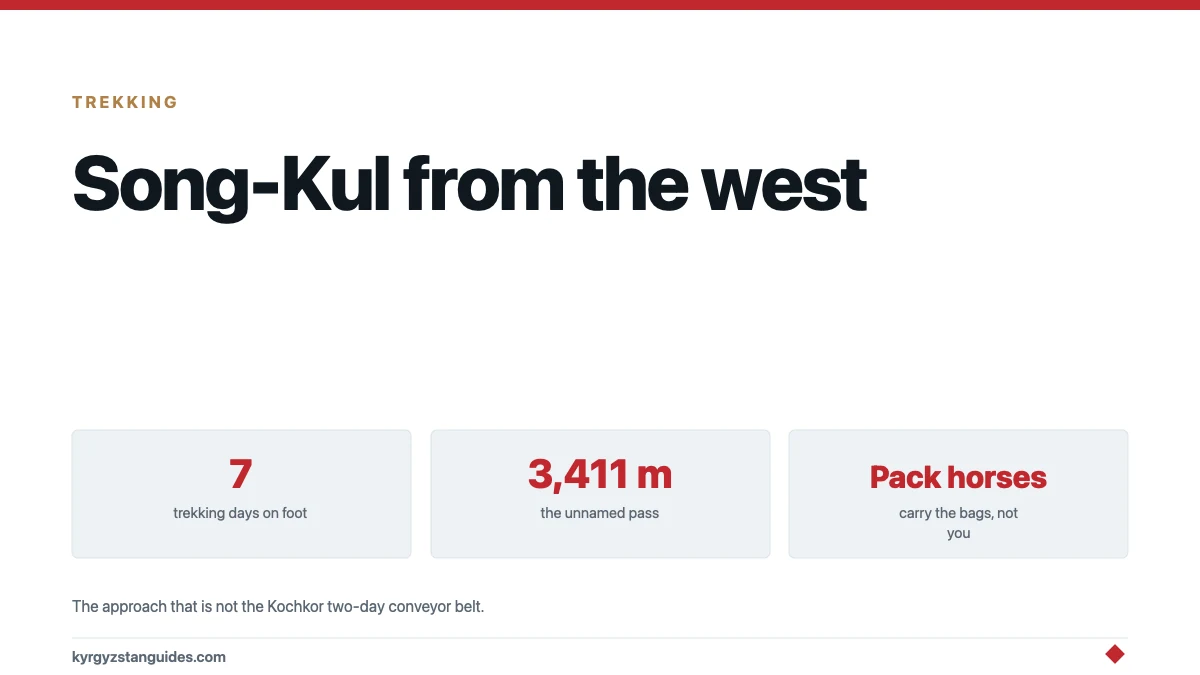
The community tourism association sells it as a ten-day trip including travel days, with seven trekking days, starting in Bishkek and ending in Kochkor.
Day one crosses the Too-Ashuu pass, runs across the Suusamyr valley, and stops at Kyzyl-Oi village for lunch and an afternoon.
Then the walking:
Trek day 1. Out of Kyzyl-Oi on an easy trail through the Oi-Kaying jailoo, about 21 kilometres, camping just below 3,000 metres among shepherd settlements.
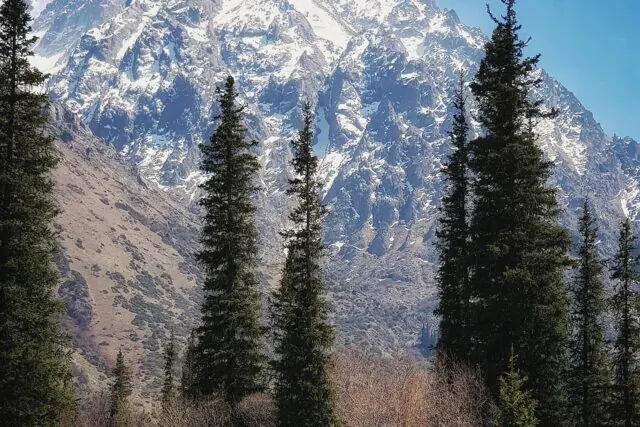
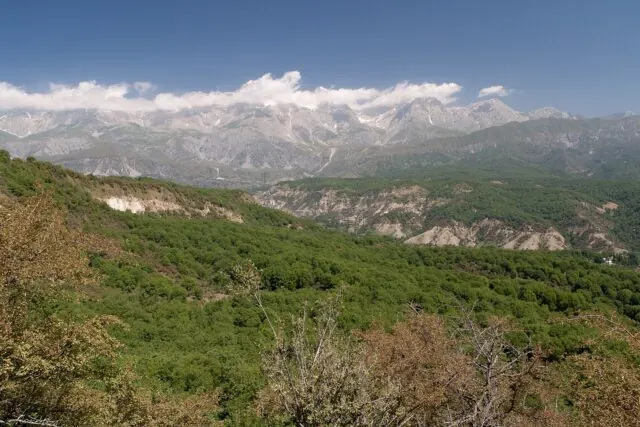
Trek days 2 to 4. A climb to a 3,411-metre pass, then a descent through alpine into forest, about 20 kilometres, camping at Sary-Kul lake.
Trek days 5 and 6. Rolling hills to the Kyzart pass, then a transfer to a guesthouse at Kyzart — with a shower, which after five nights in a tent is the detail people remember.
Trek day 7. Over the Tuz-Ashuu pass at 3,400 metres to Song-Kul, and a night in a shepherd's yurt camp.
Then a rest day at the lake: mare milking, kymyz making, herding, with horse riding optional. Final transfer to Kochkor.
Difficulty medium. Maximum altitude 3,400 metres. Season mid-June to end of September.
It is a walking trek, not a horse trek
This matters and is easy to misread. Pack horses carry the luggage only. Horse rental for riding is explicitly not included.
You walk. Group size runs four to twelve. Accommodation, meals, guides and the pack horses are included; Bishkek and Kochkor hotels, horse hire and trekking equipment are not.
No price is published. You have to ask, which is true of essentially every community-run trek in the country.
The horse alternative
If riding is the point, a different operator sells an eight-day horse expedition with four days in the saddle at 15 to 20 kilometres a day, reaching Song-Kul from the north-east rather than from Suusamyr despite the name.
$1,295 per person at four people, June to September, suitable for complete beginners. Passes listed as Kegeti, Buchuk, Kum-Bel and Jalgyz-Karagai, with a maximum just over 4,000 metres.
Note that one of those — Kegeti — is given there as 3,402 metres against the 3,805 that the Kyrgyz sport tourism federation publishes. We cover that discrepancy in the Kegeti pass guide.
Why go the long way
Three reasons, and the first is the honest one.
It is not the conveyor belt. The Kochkor approach is efficient and consequently busy. Seven days on foot from the west is a filter that almost nobody passes through.
Suusamyr is worth crossing rather than driving over. The valley is one of the great high basins of the country and most travellers see it through a windscreen between two passes on the Bishkek–Osh road. See the Suusamyr valley.
You arrive at Song-Kul having earned the altitude. A jeep puts you at 3,016 metres in a few hours from Kochkor at 1,800. Walking in over a week means the yurt night at the lake is comfortable rather than a headache, which is the recurring problem described in altitude sickness in Kyrgyzstan.
What Kyzyl-Oi is
A word on the starting point, because it is not just a road junction.
Kyzyl-Oi sits in the Kokomeren river gorge below the Suusamyr valley, on the old road between Suusamyr and Chaek. It is a small, red-walled village — the name means "red hollow" — and it is one of the community tourism association's established homestay villages rather than somewhere improvised for this trek.
That matters practically. It means there are beds, meals and people who organise pack horses, which is what makes a seven-day walk out of the back of the village possible at all.
It is also the reason the trek runs in this direction rather than the reverse. Starting from Kyzyl-Oi puts the infrastructure at the beginning, when you are sorting logistics, and the yurt camps at the end, when you want somebody else to cook.
Who this suits, and who it does not
It suits a walker with a week to give, no need to ride, and a preference for being the only group on a trail. Medium difficulty here means long days on rough ground at altitude, not technical terrain.
It does not suit anyone on a tight schedule, anyone who wants Song-Kul as one stop among many, or anyone whose actual interest is horses — in which case the Kochkor two-day product or the north-eastern horse expedition are the right answers and this is not.
It also does not suit anyone unwilling to email. Nothing about this trek can be booked from a webpage; the price, the dates and the group size all come out of correspondence, and if that is a barrier, the Kochkor jeep is one phone call away.
Practical notes
Season is genuinely mid-June to end of September. The passes hold snow either side of that and the yurt camps at Song-Kul come down.
Bring your own trekking equipment. It is excluded from the package — sleeping bag, mat, boots, waterproofs are yours to supply, and there is no rental at Kyzyl-Oi.
Cash. There is nothing resembling an ATM between Bishkek and Kochkor on this route. Carry som.
One shower in seven days. At Kyzart, on trek day six. Plan accordingly.
What we could not pin down
The price, first. Nothing is published and it must be requested.
The name of the 3,411-metre pass on trek days two to four: the itinerary gives the height but not the name. The Kyzart pass altitude is named but not given. The Sary-Kul lake altitude is not stated.
And a small internal oddity worth flagging: the itinerary gives Tuz-Ashuu as 3,400 metres and also gives 3,400 metres as the trip maximum, which sits awkwardly with a 3,411-metre pass earlier in the same route. One of those numbers is approximate.
Whether this exact itinerary still runs in 2026 we could not confirm — the page carries no date.
What you get at the end
Song-Kul itself is worth describing, because it is the payoff and it is not what a photograph suggests.
The lake sits at 3,016 metres in a treeless basin ringed by pasture. There are no permanent buildings, no village and no road around it worth the name — what exists in summer is yurt camps put up by herding families who bring their animals up for the season and take everything down again before the October snows.
That is why the rest day matters. You arrive, and instead of driving away the next morning you spend a day in a working summer camp: mares milked, kymyz made, animals moved. Our guides to Song-Kul and to Kyrgyz nomadic culture cover what that actually involves.
The contrast with the jeep version is not about scenery, which is the same lake either way. It is that a two-day trip arrives and leaves; a week on foot arrives having crossed the ground the herders cross, which changes what the camp looks like when you get there.
FAQ
How do you get to Song-Kul from Suusamyr?
On foot, over seven trekking days from the village of Kyzyl-Oi, via the Oi-Kaying jailoo, a 3,411-metre pass, Sary-Kul lake, the Kyzart pass and finally the Tuz-Ashuu pass at 3,400 metres into the Song-Kul basin.
Is the Kyzyl-Oi to Song-Kul trek a horse trek?
No. Pack horses carry the luggage but you walk, and horse rental for riding is explicitly excluded from the package. An entirely separate eight-day horse expedition reaches Song-Kul from the north-east at $1,295 per person at four people.
How hard is the Kyzyl-Oi to Song-Kul trek?
Rated medium, with a maximum altitude of 3,400 metres and daily distances of around 20 to 21 kilometres on the longer days. It runs mid-June to the end of September.
How much does the trek cost?
Not published. The community tourism association that runs it does not list a price and it has to be requested, which is standard for community-run treks in Kyrgyzstan.
Why not just take the jeep from Kochkor?
Most people should, if time is short — it is two days and around $80 to $120. The western approach is for travellers who want a week on foot, an empty route, and to arrive at 3,016 metres already acclimatised rather than straight from the valley floor.
Where do you sleep on the route?
Tents for the first five nights, a guesthouse with a shower at Kyzart, and a shepherd's yurt camp at Song-Kul. Meals, guides and pack horses are included in the package.