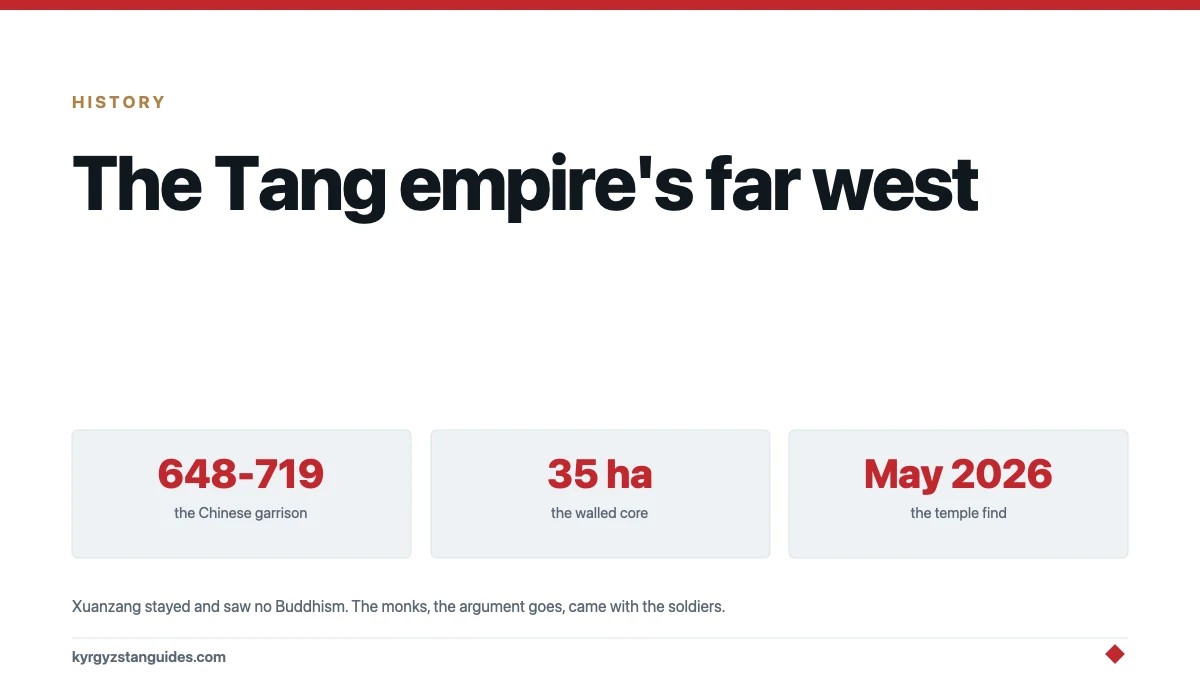
For seventy years in the seventh and eighth centuries, China's Tang empire garrisoned a city in the Chui valley. Its name was Suyab; its remains are the mounds of Ak-Beshim, about 50 km east of Bishkek; and in May 2026 a Kyrgyz-Japanese expedition announced finds there that archaeologists had been predicting since the 1940s.
Almost every traveller who reaches this valley goes to Burana tower and stops. Ak-Beshim sits a short drive away, older, historically heavier — and looking, as one travel write-up honestly put it, like a few stretches of earthen wall. This post is the case for knowing what the walls were.
Five centuries in one site
The sequence, from the scholarly record:
| Date | Suyab was |
|---|---|
| ~5th century | Founded as a trading post by Sogdian immigrants — the Iranian merchant network of the Silk Road |
| 629–630 | Visited by the pilgrim-monk Xuanzang, en route to India |
| 648 | Seat of Tang China's Protectorate General to Pacify the West |
| 679 | New walls recorded by the Old Book of Tang |
| 719 | Tang withdrawal |
| ~10th century | A Karakhanid royal seat |
| 11th century | Abandoned as Balasagun — Burana — takes over |
The footprint matches the biography: a walled inner town (shakhristan) of roughly 740 by 530 metres — about 35 hectares — plus a second enclosure of some 60 hectares. For scale, that is a city the size of a hundred football pitches, five centuries deep, lying unexcavated in proportion that makes every season's dig news.
The Buddhism puzzle
Here is the genuinely interesting scholarly problem, and it turns on a silence.
Xuanzang — the most Buddhism-attuned traveller in Asian history, the monk whose journey became Journey to the West — passed through in 630 and recorded no Buddhism at Suyab. For a Sogdian trading town of that era, that is informative silence.
The argument advanced by the archaeologist Valery Kolchenko in his study of Chui valley Buddhism runs: Buddhism arrived with the Tang, as garrison religion — plausibly boosted by Empress Wu Zetian's empire-wide temple edicts of the 690s. The one direct textual mention is a Dayun monastery recorded in a Chinese compendium of 766, tied to a visit of 750. Which excavated building was the Dayun temple remains disputed between candidates — and Suyab's two known temples, labelled AB-1 and AB-2, have siblings at Krasnaya Rechka down the valley.
If Kolchenko is right, the Chui valley's famous Buddhist layer is not deep Silk Road antiquity but something more specific: the religious footprint of a Chinese military administration, laid down in two or three generations and gone almost as fast.
Where Suyab's treasures actually are
A warning before anyone drives out expecting statuary: the site's portable glories left long ago, mostly for St Petersburg.
The emblematic case is the sleeping Buddha of Ak-Beshim — excavated in 1961, its fragments held today by the Hermitage, part of the long Soviet pattern in which Semirechye's archaeology travelled to the imperial museums that funded the digs. The same current carried material from across the valley: the foundational Semirechye expeditions of the late 1930s worked for the Hermitage, and their finds seeded collections in Russia as much as the republic's own museum in Frunze.
That diaspora is half the reason Ak-Beshim reads as empty ground. The city's five centuries produced plenty; the twentieth century redistributed it. Anyone wanting to stand before Suyab's Buddhism at eye level has better odds in Russia than in Kyrgyzstan — a sentence true of an uncomfortable amount of this country's deep past, as our post on the Saka gold lays out for an earlier millennium.
The May 2026 find
On 7 May 2026, the long-running Kyrgyz-Japanese expedition — led by Bakyt Amanbaeva and Kazuya Yamauchi — announced the remains of a temple complex at the second shakhristan: a staircase, a ramp, a fired-brick platform, dated to the 7th–8th centuries and described, carefully, as presumably Buddhist.
The careful word matters, and so does the vindication: the finds support a hypothesis the Soviet archaeologist Alexander Bernshtam put forward in the late 1940s about what lay in that part of the site. Eighty years from guess to brick. The same team's earlier seasons had already turned up grey roof tiles with Tang production traces — the mundane logistics of empire, which convince archaeologists more than treasures do.
The Li Bai question, handled honestly
You will meet the claim that Li Bai — China's most beloved poet — was born at Suyab around 701. It would make this field outside Tokmok the birthplace of a figure every Chinese schoolchild memorises, and Kyrgyz-Chinese friendship events have not been shy with it.
The sober version: the scholarly paper on the site does not mention him, and the fullest accessible treatment in English — a review of the poet's modern biography — says "plenty of evidence suggests he may have been born in Suyab." May. The family's Central Asian sojourn is part of the tradition; the pin on this exact city is argued, not established. Say "possibly born here" and you are as right as anyone.
Visiting a city-shaped field
Practicalities: Ak-Beshim lies south-west of Tokmok, reachable in the same outing as Burana — our Tokmok guide covers the logistics. Expect ramparts as grassed ridges, excavation scars, potsherds in plough-soil, and no interpretation of any kind; plans for an open-air museum are mentioned in connection with the expedition, with nothing built yet.
The visit works if you bring the story to the site rather than expecting the site to tell it. Stand on the rampart line, put Burana's minaret on the horizon, and you are looking at the whole succession this valley specialises in — Sogdian merchants, Tang soldiers, Karakhanid khans — each capital handing off to the next within a morning's walk. Our history overview threads that needle for the whole country; nowhere threads it tighter than this one field.
What I could not establish
Which structure was the Dayun monastery — the specialists themselves disagree, so this post holds the question open. Anything firmer than "may have been" on Li Bai. The open-air museum's status beyond mention. And the full 2026 excavation report: the announcement is a news item, and the careful version of its finds will be the eventual publication, which is worth waiting for before anyone upgrades "presumably Buddhist" to "Buddhist".
FAQ
What is Ak-Beshim?
The archaeological site of Suyab, a city about 50 km east of Bishkek founded by Sogdian traders around the 5th century, garrisoned by Tang China from 648 to 719, later a Karakhanid seat, and abandoned in the 11th century when Balasagun — today's Burana — superseded it. Its walled core covers about 35 hectares, with a second 60-hectare enclosure.
Was Suyab really a Chinese city?
It was a Tang military-administrative seat for roughly seventy years — housing the Protectorate General to Pacify the West from 648, with new walls recorded in 679 and withdrawal in 719. Excavations have produced Tang-style roof tiles, and the newly found temple complex is read as part of that garrison era.
What was found at Ak-Beshim in 2026?
A staircase, ramp and fired-brick platform of a 7th-8th century complex, announced on 7 May 2026 by the Kyrgyz-Japanese expedition of Bakyt Amanbaeva and Kazuya Yamauchi, and described as presumably Buddhist. The find supports a hypothesis Alexander Bernshtam advanced in the late 1940s.
Why do scholars think Buddhism came late to Suyab?
Because Xuanzang, who stayed in 629-630 and noticed Buddhism everywhere it existed, recorded none here. The case, argued by Valery Kolchenko, is that Buddhism arrived with Tang rule — the only direct textual mention is a Dayun monastery recorded in 766 — making the valley's Buddhist layer a garrison phenomenon rather than ancient bedrock.
Was the poet Li Bai born at Suyab?
Possibly — and no stronger word is honest. The tradition places his family in Central Asia around his birth in 701, and his biographers treat Suyab as a serious candidate; the site's scholarly literature does not engage the question, and no source states it as fact.
Is Ak-Beshim worth visiting?
As a field with history rather than a monument. Expect grassed ramparts, dig scars and no signage, a short drive from Burana and Tokmok — the two sites together make the valley's dynastic succession physically visible, which is the real payoff.
What happened to Suyab in the end?
The Karakhanids kept a seat there around the 10th century, then the centre of gravity moved the few kilometres to Balasagun in the 11th. Cities in this valley did not so much fall as hand over — which is why its history sits in three mounds within sight of each other.