Almost everyone who comes to Karakol for hot springs walks fifteen kilometres up a rough track to Altyn-Arashan.
Very few of them realise that Altyn-Arashan is a side valley of Ak-Suu, that the same geothermal system emerges lower down in a village with a Soviet sanatorium, and that a marshrutka goes there for 15 to 25 som.
The names
The village is Ак-Суу / Ak-Suu, Kyrgyz for "white water". Its Soviet-era Russian name was Теплоключенка / Teplokluchenka, literally "hot springs place". Older maps and Russian sources also carry Тюрген-Ак-Суу / Turgen-Ak-Suu.
All three are the same place, which matters if you are searching for it or reading an older map. It is the seat of Ak-Suu district.
Where it is
Nine to twelve kilometres east of Karakol — sources give 9, 10 and 12, and the resort complex above the village accounts for part of the spread.
Altitude is around 1,920 to 2,000 metres depending whether you mean the village or the sanatorium.
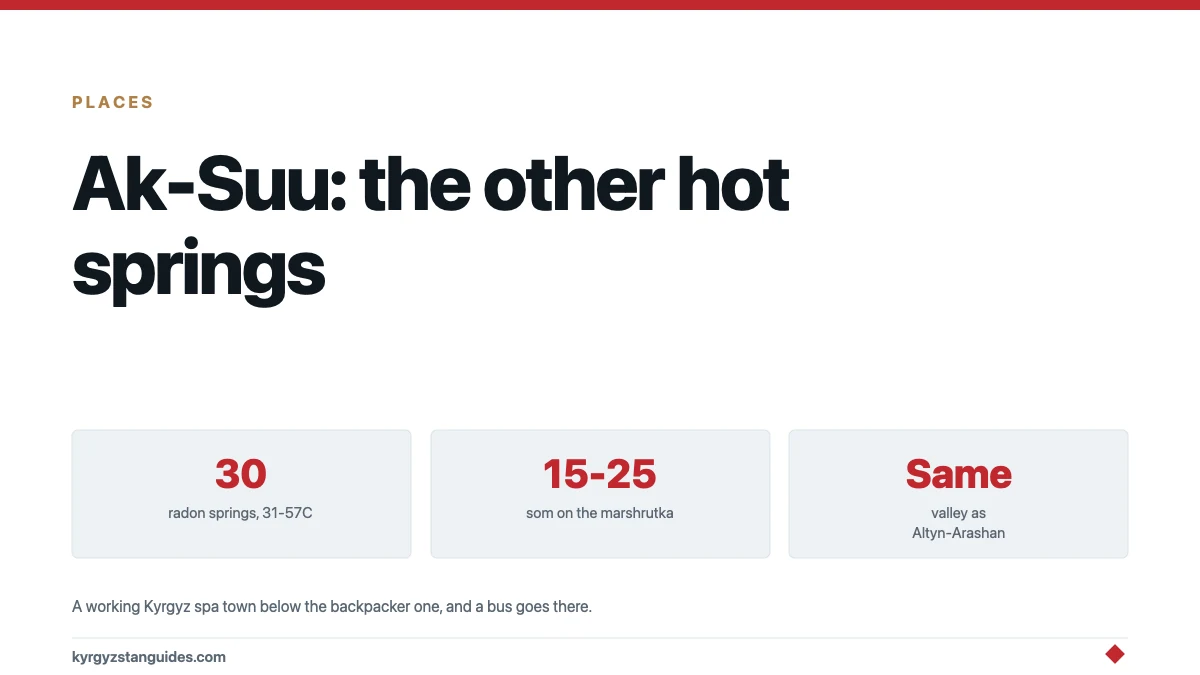
Marshrutka marked "Kurort Ak-Suu" from Karakol bus station, 15 to 25 som. That is the whole journey. See Karakol.
The springs
Around thirty thermal radon springs emerge from cracks in granite, at 31 to 57°C.
The chemistry is specific: nitrogen-thermal, sulphate-chloride-sodium, weakly mineralised, with silicon, acid fluorine, free hydrogen sulphide and a small quantity of radon.
The Ak-Suu sanatorium dates from the Soviet period and still operates, treating central nervous system conditions — one source names infantile cerebral palsy specifically. There are numerous bathhouses in the gorge that locals use at weekends.
That is the thing to understand about this place: it is a working Kyrgyz spa town, not a tourist attraction. The people in the water are there for a course of treatment, not a photograph.
How it relates to Altyn-Arashan
Directly, and this is the useful part.
The Arashan river valley branches off the Ak-Suu valley just south of the village. The track up to the Altyn-Arashan hot-spring huts starts from there — roughly fifteen kilometres on foot, four to six hours, or a jarring ride in an ex-military UAZ.
Altyn-Arashan sits at around 2,350 to 2,435 metres, three to five hundred metres above the village, with several groups of thermal springs and rustic wooden bathhouses.
So the two are the low and high ends of one geothermal system:
| Ak-Suu / Teplokluchenka | Altyn-Arashan | |
|---|---|---|
| Altitude | ~1,920–2,000 m | ~2,350–2,435 m |
| Access | Marshrutka, 15–25 som | 15 km walk or 4x4 |
| Character | Soviet sanatorium, radon baths | Timber huts, sulphur pools |
| Who is there | Kyrgyz patients on a cure | Backpackers |
Ak-Suu is where you go if you want radon baths, a bus and no walking. Altyn-Arashan is where you go if you want a hot tub in a meadow and will spend half a day getting there. Our Altyn-Arashan guide covers the upper valley.
Why go to the lower one
A case, since most guidance sends you straight past it.
It takes an hour and costs 25 som. Altyn-Arashan takes half a day each way and costs a few thousand som if you ride up. If you have one spare afternoon in Karakol rather than a spare day and a half, this is the version of the experience that fits.
It is a different thing, not a lesser one. The radon chemistry at Ak-Suu is what the sanatorium was built around, and it is medically specific in a way the sulphur pools up the hill are not. You are not getting a watered-down Altyn-Arashan; you are getting a Soviet balneological spa still doing the job it was built for.
It is the last place with a shop. If you are walking up to Altyn-Arashan, this is where the road ends as a road and where you buy what you have forgotten.
Nobody else is doing it. Altyn-Arashan in August is a backpacker destination. Ak-Suu on the same day is Kyrgyz families and people on a course of treatment, which is a different experience of the same water.
Etiquette in a working spa
Worth a note, because the social setting is not a tourist one.
People here are patients. Bathhouses are often single-sex or used in shifts, and the rhythm is a prescribed number of minutes rather than a soak. Ask before joining a pool, ask before photographing anything with people in it, and take your cue from whoever is already in the water.
Modesty standards are more conservative than at the backpacker huts upstream. Swimwear is fine; behaving as though you are at a spa resort is not.
None of this is difficult. It is simply the difference between a facility and an attraction, and the village has been treating people since long before anyone walked up the hill for a photograph.
The gorge itself
The Ak-Suu river runs through a canyon 30 to 40 metres wide with slopes up to 300 metres high, through Tien Shan spruce. There are two waterfalls, 25 and 30 metres. Kashka-Suu lake sits in the upper valley.
Trekking from here
This valley is the finishing point for several of the region's published routes:
Kok-Jar to Altyn-Arashan, two days, 18 kilometres, maximum 3,627 metres, medium, June to October.
Glacier Valleys, 47 kilometres, maximum 3,671 metres, July to September, from Jergez into the Ak-Suu valley.
Highlights of Ak-Suu, five days, 65 kilometres, maximum 3,907 metres, July to October, Jeti-Oguz to Arashan.
The Ak-Suu Traverse also finishes here, and a twelve-day traverse of the Terskey Ala-Too runs from Chon-Kyzyl-Suu to Altyn-Arashan. For the quieter options generally, see alternatives to Ala-Kul.
A note on radon
Since the springs are described as radon springs and that word carries different associations depending where you are from, it is worth being straight about it.
Radon is a radioactive gas. Balneology in the Soviet tradition treated low-dose radon water as therapeutic, and radon spas remain in use across the former Soviet Union and in parts of central Europe, including at Jeti-Oguz in the next valley system. The Ak-Suu water is described as weakly mineralised with a small quantity of radon, which is the phrasing used for this class of spa.
We are not in a position to tell you whether that is good for you, and we are not going to pretend otherwise. What we can say is that the medical framing here is a prescribed course of a set number of sessions rather than unlimited soaking, and that is how the sanatorium uses it.
If radon is a concern for you, the practical point is that you have a choice within the same valley: the springs at Altyn-Arashan higher up are described as sulphurous rather than radon, and nobody is running a treatment programme there.
What we could not find out
No prices. No bathing fee, no sanatorium room rate, no day pass in som for either Ak-Suu or the Altyn-Arashan bathhouses. The regional tourism site carries no pricing at all.
Also unknown: the sanatorium's formal name and owner, whether it runs year-round, whether the Arashan valley sits inside Karakol national nature park and whether a fee is charged at the valley mouth, and current 4x4 fares up to Altyn-Arashan.
The "thirty springs" count and the 31 to 57°C range come from a single source.
FAQ
What is the difference between Ak-Suu and Altyn-Arashan?
They are the low and high ends of the same geothermal system. Ak-Suu, also called Teplokluchenka, is a village at around 1,920 to 2,000 metres with a Soviet sanatorium and radon baths, reachable by marshrutka. Altyn-Arashan is 300 to 500 metres higher up a side valley, reached by a 15-kilometre walk or a 4x4, with timber huts and sulphur pools.
How do I get to Ak-Suu from Karakol?
A marshrutka marked "Kurort Ak-Suu" from Karakol bus station, 15 to 25 som. The village is 9 to 12 kilometres east of the town.
Why is Ak-Suu also called Teplokluchenka?
Teplokluchenka was its Russian name in the Soviet period, meaning "hot springs place". Ak-Suu is the Kyrgyz name, meaning "white water". Older maps and Russian-language sources also use Turgen-Ak-Suu. All three refer to the same village.
What are the Ak-Suu springs like?
Around thirty thermal radon springs at 31 to 57°C, emerging from cracks in granite. The water is nitrogen-thermal, sulphate-chloride-sodium, weakly mineralised, containing silicon, fluorine, hydrogen sulphide and radon. A Soviet-era sanatorium uses them to treat central nervous system conditions.
How much does it cost to bathe at Ak-Suu?
No price is published anywhere we could find — not for the sanatorium, the bathhouses or a day pass. The regional tourism site carries no pricing for the valley at all, so ask locally.
Can I walk to Altyn-Arashan from Ak-Suu?
Yes, and it is the standard approach. The Arashan valley branches off just south of the village and the track runs about 15 kilometres up, taking four to six hours on foot, or you can pay for a seat in an ex-military UAZ.