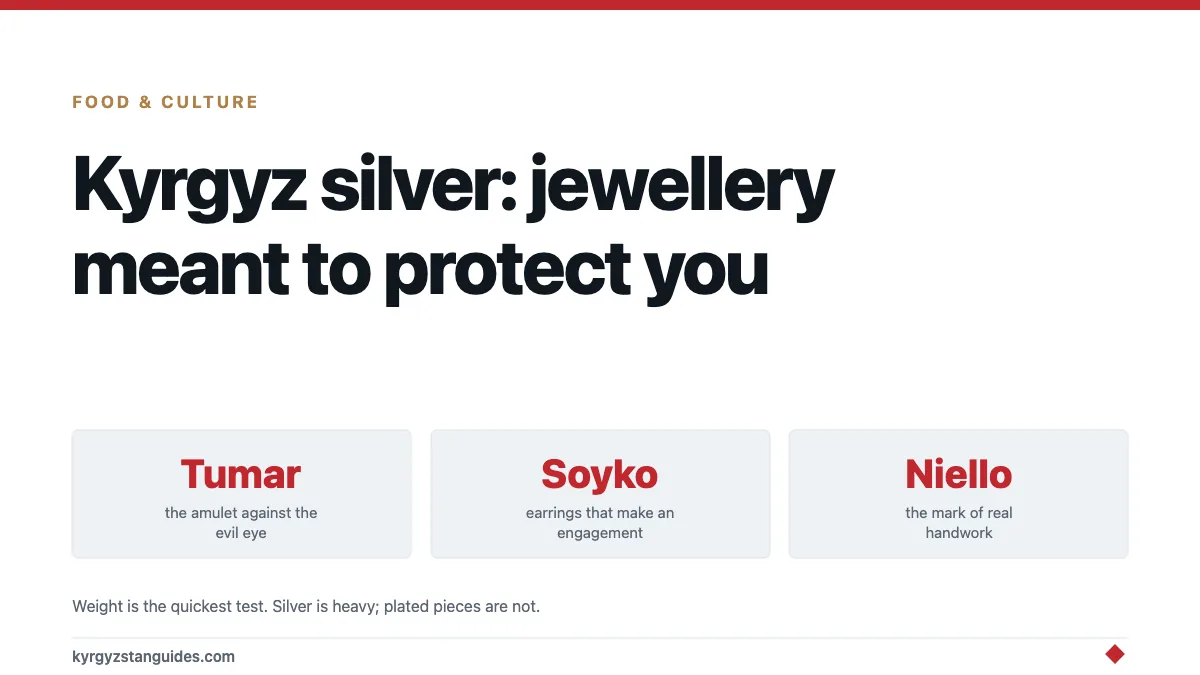
Silver in Kyrgyz tradition is not primarily decorative. It is protective, a metal understood to ward off evil, worked into amulets called tumar that guard against the evil eye, and given at the moments in a life when protection is thought to be most needed. The engagement earrings that make a Kyrgyz betrothal official are part of that logic, not a Western import.
Which makes the silver on a bazaar table a more interesting purchase than a felt keyring, and a slightly more complicated one.
The pieces and their names
Worth knowing, because a seller will use these words and because the categories tell you what the jewellery was for.
Soyko. Earrings. The craft encyclopedia's entry on Central Asian jewellery covers the regional family these belong to. The single most significant piece. A pair of earrings given by the groom's family formalises an engagement, in the ceremony called soyko saluu, which our wedding customs guide sets out in sequence.
Shakek: rings, usually simple in form with an oval or diamond-shaped centrepiece.
Bilerik — bracelets, made curled, rounded or flat.
Topchu. Buttons, which in this tradition are ornaments that also happen to fasten clothing rather than the other way round.
Chach uchtuk — braid ornaments, worn by married women. Hair told you a woman's status here, and the jewellery was part of that signalling.
Tumar, the amulet. Often a triangular or cylindrical case, sometimes holding a written prayer, worn against misfortune and the evil eye.
Breast and temple ornaments were worn for significant occasions rather than daily.
Why silver specifically
Because it's held to be a sacred metal: protective rather than merely valuable.
That belief runs across a lot of Central Asia and it shapes what got made. Amulets in silver. Children's ornaments in silver. Pieces given at weddings and births in silver. The metal was doing a job beyond looking good, which is why old Kyrgyz jewellery is often heavy, plain-formed and covered in pattern rather than being built around gemstones.
Ornament itself carried meaning too. Patterns encoded wishes (prosperity, fertility, a good marriage) and a piece given to a young couple was in effect a written blessing in a visual language everyone could read. Our guide to shyrdak felt making covers the same pattern vocabulary in a different material.
How it was made
The techniques are more varied than the finished pieces suggest: forging, stamping, cutting, embossing, engraving, niello, filigree and granulation, with inlay of nacre and coral.
Niello is the one worth recognising. A black metallic compound is fused into engraved lines, so the pattern reads as black against bright silver. It is durable, it is old, and it is a strong indicator that you're looking at traditionally made work rather than a modern casting.
Filigree and granulation (fine wire work and tiny soldered beads) are the other markers of handwork. Both take time and neither survives mass production.
The silversmith, kumush usta, held real standing in the community, and the skills passed down within families. Mostly men, though women worked in the craft too.
Buying it without being disappointed
The honest version, because bazaars sell a range.
Most of what's on a tourist table is new. That isn't a problem in itself, contemporary silversmiths do good work, but it should be reflected in the price. Pay antique prices only for something you have reason to believe is antique.
Check the weight. Silver is heavy. A piece that feels light for its size is plated or an alloy. This is the quickest test available to you.
Look for hallmarks, but don't rely on them. Soviet-era Russian silver carries a numeric standard mark; a lot of Central Asian work of any era carries nothing at all, including genuine pieces.
Look at the back. Handwork shows its construction on the reverse, solder joins, slight asymmetry, file marks. A cast reproduction is suspiciously tidy underneath.
Ask where it was made. A seller who knows the maker, or the region, is a better bet than one who does not.
Expect to negotiate. Our souvenirs guide has the wider price picture, and our bargaining notes cover where haggling is expected and where it isn't.
What happened to the tradition
Worth knowing before you judge what's on a table.
Soviet policy was not kind to this craft. Private metalworking was restricted, religious and protective objects were discouraged, and a great deal of family silver went into state buying-up schemes or was simply melted during hard decades. What survived did so in households rather than in workshops.
The result is a gap of two or three generations in the transmission of skills, and a contemporary revival that is genuinely a revival, smiths working from museum pieces, photographs and what older relatives remembered, rather than from an unbroken line of teaching.
That's not a reason to think less of new work. It is a reason to understand why a good contemporary piece costs what it does, and why a workshop that can do proper niello or filigree is a smaller category than you'd expect in a country with this much silver history.
It also explains the volume of cast reproduction on tourist tables. Reproducing a shape is easy; reproducing the technique isn't.
Where to look
Bishkek craft shops for contemporary work of reliable quality at fixed prices, more expensive, less risk.
Osh Bazaar and the city markets for range and for negotiation, with more variation in quality.
Karakol and Osh for regional pieces, and generally better prices than the capital.
Cooperatives and craft associations, which exist for felt and increasingly for metalwork, and which put more of the money with the maker.
If you want one thing that's genuinely of this place, a silver piece with niello work or filigree beats almost anything else on offer, including the felt.
A word on antiques
Be careful here, and the risk isn't just being overcharged.
Genuinely old pieces may fall under cultural property rules, and exporting antiques from Kyrgyzstan can require documentation. Our customs and duty-free guide covers the general position. A seller telling you something is two hundred years old is either wrong, or telling you about a problem at the airport.
For most travellers, new work by a living silversmith is the better purchase in every respect.
FAQ
What is Kyrgyz silver jewellery?
Traditional ornaments. Earrings (soyko), rings (shakek), bracelets (bilerik), decorative buttons (topchu), braid ornaments for married women (chach uchtuk) and protective amulets (tumar). Silver is regarded as a sacred, protective metal rather than simply a valuable one.
What is a tumar?
An amulet worn against the evil eye and misfortune, often a triangular or cylindrical silver case which sometimes holds a written prayer. It's among the most characteristic pieces in the tradition.
Why do Kyrgyz engagements involve earrings?
The ceremony soyko saluu, in which the groom's family gives the bride a pair of earrings, is what formalises an engagement. Earrings rather than a ring, and the protective significance of silver is part of why.
How can I tell if Kyrgyz silver is genuine?
Weight is the quickest check: silver is heavy, and a light piece is plated or alloyed. Look at the reverse for solder joins and file marks that indicate handwork, and treat the absence of a hallmark as normal rather than damning.
What is niello?
A black metallic compound fused into engraved lines so the pattern shows black against bright silver. It's a traditional technique, durable, and a good sign that a piece is traditionally made rather than cast.
Can I take antique silver out of Kyrgyzstan?
Genuinely old pieces may fall under cultural property rules and can require export documentation. For most visitors, buying new work from a living silversmith avoids the problem entirely and supports the craft.