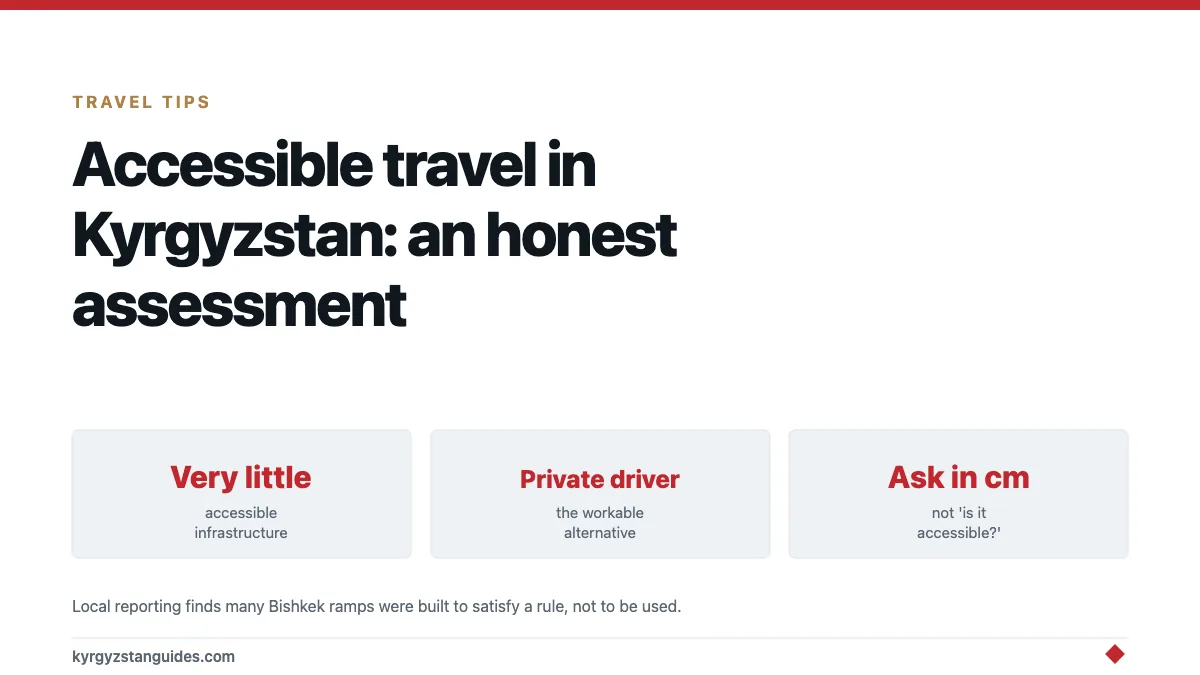
Kyrgyzstan has very little accessible infrastructure. Bishkek has some ramps, a handful of hotels with reliable lifts, and pavements that are frequently broken, obstructed or simply absent; outside the capital there's almost nothing. A wheelchair user can travel here, and people do, but it works through private transport and advance arrangement rather than through anything the country provides.
Saying that plainly is more useful than a page of encouragement, so the rest of this is what actually exists and how people plan around what doesn't.
What the situation really is
Most buildings in Bishkek lack ramps and accessible toilets. Public transport (marshrutkas above all) isn't wheelchair accessible in any meaningful sense, and the vehicles are cramped and high-stepped even for people who walk unaided.
Ramps exist, and their quality is a live subject locally. CABAR.asia's investigation into Bishkek's ramps concluded that many are built to satisfy a requirement rather than to be used, gradients too steep, surfaces wrong, handrails missing or placed where they can't be reached. That gap between what exists on paper and what functions is the thing to plan around.
The rights picture more broadly has been slow. Eurasianet's reporting has covered the delays, and the UNDP has supported a national "Accessible Country" programme, which signals intent rather than a changed street.
Provincial cities are worse than Bishkek. Villages and trailheads have nothing.
What works in your favour
Three things, and they matter more than they sound.
Most restaurants and shops are on the ground floor. Central Asian commercial buildings aren't built upward the way European ones are. Step-free doesn't mean much when there's a 15cm lip at the door, but a single step is a different problem from a staircase.
Private drivers are cheap and normal. Hiring a car with a driver for a day is a routine, affordable thing here, not a luxury service. That removes the single biggest barrier, which is public transport. Our guide to getting around Kyrgyzstan has the rates.
People help. Practically and without ceremony. That isn't a substitute for infrastructure and shouldn't have to be, but travellers consistently report it.
Planning that actually works
The approach almost everyone lands on is the same: private transport, a guide or fixer, and accommodation checked in advance rather than booked on a photo.
Base yourself in Bishkek and make day trips outward. The newer and larger hotels are where ramps and working lifts are most likely, and where staff are most likely to have dealt with the question before.
Hire a driver for the whole trip rather than arranging transport day by day. A driver who understands what you need from a vehicle and a stop is worth more than any amount of route planning.
Ask specific questions, not general ones. "Is it accessible?" will get you a yes almost everywhere. "How many steps from the street to the room?" and "how wide is the bathroom door?" get you usable answers. Photographs, if the place will send them.
Build in more time than seems necessary. Everything takes longer, and a schedule with no slack in it'll fail on day two.
What's realistically possible
Being concrete, since vague optimism helps nobody.
Bishkek itself — museums, Ala-Too Square, the parks, restaurants, the bazaars with help. Doable with a driver and patience.
Issyk-Kul's north shore, a paved road, resort hotels, some of which have lifts. The most straightforward multi-day trip in the country for anyone with mobility needs. Our Issyk-Kul guide covers the towns.
Burana Tower, the site is flat ground, an hour from Bishkek, and the field of balbal stones and the museum are reachable even if the tower's internal staircase isn't. See our Burana guide.
Ala-Archa's lower valley, the road goes into the gorge, and there's mountain scenery from the car park area. The walking trails aren't accessible, but the view doesn't require them.
Much of the country, including Song-Kul, Ala-Kul, Tash-Rabat, the jailoos and essentially all trekking, is not realistically reachable without a 4x4, substantial assistance and a high tolerance for rough ground.
The questions to actually ask a hotel
Booking sites are useless here. An "accessible" tick box on an aggregator means somebody clicked it, and photographs are shot from angles that hide steps.
Write to the property directly and ask these, in this order:
How many steps are there from the street to reception, and from reception to the room? A single step is manageable with help; four is a different trip.
Is there a lift, and does it work reliably? Older Bishkek buildings have lifts that are out of service for long stretches, and power cuts stop them entirely.
How wide is the bathroom door, in centimetres? Ask for the number, not a judgement.
Is there a bath or a step-in shower, and is there anything to hold onto?
Can a car pull up at the entrance itself?
Ask for photographs of the entrance and the bathroom. A property that sends them is telling you something useful about how seriously it takes the question, whatever the photos show.
Other access needs
The discussion here defaults to wheelchairs, which leaves out a lot.
Visual impairment, no tactile paving to speak of, unpredictable pavements, and traffic that does not reliably stop. A sighted companion is close to essential in cities.
Hearing: no induction loops, no captioning, and the language barrier compounds it. Written communication and translation apps work, and Kyrgyz people are used to writing things down for foreigners.
Reduced stamina, heart or lung conditions — the one everybody underestimates. Bishkek sits at about 800 metres and most of what visitors come for is far higher, with Song-Kul around 3,000. Anything that limits your breathing gets harder with every hundred metres of altitude. Our altitude guide sets out where the thresholds are, and that page is worth reading whatever your baseline fitness.
Insurance and medical care
Get cover that names your condition explicitly and includes repatriation. Standard travel policies routinely exclude pre-existing conditions unless declared, and this is not a country where you want to discover that at the point of claim.
Bishkek has the best medical facilities in the country by some distance. Regional hospitals are basic, and remote areas have nothing. Our emergency numbers and health guide has the contacts, and our travel insurance guide covers what policies need to include here.
This is general information rather than medical or legal advice. Talk to your doctor about altitude specifically if you have a cardiac or respiratory condition.
FAQ
Is Kyrgyzstan wheelchair accessible?
Largely not. Bishkek has limited ramps of variable quality, few accessible toilets, and poor pavements; public transport isn't accessible. Travel is possible with private transport, advance arrangement and assistance, but the country provides little infrastructure.
Can a wheelchair user visit Kyrgyzstan?
Yes, with planning. The workable approach is a Bishkek base, a hired driver for the whole trip, hotels checked by specific question rather than by description, and an itinerary weighted towards Bishkek, the Issyk-Kul north shore and flat sites like Burana.
Are Bishkek's ramps usable?
Many aren't. Local reporting has found ramps built to meet a requirement rather than to function. Too steep, wrong surface, handrails missing. Treat the presence of a ramp as a maybe rather than a yes.
Is public transport accessible in Kyrgyzstan?
No. Marshrutkas are cramped, high-stepped minibuses with no accessible provision, and intercity shared taxis are ordinary cars. Hiring a private driver is the practical alternative and is affordable by international standards.
What can I realistically see with limited mobility?
Bishkek's museums, squares and restaurants; the Issyk-Kul north shore; Burana Tower on flat ground; and the lower Ala-Archa valley from the road. Trekking areas, Song-Kul and Tash-Rabat aren't realistic without substantial assistance.
Does altitude matter for travellers with health conditions?
Yes, and it's underestimated. Bishkek is around 800m but most highlights are far higher — Song-Kul sits near 3,000m. Cardiac and respiratory conditions get harder with altitude, so discuss your itinerary with your doctor before booking.