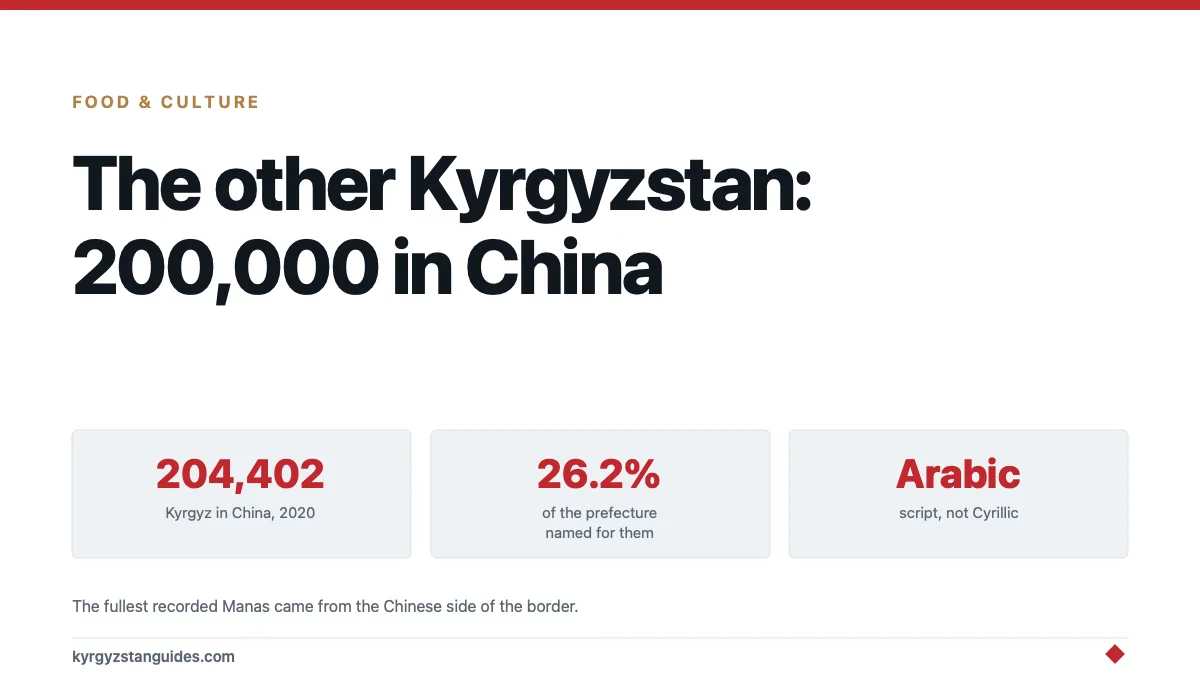
There are more than 204,000 Kyrgyz people in China, according to the 2020 census. Most of them live in a prefecture on the far western edge of Xinjiang that's named after them.
Kizilsu Kyrgyz Autonomous Prefecture covers 70,916 km². About a third the size of Kyrgyzstan itself. Along the border, with its capital at Artush, not far from Kashgar. Its population is 622,222.
And here is the detail that tells you most about the place: the Kyrgyz are 26.2% of it. The majority, 66.2%, are Uyghur.
How the border cut through them
Kyrgyz herders have used the pastures on both sides of the Tien Shan and the Pamir for a very long time. The line dividing them is recent and was drawn by other people.
Nineteenth-century agreements between the Russian and Qing empires fixed a frontier through grazing land that had never had one. The 1916 Urkun sent large numbers of Kyrgyz across it in one direction under desperate circumstances. Soviet and Chinese border closures then made the division absolute for most of the twentieth century.
The same process produced the Pamir Kyrgyz stranded in Afghanistan — a much smaller and far more isolated community on a third side of the same mountains.
So there are now three Kyrgyz populations separated by borders none of them drew: the state, the Chinese prefecture, and the few thousand in the Wakhan.
What the prefecture is
Kizilsu was established as an autonomous prefecture under China's system of ethnic minority administrative units, which gives nominal recognition, some language provision and titular status without meaningful political autonomy.
The geography is spectacular and severe. It runs along the Pamir and Tien Shan frontier, includes Muztagh Ata and Kongur Tagh (both over 7,500 m) and contains the Irkeshtam and Torugart crossings into Kyrgyzstan on its other side.
Most Kyrgyz there are herders in high valleys, and the communities around Muztagh Ata and along the Karakoram Highway are the ones outside visitors are most likely to encounter. RFE/RL went looking for them and found a population that's genuinely hard to find even inside the prefecture named after it.
They are Sunni Muslim, like Kyrgyz in Kyrgyzstan, and they speak Kyrgyz alongside Chinese. Their Kyrgyz is written in a Perso-Arabic script, not Cyrillic — which means a Kyrgyz citizen and a Chinese Kyrgyz can generally understand each other speaking and often can't read each other's writing.
The part that has to be stated plainly
Since 2017, Xinjiang has been subject to a mass internment and surveillance programme directed at Uyghurs and other Turkic Muslim populations.
Kyrgyz have not been exempt. RFA reported in 2018 that hundreds of residents of a single Kyrgyz village were being held in political re-education camps.
This isn't a travel consideration in the ordinary sense. It's context that a visitor to Kyrgyzstan should have, because:
It affects families here. Kyrgyzstani citizens with relatives across the border have in many cases lost contact with them. Some have relatives who were detained. This is a real and current thing in Kyrgyz communities, particularly in the south.
It is politically constrained. Kyrgyzstan's economic dependence on China (infrastructure lending, the bazaar trade, the railway) places sharp limits on what the government says about it. There have been protests in Bishkek; there hasn't been a change of policy.
Do not raise it casually. For some people this is a family matter and not a geopolitical discussion topic. Let them introduce it.
The trade relationship on top of it
The border isn't only a line through a people. It's the busiest economic relationship Kyrgyzstan has.
Goods come over the Torugart and Irkeshtam passes and into the wholesale markets described in our piece on the bazaar economy. Chinese lending has built roads and power infrastructure. The China–Kyrgyzstan–Uzbekistan railway is the largest project in the country's history and it enters through this same prefecture, from Kashgar over Torugart.
So the corridor that separates one Kyrgyz population from another is also the one carrying most of what the smaller of them buys and builds with.
That is the bind in a sentence, and it is why the politics here are careful. China's official account presents the Kirgiz as one of the country's recognised ethnic groups with autonomous administration; the picture from the ground is considerably more complicated.
What it means for the language and the culture
An interesting consequence, and a genuinely positive one.
Because Chinese Kyrgyz communities were cut off from the Soviet modernisation project, some traditional practice persisted there in forms that were disrupted in Kyrgyzstan itself. Oral epic traditions, older vocabulary, certain craft and herding practices.
The most significant case is the Manas epic. Some of the most important twentieth-century manaschi and the fullest recorded variants came from the Chinese side of the border. Jusup Mamay, from Kizilsu, recited a version running to hundreds of thousands of lines and is widely regarded as the greatest manaschi of the modern era. Our piece on the epic covers the tradition.
That is an uncomfortable irony. The national epic of Kyrgyzstan was preserved at its fullest by Kyrgyz who weren't in Kyrgyzstan.
It is also a reminder of what a border does over three or four generations. Two halves of one people, separated by a line neither drew, developed differently: one through Soviet modernisation, Cyrillic, Russian-language education and industrial employment; the other through Chinese administration, Arabic script and a rural economy. Both are Kyrgyz. Neither is the control group.
Can you go?
Practically: Kizilsu is reachable from Kashgar, which is reachable overland from Kyrgyzstan via Torugart or Irkeshtam, and requires a Chinese visa and generally a pre-arranged operator for the crossing.
Realistically: Xinjiang travel involves extensive checkpoints, surveillance and restrictions that change without notice, and independent movement in border prefectures is limited. Anyone considering it should research current conditions carefully and think about what their presence and their questions might mean for people they talk to.
This guide isn't going to pretend to advise on travel inside Xinjiang. What it'll say is that the border you cross at Torugart has Kyrgyz people on both sides of it, and that is worth knowing while you're standing there.
FAQ
How many Kyrgyz people live in China?
204,402 according to the 2020 census, most of them in Kizilsu Kyrgyz Autonomous Prefecture in western Xinjiang.
What is Kizilsu Kyrgyz Autonomous Prefecture?
A prefecture of 70,916 km² in western Xinjiang along the Kyrgyz border, capital Artush, with a population of 622,222 — 66.2% Uyghur, 26.2% Kyrgyz and 6.2% Han Chinese.
Do Chinese Kyrgyz speak the same language?
Yes, Kyrgyz, though written in Perso-Arabic script rather than the Cyrillic used in Kyrgyzstan. Most also speak Chinese.
Why are there Kyrgyz on both sides of the border?
The frontier was fixed by nineteenth-century Russian and Qing agreements across pasture that Kyrgyz herders had always used, and later border closures made the division permanent.
Have Kyrgyz in China been affected by the Xinjiang camps?
Yes. Reporting has documented Kyrgyz villagers being held in political re-education facilities as part of the wider programme directed at Turkic Muslim populations.
Can tourists visit Kizilsu?
It's reachable from Kashgar with a Chinese visa, but Xinjiang travel involves extensive checkpoints and restrictions that change frequently, and independent movement in border prefectures is limited.