Kyrgyzstan has about seven million people. A substantial number of Kyrgyz live outside it, and in several cases they have been outside it for a very long time.
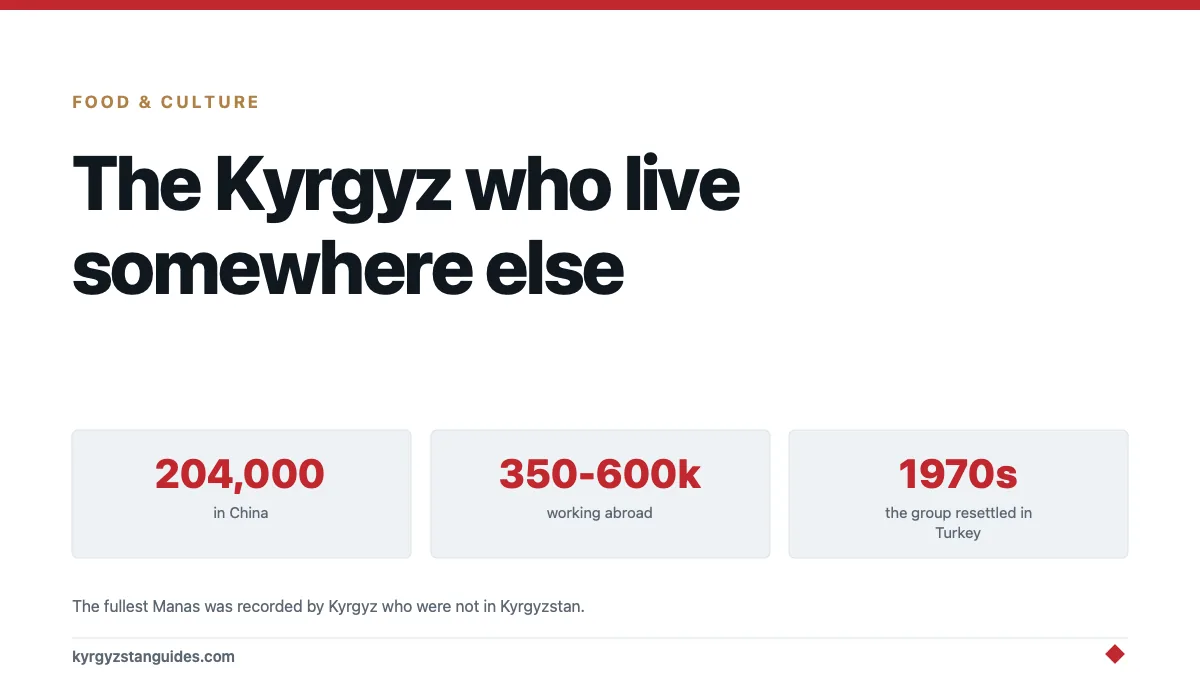
Over 204,000 in China. Several hundred thousand working in Russia at any time. A settled community in eastern Turkey since the 1980s. One to two thousand stranded at 4,000 metres in Afghanistan. Plus smaller populations in Uzbekistan, Tajikistan and, more recently, South Korea, the Gulf and the United States.
Understanding who left, and why, explains a great deal about the country you're visiting.
The ones the border left behind
Not emigrants. People who stayed still while a line moved.
China. Over 204,000 Kyrgyz live in Kizilsu Kyrgyz Autonomous Prefecture and elsewhere in Xinjiang, on pastures Kyrgyz herders used before any frontier existed. Nineteenth-century Russian and Qing agreements fixed a line through that grazing, and Soviet and Chinese border closures made it permanent.
Afghanistan. The Pamir Kyrgyz in the Wakhan corridor, isolated by the same imperial buffer logic, living at around 4,000 m with no road, no clinic and no school.
Uzbekistan and Tajikistan. Kyrgyz communities in the Fergana valley, on the wrong side of boundaries drawn in the 1920s and 1930s.
These are the deepest cases, and they weren't decisions.
The ones who fled
Urkun, 1916. The mass flight into China after the suppression of the revolt against tsarist rule. Estimates of the dead run to around 150,000. Some who reached Xinjiang stayed; their descendants are part of the Chinese Kyrgyz population.
The Pamir Kyrgyz who left Afghanistan in the late 1970s, as the country collapsed into war. After years in camps in Pakistan they were resettled in Van province in eastern Turkey, where they became a settled community.
Eurasianet's reporting on that community is worth reading for what it concludes: the resettlement worked in that people survived, and it cost them the herding life that defined them. Their grandchildren speak Turkish.
The ones who work abroad
The largest group, and the most consequential for the country now.
Somewhere between 350,000 and 600,000 Kyrgyz citizens work abroad, around 63% of them in Russia, sending home remittances worth close to a fifth of GDP.
This is not emigration in the permanent sense. It's circular: people go for a season or several years, return, go again. Families are split across two countries for decades without anyone formally leaving.
It is also diversifying. The Diplomat has tracked the re-evaluation under way: as conditions in Russia have tightened since 2022, South Korea, Turkey, the Gulf states and further afield have absorbed growing numbers — and those destinations reward English rather than Russian, which is part of why English is spreading.
The ones brought here
The diaspora runs both ways, and Kyrgyzstan is a destination as much as an origin.
Around eighty nationalities live here, and most arrived under compulsion. Koreans deported in 1937. Chechens, Karachays and Meskhetian Turks deported in 1944. Germans, some as nineteenth-century settlers and some deported from the Volga. Dungan who crossed the Tien Shan on foot in 1877. Uyghurs from across the Chinese border. Russians and Ukrainians from tsarist and Soviet settlement.
So a country that exports people is also one that received them, in a century when very few of those movements were voluntary.
That symmetry is worth holding. The Kyrgyz stranded in Afghanistan and the Meskhetian Turks put on trains to Kyrgyzstan are the same kind of event seen from opposite ends, and quite often the same decade.
What this does to the culture
Three effects worth noticing while you are here.
Preservation abroad. UNESCO's record of the Manas trilogy treats the epic as a living tradition rather than a text. Cut off from the Soviet modernisation project, Kyrgyz communities in China retained forms that were disrupted inside Kyrgyzstan. The fullest recorded versions of the Manas epic came from a manaschi on the Chinese side of the border, the national epic preserved at its most complete by Kyrgyz who were not in the country.
Divergence. Chinese Kyrgyz write in Perso-Arabic script; Kyrgyzstani Kyrgyz write in Cyrillic. Two halves of one language, mutually intelligible spoken and largely unreadable to each other written.
Return flows. Money, but also ideas, expectations and habits. A generation that worked in Moscow or Seoul comes back with a different sense of what a road, a clinic or a government should be like, and that shows up in politics. All three of the governments removed by protest fell in a country where a large share of the working population had seen how things are done elsewhere.
Names follow the money. As our guide to Kyrgyz naming explains, many families reverted to Russian-format surnames in the 2000s because they smoothed migration paperwork. That is how deep the arrangement reaches: it shapes what people call themselves.
Talking about it
Everybody has a relative abroad. This comes up within ten minutes of any conversation and is discussed matter-of-factly.
"Where is your family?" is a real question, not small talk, and the honest answer is often a list of countries.
The Chinese Kyrgyz are a sensitive subject. As our piece on them sets out, Kyrgyzstani citizens with relatives across that border have in many cases lost contact, and some have relatives who were detained. Let people raise it.
Do not describe migration as a tragedy to somebody whose income depends on it. It is a strategy, chosen under constraint, and the people using it are clear-eyed about both halves of that.
Why it matters to a visitor
Because the country you're in is not the whole country.
A village with no working-age men is not depopulated; it's distributed. A household that seems poor may be sustained by someone in Yekaterinburg. The toi you are invited to may have been paid for by a year of construction work abroad.
And the Kyrgyz world extends across four borders, in communities that have been separated for a century and in ones that reunite every winter when the construction season ends.
That is a more interesting thing to understand than any single valley.
FAQ
How many Kyrgyz live outside Kyrgyzstan?
Over 204,000 in China, between 350,000 and 600,000 working abroad at any time mostly in Russia, a settled community in eastern Turkey, and one to two thousand in Afghanistan's Wakhan corridor.
Why are there Kyrgyz in China?
Nineteenth-century Russian and Qing border agreements cut through pastures Kyrgyz herders already used, and later border closures made the separation permanent.
Why are there Kyrgyz in Turkey?
Pamir Kyrgyz who fled Afghanistan in the late 1970s spent years in camps in Pakistan and were eventually resettled in Van province, where their descendants remain.
Is Kyrgyz migration permanent?
Mostly not. Labour migration is circular, people work abroad for seasons or years and return, with families split between countries for long periods without formally emigrating.
Where do Kyrgyz migrants work besides Russia?
Increasingly South Korea, Turkey, the Gulf states and further afield, particularly as conditions in Russia have tightened since 2022.
Do Kyrgyz abroad speak the same language?
Yes, though Chinese Kyrgyz write in Perso-Arabic script while Kyrgyzstani Kyrgyz use Cyrillic, so they can generally understand each other speaking but not reading.