Osh Airport handles maybe a dozen flights on a busy day, and that's the single most useful thing to know before you land. There is one small terminal, one baggage belt that groans into life about fifteen minutes after the plane parks, and a scrum of taxi drivers waiting just past the exit doors. From touchdown to sitting in a car, thirty minutes is a slow day.
The airport sits about 10 km north of the city center. A taxi into town runs around 200-400 KGS (roughly $2.50-4.50) and takes 15-20 minutes with normal traffic. That is the entire logistics puzzle. Everything else in this guide is detail, but it's detail worth having, because OSS does almost nothing to explain itself to first-time arrivals.
Arrival: what actually happens
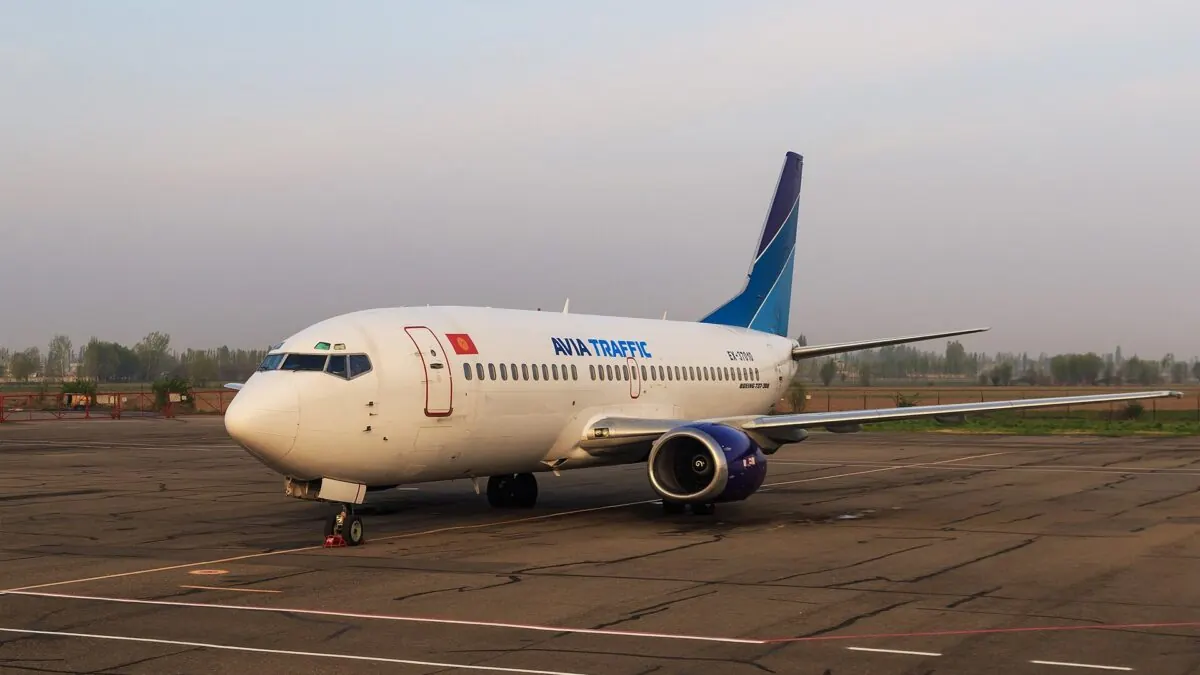
If you're arriving on a domestic hop from Bishkek, there's no passport control at all. You walk off the plane, across a stretch of tarmac, and into the baggage hall. International arrivals (mostly from Russia, plus Istanbul and a few Gulf routes) go through a short immigration line. Most Western passports get 30 days within any 60-day period visa-free; if you needed an e-visa, have the printout ready because the officers at Osh see far fewer foreign tourists than their Manas counterparts. Our full Kyrgyzstan visa guide covers who needs what.
The baggage hall is one room. There is no real duty-free, no lounge worth mentioning, and the toilets are functional rather than pleasant. Trolleys exist but are rarely where you want them. Travelers used to even mid-size regional airports should recalibrate: this is closer to a provincial bus station with a runway, and honestly, that makes it fast.
Getting into the city
Taxi is the sensible option. Drivers cluster at the exit and will quote 500-600 KGS to foreigners as an opening number; a fair price to the center is 300-400 KGS, and locals often pay closer to 250. Agree on the fare before your bag goes in the trunk — meters don't exist here. The Yandex Go app works in Osh and typically prices the run at 200-300 KGS, which is the easiest way to skip the negotiation entirely, though drivers can take ten minutes to accept an airport pickup.
Marshrutka route 107 passes the airport road and costs pocket change, but it's slow, crowded, and awkward with luggage. After a flight, we would pay the $3 for the taxi every time. If your guesthouse offers a pickup for 400-500 KGS, that is worth it for night arrivals.
SIM cards and cash at the airport
There is usually a small mobile operator counter (O! or MegaCom) in or beside the arrivals area, open for daytime flights. A tourist SIM with generous data costs around 200-400 KGS. If the counter is closed (common at night) every second shop in central Osh sells SIMs, so it's a delay, not a problem. Details on plans and registration are in our SIM card guide.
There is an ATM at the airport, but treat it as a maybe: it can be empty or offline. Arrive with some cash — dollars are easy to change in the city at good rates (1 USD is around 87-89 KGS). You need small som notes almost immediately for the taxi, so if the ATM works, take out a modest amount and break a note at the airport kiosk.
Flights: where you can actually go
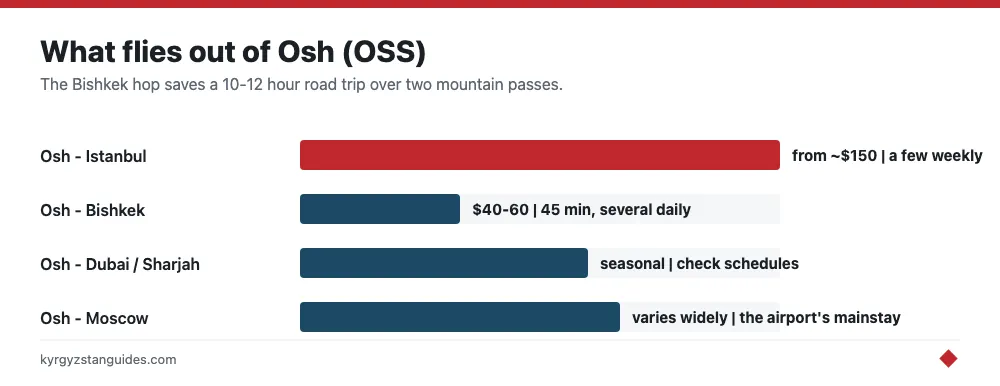
| Route | Typical price | Notes |
|---|---|---|
| Osh–Bishkek | $40-60 one way | Several daily; 45 min; saves a 10-12 hr road trip |
| Osh–Moscow and other Russian cities | varies widely | The airport’s bread and butter; serves migrant workers |
| Osh–Istanbul | from ~$150 | A few weekly; handy back door to Europe |
| Osh–Dubai/Sharjah | seasonal | Check current schedules; routes come and go |
The Bishkek hop is the one most travelers care about. At $40-60 it is one of the best-value flights anywhere, and it replaces a long, winding drive over two mountain passes. Book a few days ahead in July and August; planes do fill. Trekkers heading to Pik Lenin base camp almost all route through this airport, so peak-season demand is real.
Night arrivals
Plenty of international flights land between midnight and 5 a.m, and the airport essentially opens for the flight and closes after it. Taxis will be waiting regardless of the hour: this is the one reliable constant — but quotes rise at night, so 400-500 KGS is normal. There is nowhere comfortable to sleep in the terminal, and staff may usher everyone out once the hall clears. Book your first night’s bed in advance and warn the guesthouse you're arriving late; most in Osh are used to it.
Before you leave the airport
- Agree the taxi fare before getting in, or order via Yandex Go
- Get som: airport ATM if working, otherwise change a small note
- Grab a SIM if the counter is open; skip it if not
- Screenshot your accommodation address in Cyrillic for the driver
- Domestic to Bishkek? Check in closes early — arrive 90 minutes out
Once you're in the city, the good part starts, the bazaar, Sulaiman-Too, and some of the best plov in the country. Our Osh travel guide picks up where the taxi drops you.
Osh is still OSS, and that is worth checking
Bishkek's Manas airport changed its IATA code from FRU to BSZ on 9 August 2025. That has caused enough confusion that it is worth stating the position here plainly: Osh remains OSS, with ICAO code UCFO. No code change for Osh has been announced, and the airport operator's own notice about the Manas change covers Manas only.
The honest caveat is that this is an argument from absence — there is no positive official statement confirming OSS is staying. But the Manas change was well documented and loudly announced, and nothing comparable exists for Osh.
The airport is bigger than it looks, and is being rebuilt
The terminal you walk through feels provincial. The airfield is not. Osh runs a 3,212-metre runway, extended by 400 m with the first aircraft landing on the new surface on 1 April 2019. Since that work it takes Boeing 767-300s, 737-800s and A320s with no take-off weight restriction. The aerodrome sits at 892 metres, about 9 km north of Osh, operates 24 hours, and has an apron of 59,200 m² with nine stands.
On traffic it is not the junior partner people assume. In 2024 Osh handled 2.4 million passengers, 41.5% of Kyrgyzstan's national total of 5.8 million, against Manas's 3.3 million. For perspective on the growth, Osh was at 430,305 passengers in 2010 and 1.35 million in 2018.
A new terminal has been under construction since 14 February 2025, launched by the president. It is to be 25,443 m² over two floors plus a basement, with capacity for over five million passengers a year and up to 900 an hour, plus 650 automated parking spaces, built by the state enterprise Kyrgyzkurulush and financed from the airport company's own funds. No cost figure has been published and no completion date announced.
The airfield work runs alongside it: design in 2025, runway lengthening in 2026, lighting upgraded to ICAO Category III, and the apron expanded with 25 additional stands. Both the Bishkek and Osh runway reconstructions are scheduled to finish in 2027. If you are flying into Osh in the next couple of years, expect a building site and check which terminal you are using.
Getting into the city, with actual numbers
Two marshrutka routes serve the airport: No. 107 for eastern Osh and No. 142 for the west, at 10 som, running 06:00 to 21:00. That is genuinely pocket change, and the reason to take a taxi instead is luggage rather than cost.
Taxis run from 250 som and up to about forty minutes depending where in the city you are going, available around the clock. Those figures come from an airport information page whose own footer says it is not the official airport site, so treat them as a solid anchor rather than a guarantee.
Road distances from Osh, if you are routing onward: Bishkek 601 km, Tashkent 420 km, Namangan 142 km, Andijan 72 km. That last pair explains a lot about Osh: the Uzbek Fergana cities are closer than anywhere in Kyrgyzstan.
FAQ
How much is a taxi from Osh Airport to the city center?
A fair rate is 200-400 KGS ($2.50-4.50) for the 15-20 minute ride. Drivers quote foreigners 500-600 KGS at first, so negotiate before getting in or use the Yandex Go app, which usually prices it at 200-300 KGS.
Is there an ATM and SIM card counter at Osh Airport?
Yes, but neither is fully reliable. The ATM can be empty or offline, and the SIM counter often closes for night flights. Bring some cash to exchange, and buy a SIM in the city if the counter is shut, shops everywhere sell them.
How long before a domestic flight should I arrive at OSS?
Around 90 minutes is enough. The terminal is tiny and security is quick, but check-in counters close earlier than you might expect, and there is no online check-in fallback worth relying on for domestic hops.
How big is Osh Airport?
Bigger than the terminal suggests. The runway is 3,212 metres after a 400-metre extension, with the first aircraft landing on the new surface on 1 April 2019, and it takes Boeing 767-300s, 737-800s and A320s with no take-off weight restriction. The aerodrome sits at 892 metres and operates 24 hours.
How many passengers does Osh Airport handle?
2.4 million in 2024, which was 41.5 per cent of Kyrgyzstan's national total of 5.8 million, against Manas's 3.3 million. Osh was at 430,305 passengers in 2010 and 1.35 million in 2018, so it is not the junior partner people assume.
Is Osh Airport's code still OSS?
Yes. Manas in Bishkek changed its IATA code from FRU to BSZ on 9 August 2025, which caused enough confusion to be worth stating: Osh remains OSS, with ICAO code UCFO. No change for Osh has been announced, though this is an argument from absence rather than a positive official confirmation.
Is there a bus from Osh Airport into the city?
Two marshrutka routes serve it — No. 107 for eastern Osh and No. 142 for the west — at 10 som, running 06:00 to 21:00. The reason to take a taxi instead is luggage rather than cost, since taxis start around 250 som.
Is Osh Airport being rebuilt?
Yes. A new terminal has been under construction since 14 February 2025: 25,443 square metres over two floors plus a basement, with capacity for over five million passengers a year. No cost figure or completion date has been published. Runway and apron work runs alongside it, with both the Bishkek and Osh runway reconstructions scheduled to finish in 2027.