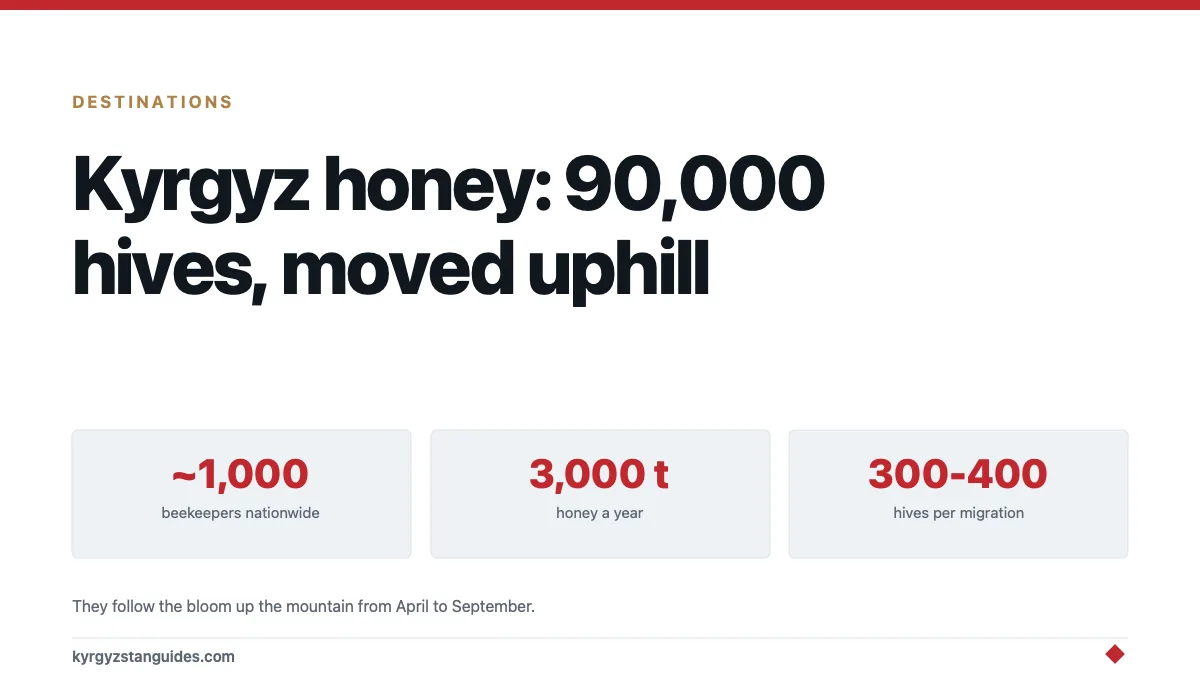
Kyrgyzstan has roughly 1,000 beekeepers running something like 90,000 hives, producing about 3,000 tonnes of honey a year.
Most of those hives don't stay still. They are loaded onto trailers and moved up the mountain as the flowering season climbs, a practice called migratory beekeeping, and in Central Asia it can mean convoys of 300 to 400 hives on wagon trains following the bloom.
If you have seen a row of brightly painted boxes in a high meadow with a caravan parked beside them and wondered what the arrangement was, that's it.
Why Kyrgyz honey is actually good
This is one of the few national products where the marketing claim is defensible.
Altitude spreads the season. In a flat country, a given plant flowers once and the season is short. Here, the same species flowers at different times at different elevations. A beekeeper who moves uphill through the summer chases one long continuous bloom instead of a short one.
The pastures are diverse and largely unsprayed. High meadows in Kyrgyzstan carry an enormous range of flowering plants. Intensive arable agriculture, and therefore intensive pesticide use, is concentrated in the valleys.
Specific plants. Sainfoin is the one behind the famous white honey; there's also esparcet, alfalfa, wild thyme, and the forest species of the walnut-fruit woodlands in the south.
Isolation. The same remoteness that makes everything else here difficult keeps some bee populations relatively free of the disease pressure found in intensively managed European apiculture. Global Voices reported on Hungarian beekeepers relocating operations here for exactly that reason.
How migratory beekeeping works
The season runs roughly April to September and the logic is straightforward.
Spring, low. Fruit blossom and early flowers in the valleys, around 700–1,200 m.
Early summer, mid. Alfalfa, esparcet and sainfoin on the lower slopes.
High summer, top. Alpine meadow flowers on the jailoo, up to 2,500–3,000 m.
Autumn, down. Back to a wintering site.
The beekeeper moves with the hives, usually living beside them in a caravan or a small hut for the whole season. It is a solitary job and a skilled one, and it's a meaningfully different rural livelihood from herding — one of the small number of ways to earn in a mountain village without going abroad to work.
The bee itself
There is a genetic question underneath all of this that is worth a paragraph.
Central Asian beekeeping has historically worked with local subspecies of Apis mellifera adapted to continental extremes, long cold winters, short intense summers, rapid weather change. Those local populations are the reason colonies here can overwinter at altitude at all.
The pressure on them comes from imported queens. A beekeeper who buys Italian or Carniolan stock because it's more productive is, over a few generations, diluting the locally adapted population. It's the identical mechanism that produced the Novokirghiz horse and cost the native breed: an improvement programme that works on the metric being measured and erodes the adaptation nobody was measuring.
Migratory beekeeping makes this faster, because moving hives around the country mixes populations that would otherwise stay separate, and moves parasites and pathogens with them. Research on migratory beekeeping elsewhere has found measurable effects on pest and pathogen loads and on colony size.
None of that makes the honey worse. It's a long-run question about whether the bees that make it stay suited to the place.
The problems
Honest, because the sector has real difficulties.
Certification. This is the big one. Export markets require documented apiary registration, residue testing and traceability. Kyrgyz beekeeping is largely informal and the regulatory framework for registering apiaries is incomplete, which blocks access to the markets that pay best.
Veterinary practice. Widespread and inconsistent use of treatments by small producers creates residue risk, which is precisely what importers test for.
Fragmentation. A thousand beekeepers with ninety hives each isn't a structure that can fill an export order or fund a laboratory.
Adulteration downstream. Kyrgyz honey has a good reputation, which means things are sold as Kyrgyz honey that aren't.
UNDP has run programmes in Kyrgyzstan aimed at exactly these gaps — supporting beekeepers on productivity and competitiveness and on modern hive management methods. The pattern is familiar from the medicinal plant trade: a genuinely good raw product, and a paperwork problem standing between it and a decent price.
Exports do happen, to China, the UAE, Russia, Japan and Saudi Arabia — but well below what the product could support.
Buying honey as a visitor
Buy at the roadside, from the apiary. On mountain roads in summer you will pass beekeepers selling from the hives. This is the best honey and the best price, and the money goes to the person who produced it.
Ask what it's. Sainfoin, esparcet, wildflower, forest. Beekeepers are specific and will tell you.
White honey is real. Sainfoin honey crystallises with very fine crystals and genuinely is pale and creamy. It isn't bleached or adulterated — see our white honey guide for how to tell real from sugar paste.
Crystallised is not spoiled. Most real honey crystallises. Liquid honey in a warm shop in October is more suspicious than solid honey.
Check your import rules. Many countries restrict honey imports. The EU and Australia are strict; check before you buy a kilo.
Packaging. Ask for a sealed jar if you are flying. Beekeepers sell into whatever container is to hand, which is charming and leaks.
Comb honey travels worst and tastes best. If you're eating it here rather than carrying it home, buy a piece of comb. It is the version most Kyrgyz people would choose.
Do not haggle hard at an apiary. Prices at the roadside are already low relative to a bazaar, and the normal bargaining conventions apply lightly to a producer selling their own crop.
Why it is worth a stop
Because it is a genuinely positive version of a story that runs sadly through a lot of this country's economy.
The fishery collapsed. The forests are down 90%. The wild herbs leave as raw material. Beekeeping is the case where the resource is renewable, the practice is sustainable, the product is high quality, and the obstacle is administrative rather than ecological.
That is a solvable problem, which makes it unusual here.
FAQ
How much honey does Kyrgyzstan produce?
Roughly 3,000 tonnes a year, from around 90,000 hives kept by about 1,000 beekeepers.
What is migratory beekeeping?
Moving hives through the season to follow the flowering as it climbs in altitude. In Central Asia beekeepers may move convoys of 300–400 hives, living alongside them for the summer.
Why is Kyrgyz honey considered high quality?
Diverse high-altitude pasture with limited pesticide exposure, a long season created by flowering at successive elevations, and relative isolation from some of the disease pressure in intensively managed apiculture.
What is Kyrgyz white honey?
Honey from sainfoin, which crystallises into very fine pale crystals, giving a naturally white, creamy product rather than a processed or adulterated one.
Where should I buy honey in Kyrgyzstan?
Directly from beekeepers at roadside apiaries in the mountains during summer. Ask what the source plant is, and request a sealed jar if you're flying home.
Does Kyrgyzstan export honey?
Yes, to China, the UAE, Russia, Japan and Saudi Arabia, though volumes are limited by incomplete apiary registration and certification requirements in higher-paying markets.