Here is our verdict up front: Nepal is the better trekking country, and Kyrgyzstan is the better trekking trip for a growing number of people. Nepal has the bigger mountains, the teahouse network, and fifty years of trekking culture behind it. Kyrgyzstan has the thing Nepal traded away long ago — empty trails — and it delivers serious alpine scenery at roughly half the daily cost, with almost no permit paperwork and no mandatory guide.
The short version of the comparison: pick Nepal if you want 5,000-meter passes, lodge-to-lodge convenience, and the sheer scale of the Himalaya. Pick Kyrgyzstan if you want solitude, wild-camping freedom, horse culture, and a trek you can organize in an afternoon rather than months in advance. Below we break the decision down by cost, crowds, infrastructure, altitude, seasons, and visas — the six things that actually change your trip.
Cost: Kyrgyzstan wins, and it is not close
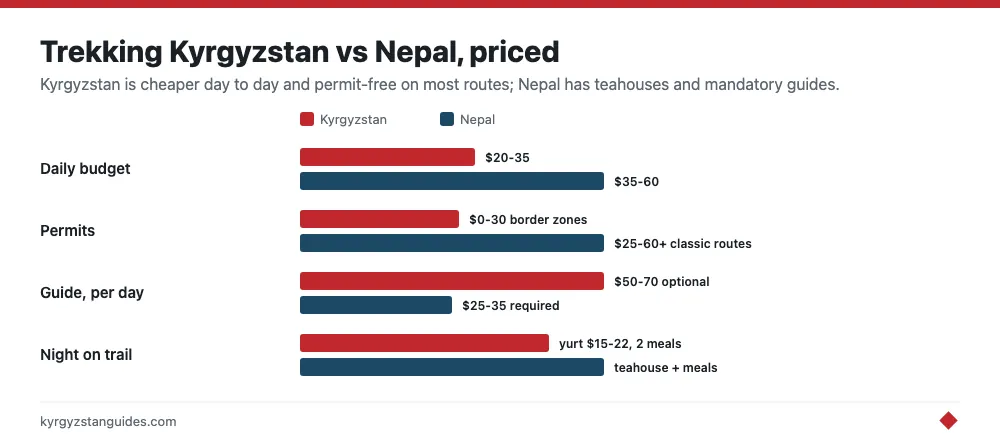
Nepal’s fees stack up before you take a single step. A TIMS card runs around 2,000 Nepali rupees, the Annapurna conservation permit about 3,000, and the Everest region combines a national park fee with a local municipality charge for roughly 5,000-6,000 rupees total. Restricted areas are another tier entirely — Manaslu costs on the order of $75-100 per week in season, plus a mandatory guide and a minimum group size. And since April 2023, Nepal’s tourism board requires a licensed guide on most trekking routes, which adds roughly $25-35 per day whether you wanted company or not.
Kyrgyzstan’s paperwork, by contrast, barely exists. The overwhelming majority of treks — Ala-Kul, Song-Kul, Jyrgalan, Alay foothills — need no permit at all. The exception is the militarized border zone near China, which covers a handful of spectacular spots like Kel-Suu and the Inylchek Glacier; a border permit there carries a state duty of 250 som, about three dollars, on a statutory four working days; the $15-30 usually quoted is the fee charged by a tour agency or CBT office a couple of weeks ahead. There is no guide requirement anywhere. Camping is free and legal almost everywhere, and a yurt bed with dinner and breakfast typically costs $15-22.
| Cost item | Nepal (typical) | Kyrgyzstan (typical) |
|---|---|---|
| Trekking permits | $25-60 on classic routes; $75-100+/week restricted areas | $0 on most routes; ~$15-30 border-zone permit |
| Guide | ~$25-35/day, required on most routes since 2023 | Optional; ~$50-70/day if you hire one |
| Nights on trail | Teahouse bed $3-10 + meals $15-25/day | Yurt with 2 meals $15-22; camping free |
| Realistic daily budget | $35-60 per person | $20-35 per person |
One honest counterpoint: hired help costs more per day in Kyrgyzstan than in Nepal because the industry is small and guides are scarce. If you were always going to book a fully guided trek, the gap narrows considerably, and a high-end Kyrgyz horse-supported expedition can cost as much as a comfortable Nepal lodge trek. It is independent and semi-independent trekkers who save the most by choosing Kyrgyzstan: no permits to buy, no guide mandate to satisfy, free camping, and food that costs a fraction of what teahouses charge at 4,000 meters, where a plate of dal bhat can run $8-10 because a porter carried the rice up for three days.
Getting-there costs deserve a line too. Flights from Europe to Bishkek via Istanbul are frequently cheaper than flights to Kathmandu, and from India both are short hops in the ₹25,000-45,000 return range depending on season. Gear is the one column where Nepal wins: Kathmandu’s rental and knockoff-gear market means you can arrive with a daypack and outfit an entire trek for pocket change, while in Bishkek rental options exist but are limited and you should arrive with your own boots, bag, and shell.
Crowds: a trekking highway versus an empty range
Nepal welcomed over a million visitors a year before the pandemic and is back near those numbers. Tens of thousands of trekkers walk the Everest Base Camp trail every season, and the Annapurna region sees even more. In peak October, popular Nepali trails have a queue-for-the-photo-spot rhythm: lodges book out, suspension bridges jam, and helicopters buzz overhead all day.
Kyrgyzstan’s busiest trail — the Ala-Kul trek above Karakol — sees dozens of hikers a day in August, not hundreds. That is the crowded one. Step onto almost any other route and you can walk from breakfast to camp meeting more shepherds than tourists. The Tian Shan and Pamir-Alay hold thousands of kilometers of valleys with no lodge, no signpost, and no one on them. If solitude is a primary reason you walk, this single factor may settle the whole debate.
Crowding changes the texture of a trek in ways first-timers underestimate. In peak-season Nepal you compete for lodge rooms after midday, walk in a loose procession between villages, and share every pass photo with forty strangers. None of that makes the Himalaya less magnificent — but it does make the experience social rather than wild. Kyrgyzstan’s version of a busy campsite is three tents and a herd of horses. Which of those pictures appeals to you more is a genuinely personal question, and it is worth answering honestly: total solitude also means no lodge to duck into when a storm rolls through, and no passing trekkers to flag down if you twist an ankle.
Infrastructure: teahouses versus yurts and tents
Nepal’s teahouse system is a genuine marvel and the main reason it remains the world’s most accessible high-mountain destination. On classic routes you sleep in a lodge every night, eat cooked meals every few hours, and carry little more than clothes and a water filter. No tent, no stove, no food logistics. It makes 15-day treks feasible for people who have never camped in their lives.
Kyrgyzstan has nothing so smooth, and pretending otherwise gets people into trouble. What it has instead is a patchwork: seasonal yurt camps on the popular routes — Song-Kul’s shores, Altyn-Arashan, the Kol-Ukok area — where a bed and hot meals are easy to find in summer, and true self-sufficiency everywhere else. Our yurt stay guide covers how the camps work, but the honest rule is this: on the top five or six routes you can travel teahouse-style with a light pack; beyond them you carry a tent, a stove, and several days of food. Route-finding is also on you, since Kyrgyz trails are largely unmarked. The full trekking overview sorts routes by how much support exists on each.
Culture on the trail differs just as sharply. Nepal’s routes pass through permanent villages with monasteries, bakeries, and an economy built around trekkers; the human landscape is part of the show. Kyrgyzstan’s high pastures are inhabited only in summer, by herding families who moved up with their animals and will move down in September. Encounters are fewer, less commercial, and often end with fermented mare’s milk you will be too polite to refuse. Neither is better; they are different genres of mountain travel — one a walk through living villages, the other a walk through a working nomadic landscape.
Altitude: the Himalaya is simply higher
This cuts both ways. Nepal’s marquee treks live at altitudes Kyrgyzstan’s popular routes never touch, and for some trekkers that high-altitude experience is the entire point. But altitude is also Nepal’s biggest source of ruined trips — itineraries stretched by acclimatization days, AMS turnarounds, expensive helicopter evacuations.
| Trek | Country | High point |
|---|---|---|
| Everest Base Camp (Kala Patthar) | Nepal | 5,644 m |
| Annapurna Circuit (Thorong La) | Nepal | 5,416 m |
| Manaslu Circuit (Larke La) | Nepal | 5,106 m |
| Ala-Kul pass | Kyrgyzstan | ~3,860 m |
| Pik Lenin base camp | Kyrgyzstan | ~3,600 m |
| Song-Kul horse trek passes | Kyrgyzstan | ~3,400 m |
Practically, Kyrgyzstan’s 3,000-4,000-meter band means most people acclimatize on the move, treks fit into a week instead of three, and the AMS risk — while real — is far more manageable. If your vacation time is short, lower mountains are part of the appeal: the entire Ala-Kul loop takes three to four days, and a wild week in the Tian Shan fits inside a standard vacation with days to spare. The flip side is that anyone chasing the specific physiology and drama of extreme altitude — the thin-air summits, the 5,000-meter passes — will only find it in Kyrgyzstan on mountaineering objectives like Pik Lenin, which is a different sport with different skills and risks.
Seasons: two windows versus one
Nepal gives you two chances a year: the post-monsoon window from about October to November, and spring from March to April. Kyrgyzstan gives you one: mid-June to mid-September, with July and August the safe bets for high passes. Outside that window, snow closes the passes and the yurt camps pack up. The detail worth noticing is that the two seasons are complementary — Nepal’s monsoon summer is precisely when Kyrgyzstan is dry and green. Trekkers who can only travel in July and August are, frankly, choosing between a soggy Nepal and a Kyrgyzstan at its absolute peak. See our month-by-month guide for how the season shifts by region.
Visas and getting there
Both countries are easy on paper. Nepal issues visas on arrival to most nationalities: $30 for 15 days, $50 for 30. Kyrgyzstan goes one better for more than 60 nationalities — including the US, UK, and EU — with 30 days within any 60-day period visa-free, while Indian travelers use a straightforward e-visa; details in the Kyrgyzstan visa guide. Flights are the variable. Kathmandu has more connections from most of the world, but Bishkek is often surprisingly cheap to reach via Istanbul, and from India both are short, comparably priced hops. Neither country should swing the decision on airfare alone.
So which should you pick?
Choose Nepal if any of these describe you:
- You want to stand above 5,000 meters and see 8,000-meter peaks with your own eyes
- You do not want to camp, ever — lodge-to-lodge comfort matters
- You are trekking solo for the first time and want other hikers around
- You are traveling in October-November or March-April
Choose Kyrgyzstan if these sound more like you:
- You want alpine lakes and glaciated peaks without another group at every viewpoint
- Your budget is tight and permit bureaucracy annoys you
- You can travel in July or August
- You like the idea of horses, yurts, and shepherd culture woven into the walking
- You are comfortable with a tent and a map, or happy to base yourself on the few supported routes
And if you have done Nepal twice already and are wondering where the adventure went — that is not really a question anymore. Book Bishkek.
Kyrgyzstan vs Nepal: quick answers
Is trekking in Kyrgyzstan cheaper than Nepal?
Yes, usually by a wide margin. Kyrgyzstan has almost no permit fees, no guide requirement, and camping is free almost everywhere. A self-organized week of trekking typically runs $20-35 per day. In Nepal, permits, the 2023 guide rules on many routes, and teahouse costs push most trekkers to $35-60 per day, and restricted areas like Manaslu cost far more.
Do I need a guide in Kyrgyzstan like I do in Nepal?
No. Kyrgyzstan has no national guide requirement. Nepal’s tourism board has required guides on most trekking routes since April 2023, with the Everest region as the main practical exception. In Kyrgyzstan you only really want a guide for border-zone areas, glacier routes, or multi-day horse treks.
Which country has higher trekking altitudes?
Nepal, by a lot. Classic Nepal treks cross passes above 5,000 meters, while most popular Kyrgyz treks top out between 3,000 and 4,000 meters. That makes acclimatization in Kyrgyzstan simpler and itineraries shorter, though altitude sickness is still possible above 3,000 meters.
Can beginners trek in Kyrgyzstan?
Yes, with one caveat. The walking itself is often easier than Nepal because altitudes are lower, but the infrastructure is thinner. Beginners should stick to supported routes like Ala-Kul from Karakol, Song-Kul horse treks arranged through CBT offices, or yurt-camp-based valleys like Altyn-Arashan and Jyrgalan.
When is the best time to trek in each country?
Nepal has two windows: roughly October to November and March to April. Kyrgyzstan has one: mid-June to mid-September, with July and August the most reliable. The two are neatly complementary, since Nepal’s summer monsoon is exactly when Kyrgyzstan’s mountains are at their best.