Kyrgyzstan is, in our view, the best bikepacking country in Asia right now. Free camping is legal almost everywhere, the visa is a non-issue for most nationalities, drivers are used to seeing loaded touring bikes, and the gravel goes on forever. If you have three weeks, ride the Issyk-Kul and Song-Kul circuit. If you have six, you can link half the country on dirt roads and never repeat a valley.
The short version for planners: come between mid-June and mid-September, expect washboard gravel more often than asphalt once you leave main corridors, carry two to three days of food on high routes, and treat every water source. Bring your own bike if you can; rentals exist in Bishkek but the quality lottery is real. This guide covers the classic routes, road surfaces, traffic, resupply, seasons, and the one topic every cyclist asks about quietly: the dogs.
Why cyclists rate Kyrgyzstan so highly
Three things separate Kyrgyzstan from its neighbors. First, land access: there is no permit system for most of the country, no fenced-off ranchland, and a nomadic culture that treats a tent by a river as completely normal. Second, altitude without extremes: passes sit mostly between 3,000 and 3,900 meters, high enough to feel serious but low enough that a fit rider acclimatizes in days rather than weeks. Third, the Silk Road Mountain Race has mapped and publicized an enormous network of rideable dirt routes since 2018, so route information is far better than the country’s size would suggest.
Costs help too. A guesthouse bed runs around $25-40, a yurt stay with dinner and breakfast typically $15-22, and a full day of eating from bazaars and roadside cafes rarely passes $10. Riders who camp most nights report monthly budgets under $500 excluding flights.
The classic routes
Around Issyk-Kul
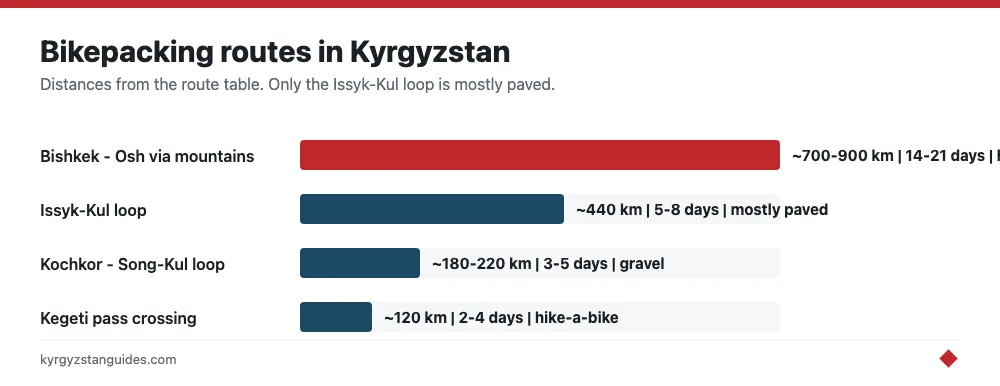
The loop around Issyk-Kul lake is about 440 kilometers and is the gentlest introduction to riding here: paved nearly the whole way, guesthouses every 30-50 kilometers, and a bailout option in the form of marshrutkas that will usually take a bike for a small extra payment. The north shore carries most of the traffic; the south shore is quieter, prettier, and where we would spend the majority of the ride. Detours up side valleys like Jeti-Oguz, Barskoon, and Juuku turn an easy week into a genuinely interesting one. Count on five to eight days at a relaxed pace.
Song-Kul loops
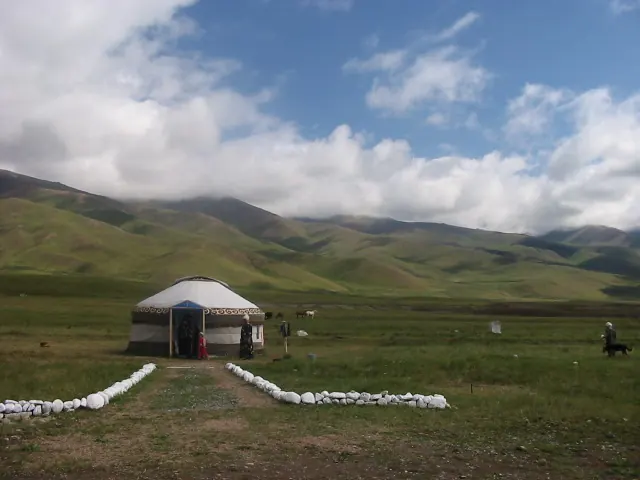
Riding to Song-Kul at 3,016 meters is the signature Kyrgyz bikepacking experience: a huge grassland plateau ringed by yurts and horses, reached only by dirt passes. The three standard approaches are Kalmak-Ashuu from the north (steep, dramatic, roughly 3,400 meters at the top), Moldo-Ashuu from the south (longer, more gradual, arguably the most scenic descent in the country), and the famous switchbacks of the 33 Parrots road on the southeast side. A Kochkor-to-Kochkor loop over two different passes takes most riders three to five days. Nights at the lake are cold even in August; expect frost.
Kegeti Pass
Kegeti is the hard-person’s shortcut from the Chuy valley south toward Kochkor: a climb to roughly 3,780 meters on a road that degrades from gravel to rocky doubletrack to, near the top, a push. It is usually snow-free only from July to mid-September. The reward is a wild descent into the Karakechke side and a link toward Song-Kul that avoids the main highway entirely. This is loaded-mountain-bike terrain, not touring-bike terrain, and we wouldn't take a trailer over it.
| Route | Distance | Days | Surface | Difficulty |
|---|---|---|---|---|
| Issyk-Kul loop | ~440 km | 5-8 | Mostly paved | Easy-moderate |
| Kochkor–Song-Kul loop | ~180-220 km | 3-5 | Gravel, dirt passes | Moderate-hard |
| Kegeti Pass crossing | ~120 km (Tokmok to Kochkor side) | 2-4 | Rough dirt, hike-a-bike | Hard |
| Bishkek–Osh via mountains | ~700-900 km depending on line | 14-21 | Mixed, mostly unpaved | Hard |
Road surfaces: what the map won’t tell you
Main corridors — Bishkek to Karakol along the north shore, Bishkek to Osh over the Too-Ashuu and Ala-Bel passes, Bishkek to Naryn — are paved and mostly in decent condition. Everything else defaults to gravel, and Kyrgyz gravel comes in three moods: smooth hardpack you can ride at 20 km/h, washboard that shakes bottle cages loose, and river-rock sections where 8 km/h feels fast. Washboard is the defining texture of the country; wide tires at low pressure matter more than suspension. We would call 50 mm the sensible minimum tire width and 2.2 inches the comfortable choice.
Rain changes everything. Clay sections around Song-Kul and in the Naryn region turn to peanut butter after storms and can jam a frame solid in minutes. If black clouds are building, camp early rather than pushing into it.
Traffic reality
Honest assessment: the riding on dirt roads is blissfully quiet, you might see five vehicles a day near Song-Kul — but the paved trunk roads deserve respect. Driving standards are aggressive, overtaking is optimistic, and shoulders are inconsistent. The Bishkek–Kara-Balta stretch and the north shore of Issyk-Kul in July and August are the worst offenders. Ride these early in the morning, use a rear radar or at least a bright taillight, and where a marshrutka can skip an ugly section, let it. Our full transport guide covers how to load a bike onto buses and shared taxis without drama.
Water and resupply
Water is everywhere in the mountains and almost all of it is grazed by livestock, so filter or treat every liter. Streams are plentiful on all the classic routes; dry stretches are limited to a few sections around the western end of Issyk-Kul and parts of the Kazarman road. Two liters of capacity is enough for most riders, four if you dry-camp deliberately.
- Village magazins (small shops) stock noodles, biscuits, chocolate, bread, and sometimes cheese — enough to survive, not to thrive.
- Real resupply happens in bazaar towns: Kochkor, Naryn, Karakol, At-Bashy, Kazarman. Dried fruit and nuts by the kilo are the best trail food in the country.
- Yurt camps in season will sell bread, kymyz, and often a hot dinner even to non-guests. Carry small som notes.
- Fuel canisters for stoves are reliably found only in Bishkek and Karakol; plan around that or run a multi-fuel stove on benzin.
Seasons: a shorter window than you think
The high-route season is mid-June to mid-September, and even then storms can drop snow on 3,500-meter passes in August. June brings green hills and full rivers but lingering snowfields on north-facing passes; July and August are prime; early September is quieter with golden light and cold nights. The lake loop extends the season by a month on each side. For the broader picture, see our month-by-month breakdown — cyclists should read spring dates pessimistically, because passes hold snow long after the valleys turn green.
Renting vs bringing your bike
Bring your own if the trip matters to you. Bishkek has a handful of shops and hostels renting hardtail mountain bikes for roughly $10-20 per day, and quality ranges from decent to death-trap; brakes, drivetrains, and racks are the usual weak points. For a week around Issyk-Kul a rental is a reasonable gamble. For Kegeti or a multi-week dirt route, mechanical self-sufficiency is the difference between an anecdote and a rescue, and an unfamiliar rental undermines it. Spares to carry regardless: sealant, a spare derailleur hanger, brake pads, and a tire boot. Bishkek’s shops can true a wheel but don't count on finding a specific 12-speed part. Our packing list covers the non-bike gear that earns its weight here.
About the dogs
Every rider asks, so here's the straight answer: shepherd dogs guarding flocks are a real, manageable hazard. They are doing a job. Protecting sheep from wolves — and a fast-moving bike reads as a threat. The technique that works is boring and reliable: stop pedaling, get off if they close in, put the bike between you and the dog, and walk past slowly while the shepherd (usually nearby) calls them off. Chasing instincts die the moment you stop being prey. Village dogs are noisier but less committed. Actual bites are rare among the hundreds of riders crossing the country each summer, but rabies exists in Central Asia, so any bite means a clinic visit. Some riders carry a dazer or a handful of stones; a firm shout and a dismount solve 95 percent of encounters.
FAQ
Do I need a mountain bike for Kyrgyzstan?
For the Issyk-Kul loop, any solid touring or gravel bike works. For Song-Kul, Kegeti, and other dirt-pass routes, you want mountain-bike tires (2.0 inches or wider) even if the frame is a rigid gravel rig. Washboard and river rock punish narrow rubber.
Is wild camping legal and safe?
Yes on both counts, with normal precautions. Camp out of sight of the road when practical, ask permission if you are near a yurt (you will usually be invited in for tea), and expect curious visitors rather than trouble. Theft from tents is rare.
How fit do I need to be?
The lake loop suits any regular cyclist. Dirt routes demand comfort with 1,000-1,500 meter climbing days at altitude on bad surfaces, plus the patience to push a loaded bike occasionally. Riders who train on gravel at home adapt within a week.
Can I fly my bike into Bishkek easily?
Yes. Manas airport handles bike boxes routinely, taxis large enough for a box wait outside arrivals, and most Bishkek hostels will store packaging for your return flight. Confirm your airline’s sports-equipment fee before booking; it varies from free to painful.