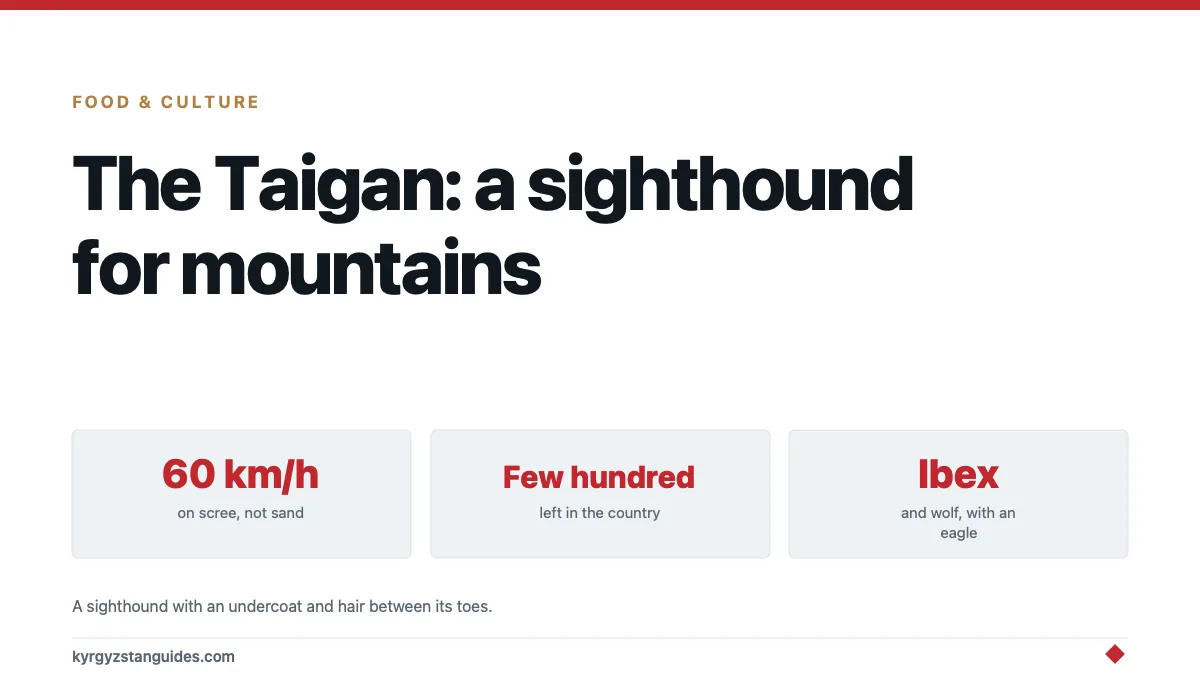
There is a dog bred specifically to run down ibex on scree at 3,000 metres. It hunts alongside a golden eagle. It reaches around 60 km/h. It is Kyrgyzstan's national breed, and there are only a few hundred of them left.
The Taigan gets a fraction of the attention that eagle hunting gets, which is odd, because in the traditional hunt the dog and the bird work together and the dog is arguably doing the harder job.
What a Taigan is
Taigan simply means hound in Kyrgyz. It is also called the Kyrgyz Taighany or Kyrgyz borzoi, and it belongs to the sighthound family: the group that includes salukis, borzois and Afghan hounds, built for speed and for hunting by sight rather than nose.
Except the Taigan isn't quite that, and the difference is the point.
| Feature | Taigan |
|---|---|
| Height | Roughly 58–66 cm at the shoulder |
| Weight | About 23–32 kg |
| Top speed | Around 60 km/h |
| Coat | Soft, slightly wavy, medium length, with a dense winter undercoat |
| Feathering | Heavy on ears and tail |
| Feet | Thick hair between the pads |
A classic desert sighthound is thin-coated and fine-boned, because it runs on flat sand in heat. The Taigan is a sighthound adapted to a cold mountain: undercoat for winter, feathering that sheds snow, and hair on the paws working as something close to a boot on ice and sharp scree.
It also, unlike most sighthounds, works scent and will retrieve. In terrain where the quarry disappears behind a ridge every thirty seconds, a dog that only hunts by sight isn't much use.
What it hunts
Ibex, roe deer, fox, badger and wolf.
The ibex part is worth sitting with. Our guide to ibex and argali covers how these animals move on ground that most humans need rope for. A dog bred to pursue them on that surface is a serious animal.
Wolf hunting is the other traditional use, and it's the one that explains the temperament. A dog expected to engage a wolf isn't a pet-shaped sighthound.
It is worth noting what this dog is not. Kyrgyzstan's other well-known dog is the livestock guardian that lives with sheep on the jailoo: a large, independent animal whose job is to deter predators, and which will take your approach to a flock seriously. A survey of Kyrgyz dogs separates the two clearly, and so should you: the guardian is the one to give a wide berth to when you walk past a herd.
The eagle partnership
This is the part almost nobody outside Kyrgyzstan and Kazakhstan knows about.
In the traditional hunt (salburun) the dog and a trained golden eagle work as a team. The eagle has the altitude and the view; the dog has the ground and the endurance. The bird can mark and hold quarry; the dog can push it out of cover and reach it over broken terrain the falconer cannot cross.
It is a genuinely sophisticated hunting system, and it is one of the older continuously practised ones anywhere. Reporting on the breed describes the same partnership.
Why there are so few left
The pattern will be familiar from the native Kyrgyz horse.
The Soviet period discouraged private hunting and the household economy that supported working dogs. A hunting hound is expensive to keep when hunting is neither your food source nor legal in the old way.
Crossbreeding. Without a maintained studbook and an economic reason to breed selectively, a working population dilutes quickly.
No international recognition. A breed reference profile notes the same thing: the Taigan is recognised by the Hunting Commission of Kyrgyzstan's environment ministry and by the Russian Kennel Club. The FCI (the body that governs breed standards internationally) does not recognise it. That matters practically: no FCI recognition means no international pedigree market, no show circuit, and far less money flowing back to breeders than a comparable rare breed in Europe attracts.
Small numbers compound. A population of a few hundred has a genetic problem as well as a numbers problem.
Estimates put the surviving population in the low hundreds. That is the same order of magnitude as an endangered wild species, in a domestic animal that took centuries to develop.
What is being done
Less than the situation warrants, and it's mostly private.
There are breeders and hunting associations in Kyrgyzstan working to maintain the line, register animals and push for international recognition. Salburun has been promoted as heritage: it features at the World Nomad Games, which Kyrgyzstan hosted and built much of its cultural tourism image around, and that promotion has given the dog a visibility it did not have twenty years ago.
The gap is between visibility and viability. A dog that appears in a festival demonstration once a year is being preserved as a performance. A dog that is still used to hunt ibex in Naryn region in winter is being preserved as a breed, because the selection pressure that made it's still operating.
The honest position: nobody has published a rigorous census, the numbers in circulation are estimates, and the difference between "a few hundred" and "a few dozen breeding animals" is the difference between difficult and finished. That uncertainty is itself a sign of how little institutional attention this has had. Compare it with the snow leopard, which has international funding, collaring programmes and published population models, for a wild animal that is harder to count.
Can you see one?
Not easily, and not by turning up somewhere.
At festivals. Salburun demonstrations and the World Nomad Games are the realistic option. Taigans appear alongside the eagles and the traditional games, and this is where most visitors who see one see one.
In Naryn and Issyk-Kul regions, with hunting families. This isn't a drop-in thing; it needs a connection through a guide or a community tourism office.
Not at a kennel. There is no visitor breeding centre.
If you do meet one:
Ask before touching. These are working animals, not exhibition dogs, and some are sharp with strangers.
Do not compare it to a greyhound out loud. People here are proud of the distinction, and they're right about it.
Ask about the hunt rather than the dog. You'll get a much better conversation.
Why it matters
Because the Taigan is a piece of applied knowledge, not an ornament.
Somebody spent generations selecting for a sighthound that could take an undercoat without losing speed, work scent as well as sight, cross scree without wrecking its feet, and cooperate with a bird of prey. That is a design solved by trial over a very long period, in a specific landscape, by people who needed it to work.
It sits alongside the yurt, the native horse and kymyz as technology that looks like folklore from the outside. When the last few hundred of them go, what is lost isn't a picturesque animal. It is the answer to a problem nobody is solving twice.
FAQ
What is a Taigan dog?
Kyrgyzstan's native sighthound, bred for hunting in high mountains. The name means hound in Kyrgyz, and the breed is also called the Kyrgyz Taighany or Kyrgyz borzoi.
What does a Taigan hunt?
Ibex, roe deer, fox, badger and wolf, often in high, broken terrain and sometimes in coordination with a trained golden eagle.
How fast is a Taigan?
Around 60 km/h, which is fast for a dog working on scree and mountain slopes rather than flat ground.
Is the Taigan endangered?
Effectively yes. The surviving population is estimated in the low hundreds, and the breed is widely described as close to extinction.
Is the Taigan a recognised breed?
It's recognised by the Hunting Commission of Kyrgyzstan's environment ministry and by the Russian Kennel Club, but not by the FCI or the main international breed clubs.
Where can tourists see a Taigan?
Most realistically at salburun hunting demonstrations or the World Nomad Games. Otherwise it requires a connection to a hunting family, usually arranged through a guide or a community tourism office.