Kyrgyzstan is an obvious drone country. Empty valleys, no crowds, yurts on green pasture, glaciers, and light that photographers travel for.
It is also a country with sensitive borders on every side, active military sites, and a regulatory position that is tightening rather than loosening.
Here is what currently applies, what is coming, and the specific places that will get your drone confiscated.
Bringing one in
Tourists can bring drones into Kyrgyzstan. Customs officers generally allow entry where the drone is clearly for recreational or photographic use.
Carry it in hand luggage, keep the batteries with you as airlines require, and do not be evasive if asked what it is for.
The current position for a tourist
As a foreign visitor flying recreationally, you do not need to register the drone or obtain a permit in advance, provided you stay strictly in uncontrolled airspace.
The core restrictions:
| Rule | Limit |
|---|---|
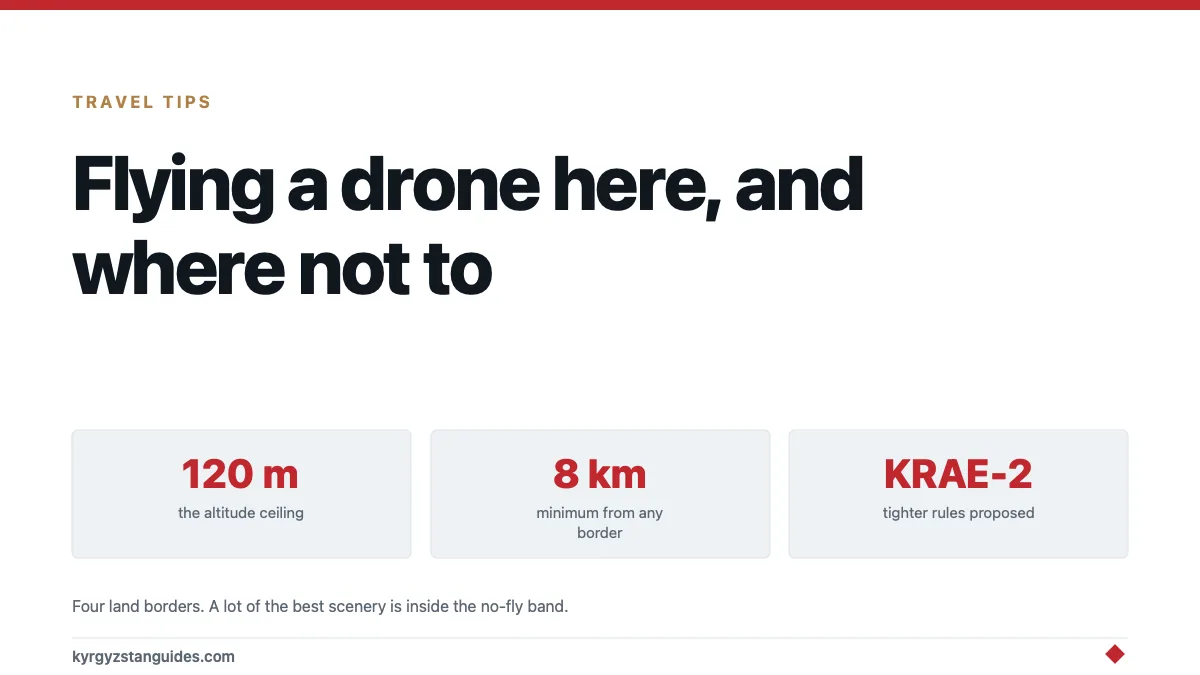
| Maximum altitude | 120 m (400 ft) |
| Distance from any national border | at least 8 km |
| Drones over 25 kg | Require civil aviation registration |
| Airports, military sites, border zones | Prohibited |
The 8-kilometre border rule is the one that matters most here, and it isn't a small constraint. Kyrgyzstan borders China, Kazakhstan, Uzbekistan and Tajikistan, and a very large share of the scenery people come to film is close to one of those lines.
What is coming
Kyrgyzstan has been working on tighter regulations, discussed as KRAE-2, which would introduce a permit-based regime for most drone flights.
Under the proposed framework, flights would require approval from air traffic control, with permission obtained at least three days in advance, and additional coordination with security agencies, local authorities and defence bodies.
If that comes into force as drafted, casual recreational flying by a visitor becomes substantially harder. Regional overviews of drone rules track the position across Central Asia, where Kyrgyzstan has historically been the most permissive and Uzbekistan and Turkmenistan the least. 24.kg reported on the proposed rules, and this is an area where you should check the current position rather than relying on any guide, including this one.
Why the rules are tightening
Not arbitrary, and worth understanding so the restrictions read as something other than obstruction.
Four land borders, several of them recently contested. The Kyrgyz–Tajik frontier was the site of armed clashes in 2021 and 2022 and was only fully delimited in March 2025. A drone near that line is not a photography question.
Russian and Kyrgyz military infrastructure. Kant airbase is operational, and the country hosted an American base until 2014.
Regional security climate. Drones have become a battlefield technology in ways that have made every government in this region more alert to small unregistered aircraft than it was five years ago.
A functioning civil aviation authority with limited capacity. Blanket restrictions are cheaper to enforce than case-by-case assessment.
None of that makes a tourist with a consumer drone a threat. It does mean the benefit of the doubt is thinner than it would be in Europe, and an argument at a checkpoint is one you will lose.
Where absolutely not to fly
Anywhere near a border. Torugart, Irkeshtam, Kyzyl-Art, Karamyk, Korday and the entire frontier zone. This includes a great deal of the Pamir and the eastern Tien Shan.
Border-permit areas. Kel-Suu, Chatyr-Kul, Sarychat-Ertash and the high eastern valleys sit inside zones that already require a permit to enter on foot. A drone there's a different order of problem.
Airports. Manas and Osh, and any airstrip. ICAO's framework for unmanned aircraft is the international standard national rules are written against.
Military installations, including Kant airbase near Bishkek — Russia's, and not a place to experiment.
Industrial sites with security. Kumtor has a perimeter and a haul road, and the Khaidarkan mercury plant is a working facility.
Government buildings in Bishkek. The White House, ministries, parliament.
Over people. Crowds, festivals, the World Nomad Games, a toi.
Where it works well
Assuming you are clear of borders and have checked current rules:
The central valleys. Suusamyr, Kochkor, the approaches to Song-Kul, far from any frontier and spectacular.
Ala-Archa and the Bishkek-side gorges, well inside the country.
Issyk-Kul's shores, away from the airport and the military sanatoria.
Jyrgalan and the Karakol valleys, with care about how far east you go.
Practical flying notes
Altitude affects the drone, not just you. Thinner air at 3,000 m means less lift, shorter flight times and reduced payload margin. Expect noticeably worse performance than the specification implies.
Cold kills batteries. Keep them warm inside a jacket until the moment you fly.
Wind is the real limit. As our mountain weather guide explains, valley winds pick up through the day and pass winds are constant. Fly early.
No signal means no recovery. If you lose a drone in a side valley, you're walking to it.
Ask before filming people or livestock. A drone over somebody's flock will spook the animals and annoy the herder, and rightly.
Do not fly at yurt camps without asking the family. It's their home for the season.
If you're stopped
Be polite and cooperative. Officials asking about a drone near a border are doing their job.
Have your reasoning ready. Recreational, not commercial, and you know the altitude and border rules.
Do not argue about jurisdiction. Offer to land it and put it away.
Commercial filming is a separate regime. If you are being paid, you need permits, a local fixer and accreditation. Do not attempt it on a tourist footing. The same applies to journalism, as our media guide notes.
Do not delete footage to hide it. If you flew somewhere you should not have, the honest route is better than the concealed one.
The honest recommendation
If your trip is built around drone footage, research the current regulations properly before you fly out, and be prepared for the answer to have changed.
If a drone is a nice-to-have, bring it, fly it in the central valleys well away from frontiers, keep it under 120 m, and accept that a meaningful share of the country's best scenery is inside a zone where you shouldn't launch.
FAQ
Can I bring a drone to Kyrgyzstan?
Yes. Customs generally allows drones for recreational or photographic use. Carry it in hand luggage with batteries as airlines require.
Do tourists need a drone permit in Kyrgyzstan?
Currently, recreational flying in uncontrolled airspace doesn't require registration or a permit. Tighter permit-based rules have been under discussion, so check the current position before travelling.
What is the maximum drone altitude in Kyrgyzstan?
120 metres, or 400 feet.
How far must I stay from the border with a drone?
At least 8 kilometres from any national border, which rules out a substantial part of the country given Kyrgyzstan's four land neighbours.
Where is drone flying banned in Kyrgyzstan?
Border zones, airports, military sites including Kant airbase, secured industrial sites such as Kumtor, government buildings and over crowds.
Does altitude affect drone performance?
Yes, significantly. Thin air at 3,000 m reduces lift and flight time, and cold shortens battery life considerably.