Most of the economic stories in these guides end the same way. Wool is worthless. Herbs leave as raw plant matter. Gold leaves as ore. Labour leaves as people.
Fruit, nuts and vegetables are the exception, and they're worth understanding for that reason alone. The crops that went the other way — tobacco and cotton — are a separate story.
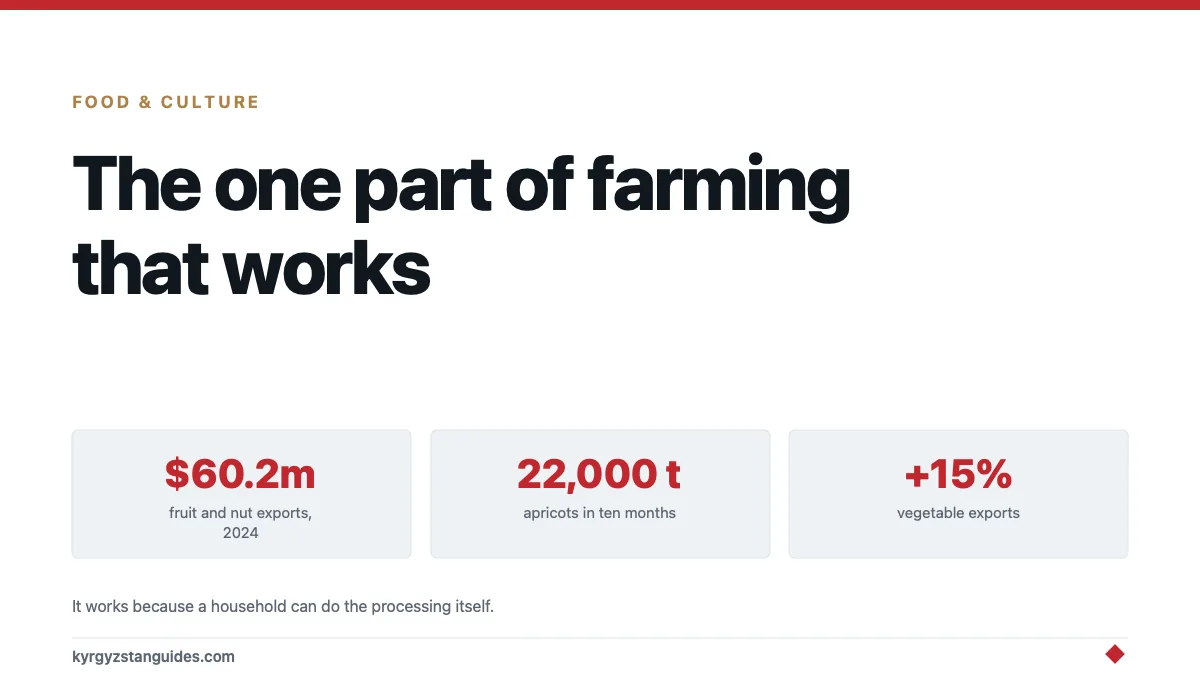
In 2024, Kyrgyzstan exported $60.2 million of fruit and nuts and $109.1 million of vegetables. The vegetable figure grew 15% year on year. Around 22,000 tonnes of apricots went out in ten months of that year.
These are small numbers by world standards and large ones for this country.
What actually sells
Apricots. Batken is the centre, fresh and dried, and the dried trade is the one with the higher margin. Kyrgyzstan delivered its first dried apricot shipment to China in 2025 as part of a deliberate market expansion.
Walnuts. From the walnut-fruit forests around Arslanbob, covering some 42,500 hectares. Gathered largely by hand during the autumn harvest, by families with traditional rights to specific plots.
Beans. Less glamorous and arguably the biggest success. The Talas region is the production hub, and Kyrgyz beans go to Turkey, Russia, India, Iran and Europe, with sixteen companies registered as suppliers to China from 2024.
Vegetables generally, which is where the growth is — vegetable exports grew 15% in 2024 while fruit and nuts declined.
Honey, small but premium, covered in our beekeeping guide.
The USDA's Kyrgyzstan page tracks the sector's trade data, and the US commercial guide to Kyrgyz agriculture is a readable overview of where the constraints sit.
Why this works when wool doesn't
Four reasons, and they're instructive.
Minimal processing required. An apricot can be dried in the sun. A walnut needs shelling. A bean needs cleaning. None of that requires the industrial plant that wool scouring or herb extraction demands and that the country lost in the 1990s.
The product is inherently high-value. Nuts and dried fruit carry enough value per kilo to justify transport from a mountain valley, which coarse greasy wool does not.
Altitude is an advantage. Kyrgyz fruit is frequently sweeter and more intensely flavoured than lowland equivalents, because of the day-night temperature swing and the sun at altitude. That is a genuine quality argument rather than marketing.
The buyers are nearby and hungry. Russia, Kazakhstan, Uzbekistan, Turkey, China and Iran are all within reach, and several of them are large net importers of exactly these products.
The seasonal reality of a fruit economy
Worth understanding because it shapes rural life as much as the herding calendar does.
Late June to August is stone fruit: apricots first, then cherries, peaches and plums. This is the intense period in Batken and the southern valleys, and it's all hands.
August into September is melons, grapes and tomatoes.
Late September into October is the walnut harvest, when whole villages move into the forest for weeks.
Then nothing, until the following June.
That compression is the fundamental problem with fruit as a household income. A family's entire fruit earnings arrive in a few weeks, must cover a year, and are exposed to a single bad frost or hailstorm. Drying is partly a response to it: a dried apricot can be sold in February.
It also explains why fruit income and migration income coexist rather than competing. One is seasonal and local, the other is year-round and abroad, and a great many southern households run both.
The problems
It isn't an unqualified success, and the 2024 numbers show why.
Fruit and nut exports fell 11.3% in 2024, from $67.9 million to $60.2 million. Vegetables rose; fruit and nuts did not.
Certification and logistics. The same barrier as everywhere else here: access to higher-paying markets needs documented quality, residue testing and cold chain. Uzbekistan has been working with Kyrgyzstan specifically to help route nuts and dried fruit into global markets, which tells you where the gap is.
The forests are declining. Walnut output depends on a resource that has lost roughly 90% of its area in fifty years, as our walnut-fruit forest guide sets out. This isn't a sustainable base without intervention.
Imports dwarf exports. Kyrgyzstan's imports of fruit, nuts and vegetables from China reached around $1 billion in 2025 — against $170 million of exports in all directions. A great deal of that's re-export trade through the bazaar system rather than domestic consumption, but the asymmetry is real.
What you'll see
Roadside fruit stalls in summer, all over the south and around Issyk-Kul. Apricots, cherries, melons, grapes, tomatoes.
Drying racks. Apricots laid out on cloth, on roofs, on flat ground. This is the processing step, done in the open, in the sun.
New plastic greenhouses. One of the genuinely growing features of the rural landscape, and one of the few new things in the inventory of a Kyrgyz village.
The bazaars. Produce markets in every town, which is where the domestic half of this goes.
Buying it
Buy at the roadside. Cheaper, better, and the money reaches the grower.
Apricots in June and July in Batken and the south. Dried apricots year-round.
Walnuts from late September, during and after the Arslanbob harvest.
Melons in August — genuinely exceptional, and the thing Babur wrote about the Fergana valley five hundred years ago in the Baburnama.
Check import rules before carrying anything home. Many countries restrict fresh produce and some restrict nuts. Dried fruit is generally the safest thing to travel with; our souvenirs guide covers the rest.
Wash it. Ordinary advice, and our tap water guide applies to the washing water too.
Why it matters
Because it is the counter-example that shows the problem elsewhere is solvable.
Kyrgyz fruit and nuts succeed because the processing step is small enough for a household to perform, the product is valuable enough per kilo to move, and the buyers are close. Everything that has failed here failed on one of those three.
That is an argument for a particular kind of development: not heavy industry, but small-scale processing, certification support and market access. It's unglamorous, it is what the medicinal plant and wool sectors have been asking for, and the fruit trade is the evidence that it works.
FAQ
What does Kyrgyzstan export agriculturally?
Principally fruit and nuts, apricots, walnuts, along with beans, vegetables and honey. In 2024 fruit and nut exports totalled $60.2 million and vegetables $109.1 million.
Where do Kyrgyz apricots come from?
Mainly Batken region in the south-west, sold fresh and dried. Around 22,000 tonnes were exported in ten months of 2024.
Where do Kyrgyz walnuts come from?
Against the wider picture of three-hectare farms and imported wheat, this is the exception. The walnut-fruit forests around Arslanbob in Jalal-Abad region, covering roughly 42,500 hectares, harvested by hand each autumn.
Are Kyrgyz beans a major export?
Yes. Talas region is the production hub, exporting to Turkey, Russia, India, Iran and Europe, with registered suppliers to China from 2024.
Is Kyrgyz agriculture growing?
Vegetable exports grew 15% in 2024, while fruit and nut exports fell 11.3%. Fruit production is projected to rise modestly through 2028.
Where should I buy fruit in Kyrgyzstan?
Roadside stalls and town bazaars, where prices are lowest and the money reaches growers. Check your own country's import rules before carrying produce home.