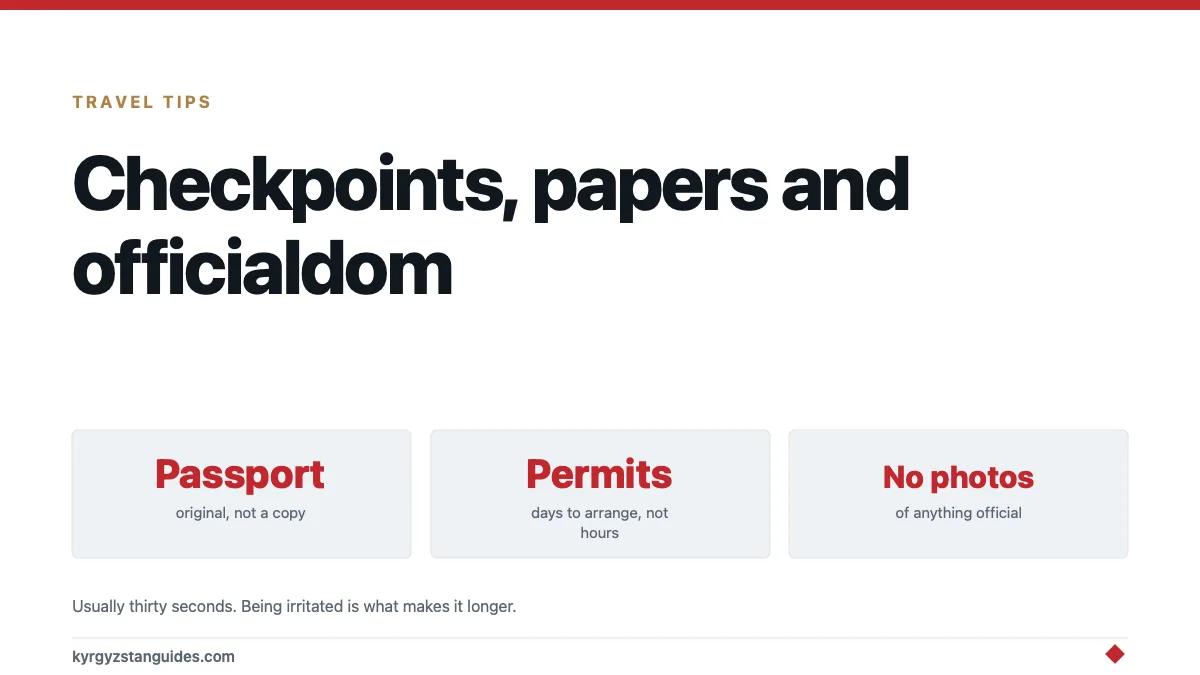
You will pass through checkpoints. You may be stopped and asked for your passport. This is normal, it is usually brief, and it's one of the parts of travel here that guides handle badly. Either pretending it never happens or implying every encounter is a shakedown.
Neither is accurate. Here is the practical version.
Where you will meet officialdom
Road checkpoints. Permanent posts on main roads, particularly approaching border regions, on the road south past Osh, and around sensitive zones. Vehicles slow, sometimes stop, and documents may be checked.
Border zones. Areas requiring permits — Kel-Suu, Chatyr-Kul, the high eastern valleys and the approaches to the frontiers. Here checks are thorough and expected.
Borders themselves. Ordinary immigration procedure, covered in our border crossings and visa guides.
Occasionally in Bishkek. Document checks on the street are uncommon for foreigners and not unheard of.
Airports. Standard.
What to carry
Your passport, always. A photocopy is not sufficient at a border-zone checkpoint, though it is usually fine for a casual street check.
Your border permit if you are in a permitted zone, in original.
Your entry stamp. Know your entry date, and know your allowance, as of 31 December 2025 it is 30 days within any 60-day period for most Western passports, not 60 days as a great deal of older material still says. Our visa guide covers the change.
A phone with your operator's number if you're on an arranged trip.
How an encounter actually goes
Usually: an officer looks at your passport, possibly asks where you are going and where you are staying, hands it back, and waves you on. Thirty seconds to two minutes.
The useful behaviours:
Be polite and unhurried. Irritation is the thing that lengthens an encounter.
Hand over documents with two hands, as with anything given to someone in authority here. Our etiquette guide covers why.
Answer the question asked. Where from, where to, how long. Short answers.
A few words of Kyrgyz or Russian help enormously. Salamatsyzby, and the name of where you're going.
Do not film or photograph. Not the checkpoint, not the officer, not the sign. This is the fastest way to turn two minutes into an hour.
Do not hand over your passport and walk away. Stay with it.
If money is suggested
It happens, more often to drivers than to foreign passengers, and more often over traffic matters than documents.
Stay friendly and slightly baffled. Not confrontational, not compliant.
Ask for the official procedure. A written fine, a receipt, the station. The request for paperwork resolves most situations because paperwork is the thing nobody wants.
Do not offer. Offering creates the problem you're trying to avoid.
Have your embassy's number saved offline, alongside the emergency numbers, and be willing to say calmly that you would like to call your embassy. Most governments publish a country page with consular contacts. The UK FCDO's Kyrgyzstan advice is one example, and yours will have an equivalent.
Keep small amounts separate from your main money, as our scams guide advises for general reasons.
Most travellers complete a trip here without any of this arising.
Border-zone permits in practice
The paperwork most likely to matter, and the one people leave too late.
What needs one. Areas along the Chinese and Tajik frontiers: Kel-Suu, Chatyr-Kul, the Inylchek and Khan Tengri approaches, Sarychat-Ertash, and stretches near the Torugart and Irkeshtam roads.
How long it takes. Days to a couple of weeks depending on the zone and the season. This isn't something to arrange on arrival.
Who arranges it. A local operator or CBT office, with your passport details. Independent application is possible and slower.
Carry the original. A photo of it on your phone isn't what will be asked for.
The permit names people and dates. Changing your plans may invalidate it, and the officer at the post will check the names against the passports in the vehicle.
Mountaineering has a separate layer, covered in our permits guide, and the Mountain Rescue Service registration is a third and unrelated thing.
Plan the permit first and the itinerary around it, rather than the reverse. Every year people arrive at a checkpoint below Kel-Suu and are turned around, which costs two days of driving.
What genuinely gets you in trouble
Worth being clear about, because these are the real risks rather than the imagined ones.
Photographing military, border or security infrastructure. Including Kant airbase, checkpoints, and the perimeter of Kumtor.
Flying a drone where you shouldn't. Our drone guide sets out the rules, including the 8 km border rule.
Entering a border zone without a permit. Not a formality.
Overstaying. Taken seriously and fined, and the exit desk has no discretion. Check the current rules with the Kyrgyz foreign ministry rather than a blog, including this one.
Drugs. Penalties are severe. Kyrgyzstan sits on a trafficking route from Afghanistan, which is why enforcement is taken seriously rather than casually; the UNODC's regional work sets out the context.
Removing antiquities. Including material from archaeological sites, as our pieces on kurgans and the sunken city note.
Traffic stops, if you're driving
A different situation from being a passenger, and the one where things most often go sideways.
Speed and documents are the two triggers. Carry your licence, an international driving permit, the vehicle's papers and insurance, our car rental guide covers what the hire company should provide.
Cameras are increasingly automatic. Fixed speed enforcement exists on the main roads, which has changed behaviour more than roadside stops have.
A written fine is the correct outcome. Ask for it.
Do not argue about the speed reading. Ask what the procedure is and follow it.
Know that the hire company will chase you for anything unpaid, usually via the deposit.
If you are a passenger and your driver is stopped, the correct behaviour is to sit quietly and let them handle it. Getting out to help isn't help.
The broader context
Kyrgyzstan is a low-crime country and the police presence a visitor encounters is mostly about borders rather than about you.
The country has a genuinely complicated relationship with its own institutions — three governments removed by street protest, as our political system guide covers, and a press environment that has tightened sharply. Kyrgyz people discuss both freely and with limited patience for official authority.
As a visitor you sit outside all of that. The practical position is straightforward: carry your passport, respect the border zones, don't photograph what you shouldn't, and treat the people at checkpoints as people doing a job.
FAQ
Are there police checkpoints in Kyrgyzstan?
Yes, on main roads particularly near border regions and permitted zones. Checks are usually brief and involve looking at documents.
Do I need to carry my passport in Kyrgyzstan?
Yes. A photocopy is generally fine for a casual street check but not for a border-zone checkpoint, where the original and any permit are required.
What should I do if asked for a bribe?
Stay friendly, don't offer anything, and ask for the official procedure, a written fine, a receipt or the station. Have your embassy's number saved offline.
Can I photograph checkpoints or border posts?
No. Photographing military, border or security infrastructure is the most reliable way to create a serious problem for yourself.
What is the visa-free allowance now?
Thirty calendar days within any 60-day period for most Western passports, changed on 31 December 2025 from the previous 60 days. Overstaying is fined.
Is Kyrgyzstan safe in terms of policing?
It is a low-crime country, and encounters with officials are mostly routine border-related checks rather than anything directed at visitors.