You bought a shyrdak. It is two metres of dense felt and it doesn't fit in your bag.
This is a common problem here, because the good souvenirs are textiles and textiles are bulky. The options are limited, the rules are specific, and the thing most likely to go wrong is customs rather than the post.
The options
Kyrgyz Post (Kyrgyzpochtasy). The national service, a member of the Universal Postal Union. Cheapest by a wide margin, slowest, and with limited tracking. Fine for things you can afford to lose.
International couriers. DHL and equivalents operate in Bishkek. Expensive, fast, properly tracked. The sensible option for anything valuable.
Carry it. Often the right answer. A rolled felt carpet becomes surprisingly compact and most airlines will take it as an extra checked bag for less than shipping costs.
Ask the seller. Craft cooperatives selling to visitors frequently arrange shipping and know the process better than you do.
Before you post anything
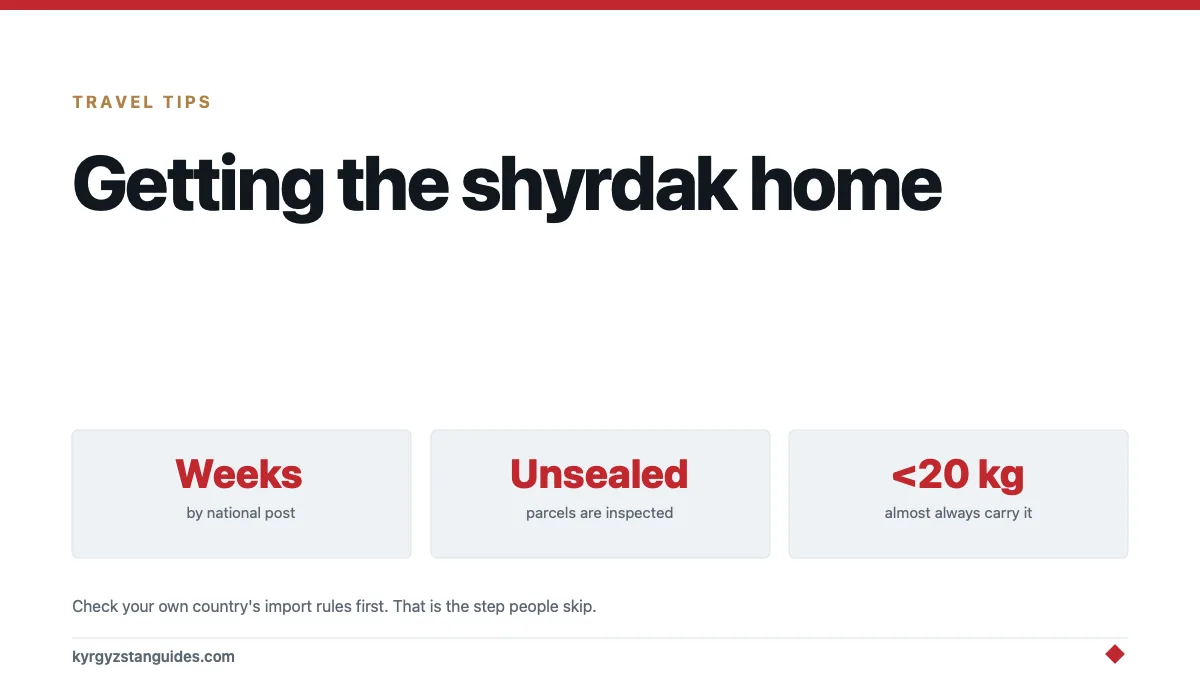
Check your own country's import rules first. This is the step people skip and it's the one that causes problems. Most customs authorities publish them — the UK's guidance on bringing goods into the country is one example and yours will have an equivalent. Your customs authority, not Kyrgyzstan's, will decide whether your parcel arrives.
Know what is restricted. Common issues:
| Item | Problem |
|---|---|
| Antiques and antique textiles | Export licence may be required |
| Fresh produce, nuts, honey | Restricted or prohibited in many countries |
| Animal products, fur, wool items | Varies; wool textiles are generally fine |
| Plant material, seeds | Frequently prohibited |
| Ephedra and bulk herbs | Controlled. See our medicinal plants guide |
| Archaeological material | Illegal. Do not |
The last row is not a formality. UNESCO's convention on illicit trafficking of cultural property is the framework, and Kyrgyzstan's archaeological record (kurgans, cave sites, the submerged town) is actively looted.
Antique export is the one that catches people. Genuinely old textiles, as our tush kyiz guide notes, may require documentation to leave the country. Ask the seller and get whatever paperwork exists.
How to actually do it
Go to a main post office, in Bishkek or a regional centre. Village offices handle domestic post.
Bring your passport.
Do not seal the parcel before you arrive. Contents are inspected.
Bring your own packing or buy it there — boxes, tape, and something waterproof for textiles.
Expect a customs declaration form, in Russian, listing contents and value.
Declare honestly. Undervaluing to reduce duty at the far end is the thing that gets parcels held.
Keep the receipt and any tracking number, photographed, because the paper won't survive the trip home in your bag.
Allow weeks, not days, by post. Courier is days.
Bring a Russian or Kyrgyz speaker if you can. This is a transaction where our phrases guide will only get you so far, and a guesthouse owner will often help.
What is actually worth sending
Felt. Shyrdaks and ala-kiyiz are heavy, bulky and robust. They survive posting well and are the classic reason to use the post office.
Tush kyiz embroidery. Large, light, fragile at the edges. Roll rather than fold.
Nothing fragile. Ceramics and glass are a poor bet.
Not food. Our fruit guide covers the dried apricots and walnuts you'll want to take; carry those, and check your own import rules before you do.
Not honey unless you have checked, since many countries restrict it.
Taking it as luggage instead
Usually the better answer, and worth doing the arithmetic properly.
Extra checked bag. Most airlines serving Bishkek sell an additional piece for considerably less than international shipping costs, and it arrives with you.
A shyrdak rolls smaller than it looks. Two metres of felt becomes a cylinder you can strap to a rucksack or put in a cheap holdall bought at the bazaar.
Buy the bag there. A large zipped laundry bag from any bazaar costs almost nothing and is exactly what everyone in the region uses.
Weigh it before the airport. Guesthouses usually have scales, and excess baggage charged at the desk is the expensive way to discover a problem.
Hand luggage for the fragile and valuable. Silver, small carvings, anything you would mind losing.
Keep receipts accessible, not buried, in case you are asked at your own customs.
The general rule: anything under about 20 kg is almost always cheaper and safer to carry. Shipping makes sense for things you genuinely cannot lift or that you buy at the start of a longer regional trip.
The alternative worth considering
Buy less, and buy small.
Our souvenirs guide covers what travels well: a kalpak, felt slippers, silver jewellery, a small carved tunduk, a bag of dried fruit. All of it fits in a rucksack.
The two-metre shyrdak is a wonderful object and it's also a logistical project. If you want one, decide that before you are standing in a workshop in Kochkor with no plan.
Why the post is the way it is
Briefly, because it explains the limitations rather than excusing them.
Kyrgyz Post inherited a Soviet network built for a country that no longer exists, serving a population spread across mountain villages connected by one highway. International mail leaves through Bishkek and then depends on transit arrangements with neighbours.
The same constraints that make wool worthless and herbs hard to export apply here: remoteness, thin volumes, and a logistics chain that was designed as part of a larger system and then had the larger system removed.
What has partly filled the gap is the informal one. Goods move with people, a relative going to Moscow, a driver heading to Almaty, a trader returning from the bazaar circuit. That network is fast, cheap and entirely unavailable to a visitor, which is why your options are the formal post or a courier.
Receiving things in Kyrgyzstan
Occasionally relevant for long stays.
Have it sent to a hotel or guesthouse, with their phone number, and warn them.
Poste restante is unreliable.
Expect customs charges on anything of value, payable by you on collection.
Gear replacement is often faster bought locally. Bishkek has outdoor shops, as our gear guide notes, and waiting three weeks for a parcel is rarely the better plan.
FAQ
Can I post things home from Kyrgyzstan?
Yes, through Kyrgyz Post from main post offices or via international couriers in Bishkek. The post is far cheaper and considerably slower.
Where do I post a parcel in Kyrgyzstan?
A main post office in Bishkek or a regional centre. Bring your passport, leave the parcel unsealed for inspection, and expect a customs form in Russian.
Can I export antique textiles from Kyrgyzstan?
Genuinely old items may require export documentation. Ask the seller before buying and obtain whatever paperwork is available.
Should I post a shyrdak home?
It's a common reason to use the post office, since felt carpets are bulky and robust. Carrying it as an extra checked bag is often cheaper, so compare both.
Can I take food home from Kyrgyzstan?
Check your own country's rules first. Dried fruit and nuts are usually the safest, while fresh produce, honey and plant material are restricted in many countries.
How long does post from Kyrgyzstan take?
Weeks by national post, with limited tracking. International courier services take days and cost substantially more.