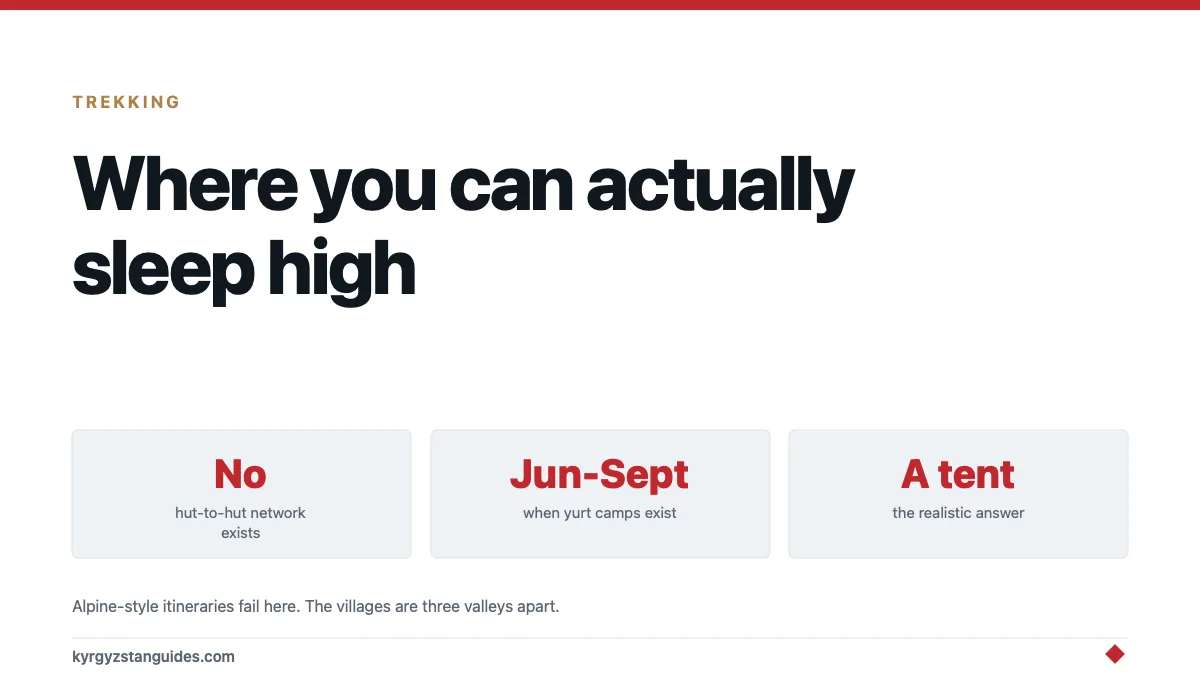
There is no hut system here.
If you have trekked in the Alps, the Pyrenees or Norway, the mental model of walking hut to hut with a bed and a hot meal at the end of each day does not transfer. Kyrgyzstan has a handful of structures, a lot of tents, and yurts that exist for four months.
Knowing what's actually out there decides what kind of trip you can plan.
The four kinds of high shelter
Yurt camps. Seasonal, roughly June to September, run by herding families or tourism operators. Beds, food, tea. This is the closest thing to a hut and it isn't a hut — as our jailoo calendar explains, the yurts are physically packed away outside the season.
Alpine huts and base camps. A very small number, mostly Soviet-era climbing infrastructure. Ratsek hut in Ala-Archa is the best known and most accessible. South Inylchek and Pik Lenin base camps are expedition facilities rather than public shelters.
Shepherd huts and koshara. Stone or mud structures used by herders, scattered across the pastures. Not accommodation — they belong to somebody — but in an emergency they exist. The same hospitality obligation that governs a village house applies on the mountain, and a herder will take in someone genuinely in trouble. That isn't a plan; it is a last resort, and it's one reason registering with the rescue service matters more than relying on finding a roof.
Your tent. The realistic answer for most multi-day routes. Our camping guide covers it and our gear guide covers what to bring.
What this means for planning
You're carrying your accommodation. On almost any multi-day trek here, a tent and a sleeping bag aren't optional extras.
Weight matters more than in hut-to-hut country. Tent, bag, mat, stove, fuel, and food for the whole route.
Resupply is limited. Villages at the bottom of a valley have a shop; the route doesn't.
Water is generally abundant and needs treating, as our tap water guide and WHO's drinking-water guidance both indicate, glacier-fed streams pass through pasture with livestock on it.
Horses change the arithmetic. Hiring baggage horses, as our guide to hiring describes, is the local solution to the weight problem and it isn't expensive.
Where huts do exist
Ratsek hut, Ala-Archa, around 3,300 m. Reached in a long day from the alplager, basic, crowded in season, and the usual base for the peaks above it.
Ala-Archa alplager itself, at the road head, with rooms and a canteen. Our Ala-Archa guide covers the park, which is an hour from Bishkek and the most accessible mountain terrain in the country. UNEP-WCMC's protected area record lists it among Kyrgyzstan's designated sites.
Karakol valley and Altyn-Arashan. Altyn-Arashan has guesthouses and hot springs at around 2,600 m — not a mountain hut, and a real bed.
Jyrgalan, where guesthouses and yurt camps support a network of day and multi-day routes, which is why it works as a trekking base.
Pik Lenin base camp at Achik-Tash, around 3,600 m, with tent accommodation and catering during the climbing season, reachable by vehicle as our base camp guide covers.
South Inylchek base camp, by helicopter or multi-day glacier approach, for the high peaks and within reach of the lake that empties itself every August. Border-zone permits apply, as our border guide explains.
Sleeping in a yurt camp
The realistic high-altitude bed, and worth understanding.
Expect cold. At 3,000 m in July, below freezing overnight is ordinary. Our yurt stay guide covers what to bring; the short answer is more than you think.
Felt is a good insulator and the door isn't.
The stove goes out. It's lit in the evening and by four in the morning the yurt is at the outside temperature.
Book ahead in season at popular camps such as Song-Kul, directly or through a CBT office.
Shoulder season is a gamble. In early June a camp may not be up yet; in late September it may have come down.
The routes this suits
Knowing the shelter picture tells you which trips actually work here.
Base-and-day-walk. Stay in a guesthouse in Jyrgalan, Karakol or Arslanbob and walk out and back. No tent, real beds, and a great deal of good walking.
Yurt-to-yurt in season. Possible in a few areas in July and August with planning, and closest to the hut experience.
Supported trekking with horses. Horses carry the camp, you walk, and the horseman handles the animals. This is the classic Kyrgyz format and the one that opens the biggest routes.
Fully independent. Everything on your back, which is the only option for most of the serious routes in our hardest treks guide.
Expedition. Base camps, helicopters, permits, and the Snow Leopard peaks.
The mistake is planning an Alpine-style itinerary, a different village each night, carrying a day pack, and discovering at the trailhead that the villages are three valleys apart.
Wild camping
Legal and normal, with the ordinary caveats.
Ask if you're near a household. Somebody owns or uses that pasture.
Not on a dry streambed. Ever. Our mudflow guide explains why the flat gravelly spot is flat.
Away from livestock and guardian dogs, as our piece on animal risks covers.
Carry everything out, including organic waste, which does not decompose at altitude. See our litter guide.
Know the weather pattern. Afternoon storms, and the daily cycle that produces them.
Why there's no hut system
Because the country never had a reason to build one.
Alpine hut networks were built over a century by national alpine clubs (the Swiss Alpine Club alone runs around 150 huts) funded by large domestic memberships, in countries where mountain recreation became a mass activity early. Kyrgyzstan's mountain infrastructure was Soviet and was built for mountaineering expeditions and sport, not for recreational walking. Base camps and climbing huts, not a network of staffed refuges a day apart.
After 1991 the funding went, along with most of the rest of the institutional inheritance.
What filled the gap was the thing the country already had: households with yurts, horses and pasture. Community-based tourism didn't build accommodation; it connected travellers to accommodation that already moved up the mountain every June.
That is a better answer than a hut network for most purposes, and it's unavailable for eight months of the year.
FAQ
Are there mountain huts in Kyrgyzstan?
Very few. Ratsek hut in Ala-Archa is the best-known, along with expedition base camps. There is no hut-to-hut network comparable to the Alps.
Do I need a tent to trek in Kyrgyzstan?
For almost any multi-day route, yes. Accommodation on the trail is limited to seasonal yurt camps and a handful of huts.
When are yurt camps open?
Roughly June to September. Outside that window the yurts are packed away with the herding families who own them.
How cold is a yurt at night?
At 3,000 m in summer, below freezing is ordinary. The stove is lit in the evening and is out well before dawn.
Can I wild camp in Kyrgyzstan?
Yes. Ask if you are near a household, avoid dry streambeds and livestock, and carry out all waste including organic material.
Why does Kyrgyzstan have no hut network?
Its Soviet-era mountain infrastructure was built for expeditions rather than recreational walking, and the funding ended in 1991. Seasonal yurt camps filled the gap instead.